14 Front Porch Lighting Ideas

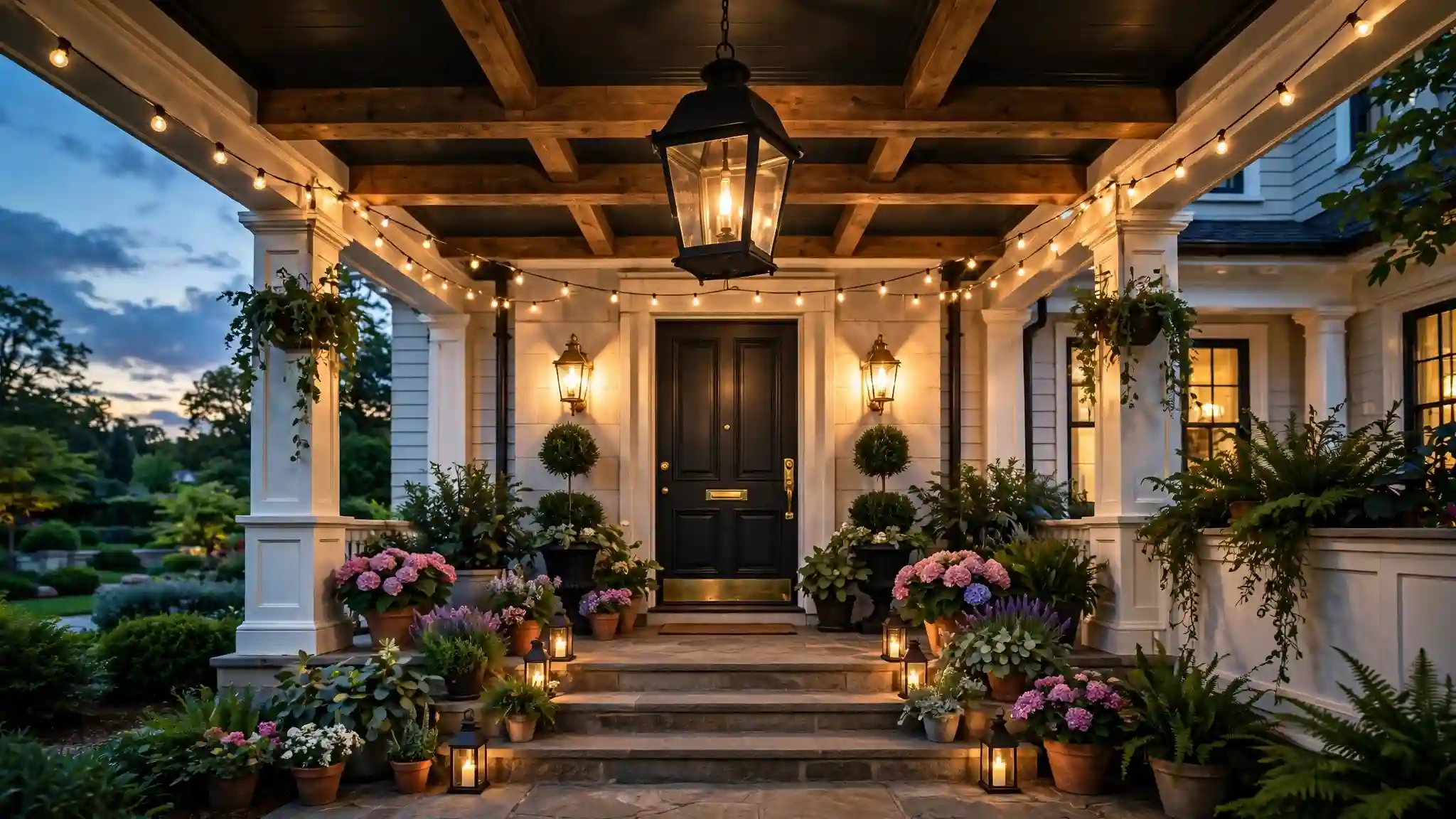
Most front porches get one light. A single overhead bulb, maybe a plain sconce on each side of the door, and that’s it.
But the porches people stop scrolling for almost never rely on one fixture doing all the work.
They layer light at different heights, mix a statement pendant with floor lanterns, or let string lights carry the whole ceiling.
These 14 front porch lighting ideas came from real entryways, from a brass and glass tunnel entrance to a farmhouse porch wrapped in fairy lights from post to rafter. Some lean formal with matched brass lanterns framing an arch.
Others go rustic, letting vines and lanterns tangle together on purpose. A few solve a problem most people forget about entirely, like lighting the actual steps so nobody trips walking up in the dark.
Whatever your house looks like, there’s a version of layered light here that fits it. Scroll through and pin the ones that match your entry, then start with just one layer and build from there.
14 Front Porch Lighting Ideas
1. A Statement Pendant Turns a Plain Portico Into a Grand Entrance
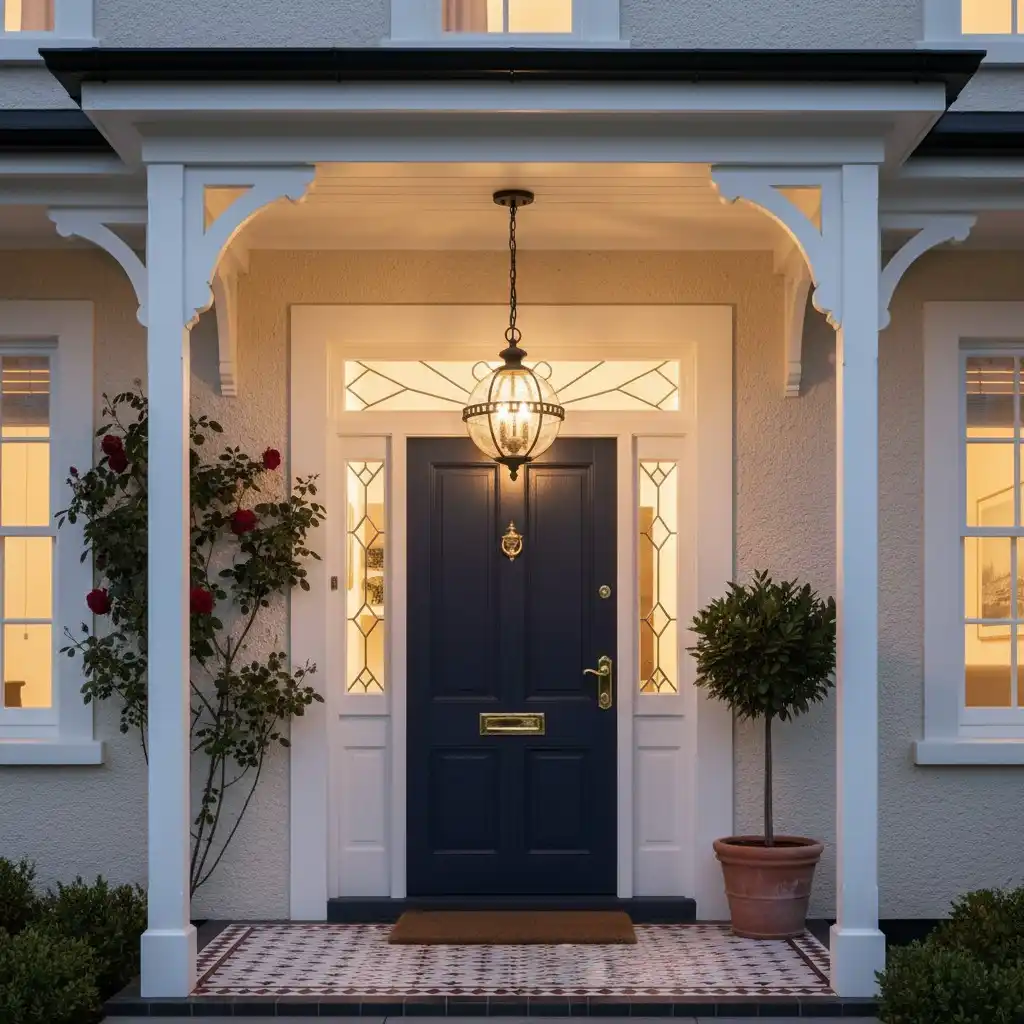
Hanging a single oversized lantern from the ceiling of a covered porch does more for curb appeal than almost any other lighting choice on this list.
In this entryway, a glass globe pendant with black iron trim drops from a long chain right above the welcome mat, throwing a warm pool of light across the door and the tile below.
The scale is what sells it. A fixture this size fills the negative space under a deep portico roof without a single wall sconce needed.
How to get this look:
- Measure the height of your porch ceiling and choose a chain length that lets the fixture hang roughly at eye level or slightly above.
- Pick a globe or lantern shape in black or aged bronze so it reads as a fixture, not a bare bulb.
- Add warm white bulbs, nothing cool or blue, to keep the glow feeling like candlelight.
- Center it over the doormat, not the door itself, so it lights the space where guests actually stand.
2. Cluster Mismatched Lanterns at Floor Level for a Candlelit Welcome
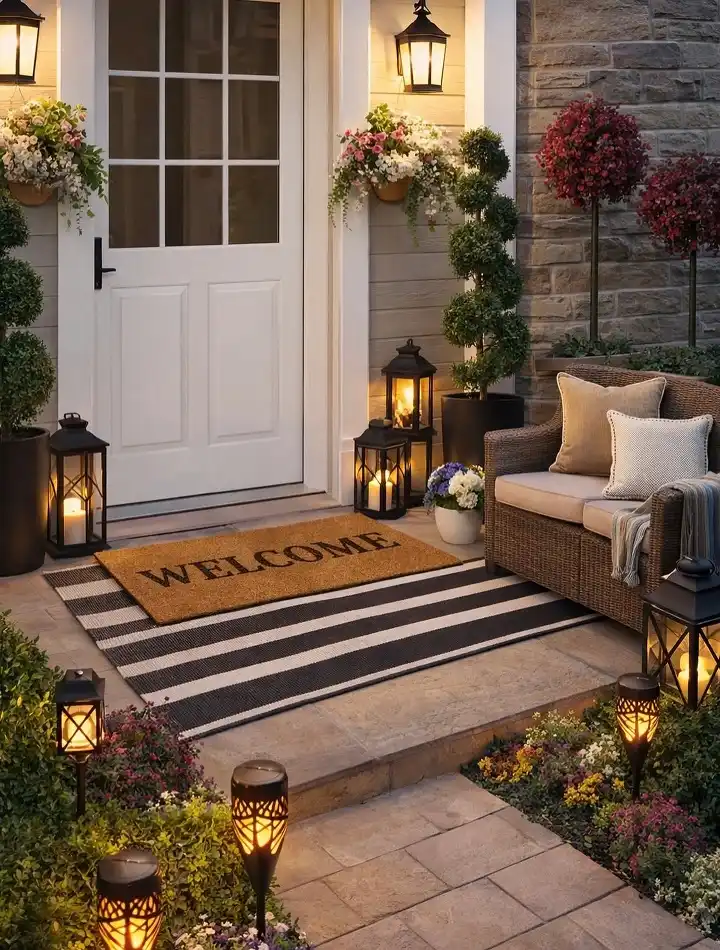
Group three or four black lanterns of different heights right beside the door instead of relying on one overhead fixture to do all the work.
In this entry, tall floor lanterns sit next to shorter ones near the welcome mat, and the flicker of the candles inside reads as warm and lived in rather than staged.
Matching wall sconces on either side of the door tie the grouping together, and flame-style solar lights repeat the same amber glow along the walkway so the whole path feels connected to the porch, not separate from it.
Tall and short lanterns side by side create depth instead of a flat row of matching light.
Every lantern shares black metal and glass, so a mismatched cluster still looks pulled together.
Flame-style walkway lights repeat the same warm tone so the glow leads guests all the way to the door.
3. Sculptural Sconces Can Replace a Pendant Entirely on Modern Homes
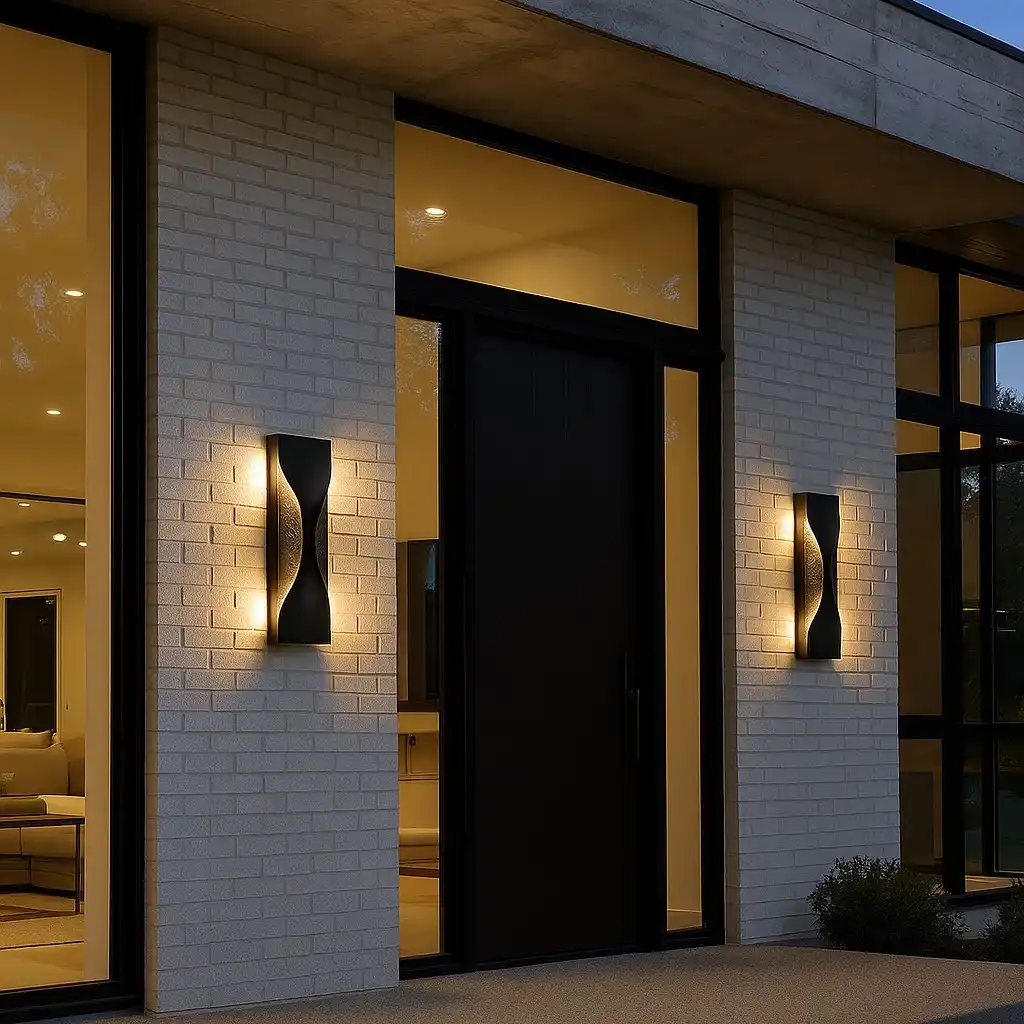
Not every entry needs a hanging fixture overhead. On a flat-roofed modern facade, a pair of sculptural wall sconces flanking the door does the job better, washing the brick in an up and down glow that shows off the texture instead of flattening it.
The hourglass shape here reads almost like art in daylight, then turns functional at night.
Because the light spills both up and down the wall, there is no single hot spot or dark gap the way a plain porch light often leaves.
For a facade this clean and geometric, skip anything with scrollwork or glass panes. The lines of the fixture should match the lines of the house.
Pick a sculptural, up-and-down fixture with clean geometric lines.
Mount it at the same height on both sides of the door for symmetry.
Ornate lantern styles with scrollwork or glass panes.
Yellow toned bulbs that clash with the cool concrete and brick.
4. Layer String Lights Above a Statement Pendant for Full Farmhouse Charm
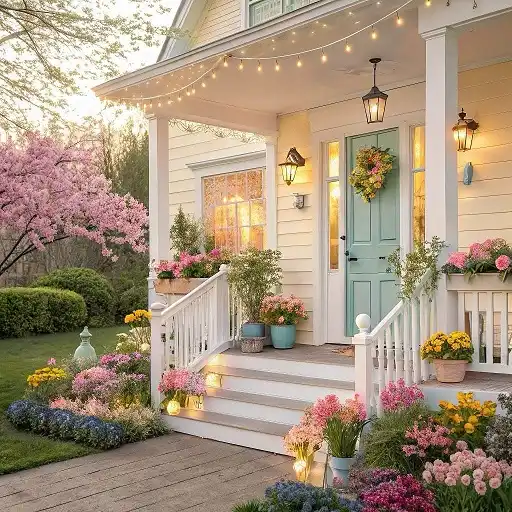
String lights along the porch roofline give a soft glow that regular fixtures alone cannot match, especially once the sun starts going down.
On this farmhouse porch, warm bulb string lights loop along the eaves while a black lantern pendant hangs at the top of the steps and matching sconces flank the door, so the light comes from three different heights at once instead of one flat source.
Subscribe to DIY Craft Bloom
Get updates on the latest posts and more from DIY Craft Bloom straight to your inbox.
- Roofline string lights soften the architecture and add a party glow without looking like a party
- A pendant at the entry keeps the actual walking path well lit, which string lights alone cannot do
- Small sconces near the door repeat the black finish so the whole porch reads as one styled scheme, not three separate purchases
5. Under a Pergola, Split the Lighting Job Between Overhead and Floor Level
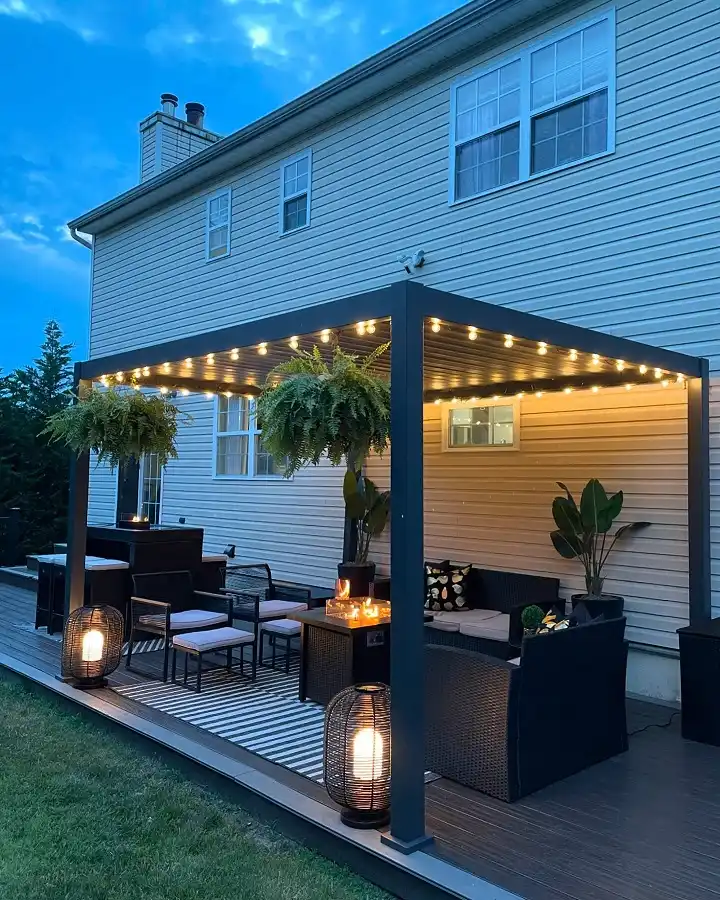
Covered decks and pergolas call for a completely different lighting plan than a plain porch roof.
Here, warm string lights run along the pergola beams for soft ambient light across the whole seating area, while two tall woven lanterns sit right on the deck boards at the entry point, marking where guests step up.
A small fire pit table with candles in the middle adds a third, lower layer of glow. Nothing here is a single hardwired fixture. It is a system of smaller lights working together.
This layered approach matters most on structures without a ceiling to hang a pendant from, so string lights carry the overhead role instead.
6. Wrap Micro Lights Around Posts and Potted Trees for a Cottage Glow
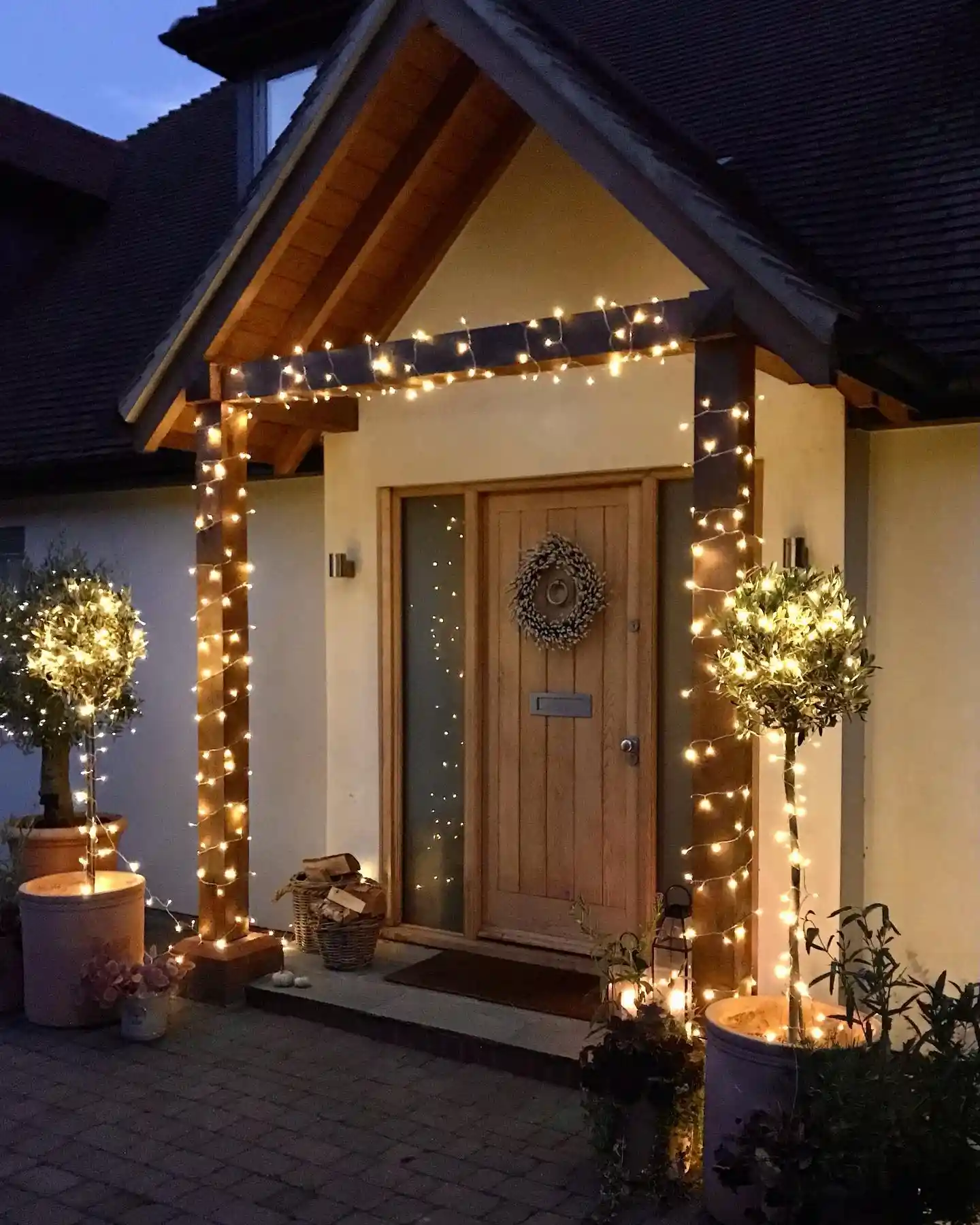
Fairy lights are not just for the ceiling. Wound tightly around the wooden posts of this gabled entry, they turn plain structural beams into something that looks intentional after dark, and the same trick works on the potted topiaries flanking the door.
Wrapping instead of draping is what makes the difference. A loosely hung string reads as decoration, but a tightly coiled one looks like it was built into the architecture.
Add a few threads cascading down a glass door panel and even the entry itself starts to glow.
Start at the base of each post and spiral upward in tight, even loops, tucking the end near the top so no loose wire hangs off.
On the topiaries, weave the lights through the branches rather than just around the outer leaves, so the glow comes from inside the greenery instead of sitting on top of it.
A single 200 count string usually covers one post and one small tree with room to spare.
Use warm white LED strings on a timer or solar sensor so the posts and trees light up automatically at dusk without you flipping a switch every evening.
7. Match Brass Lanterns in Pairs for a Formal, Symmetrical Entrance
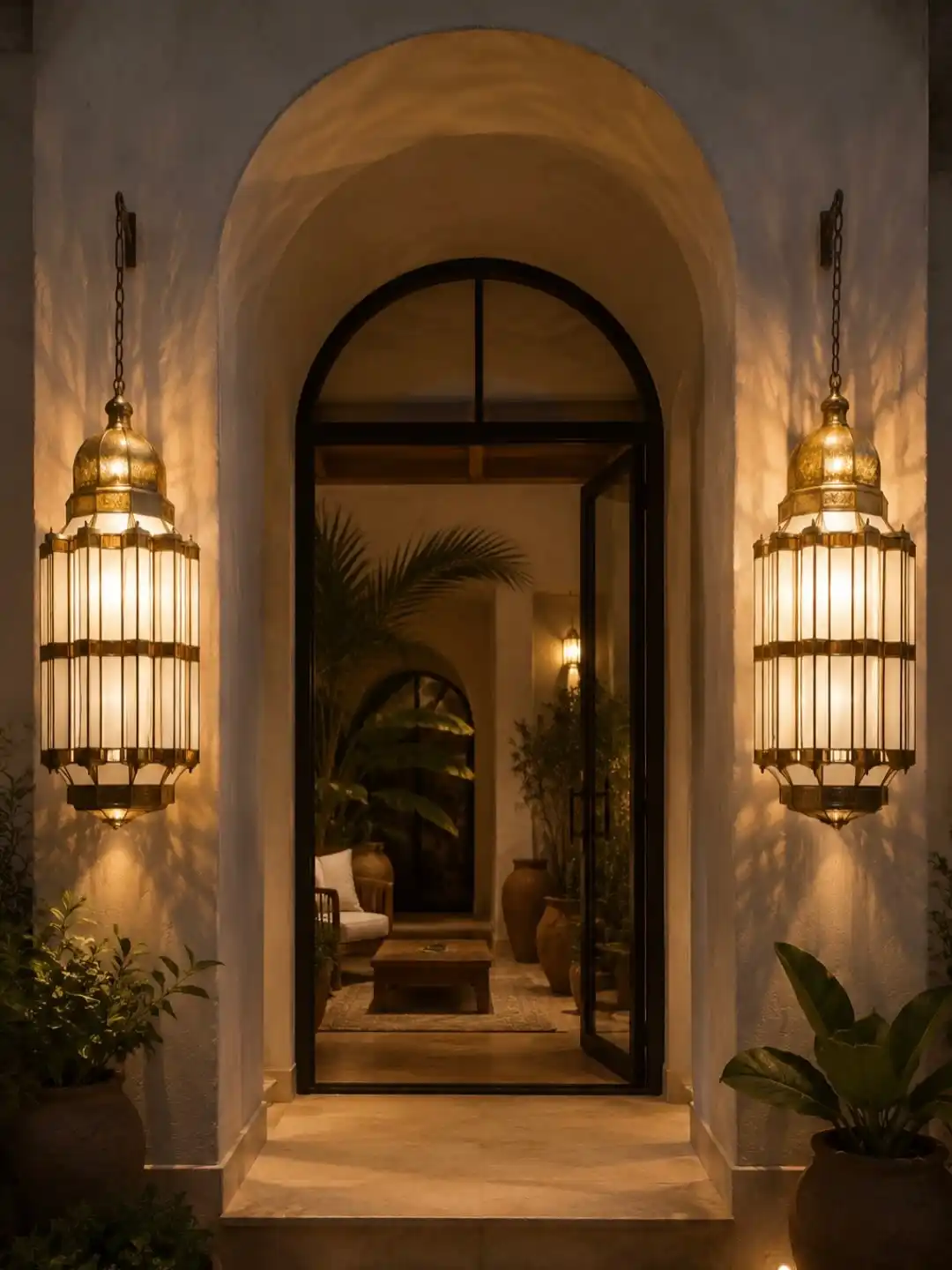
Symmetry does a lot of heavy lifting here. Two identical brass lanterns, each with pierced metal panels and frosted glass, hang from chains on either side of an arched doorway, and the repetition alone gives the entry a formal, almost ceremonial feel.
The warm brass finish plays off the sand colored walls, while the hexagonal shape and detailed metalwork cast soft shadow patterns across the arch at night.
This is a look built for homes with real architectural presence, where the entry itself is already a feature worth framing.
Hang both fixtures at the exact same height, measured from the floor rather than the ceiling, since arches and porticos are rarely perfectly level.
Keep the chain length identical on both sides too, since even a two inch mismatch is noticeable once the lights are on and casting shadows.
Skip this pairing on a small or plain facade. It needs an arch, a portico, or some kind of framed opening to actually land.
8. Cover the Whole Porch Ceiling in Lights, Not Just the Edges
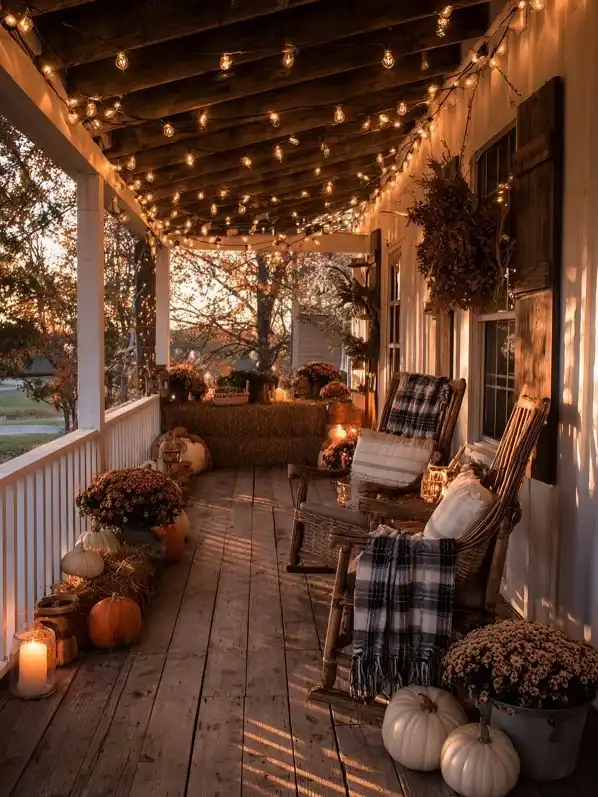
Some porches call for coverage, not just accents. Here, string lights criss-cross the entire ceiling in loose, overlapping rows, turning the whole space into a warm canopy rather than lighting just the perimeter.
It takes more lights than a single roofline strand, but the payoff is a porch that glows evenly from every angle, with no dark corners near the rocking chairs.
Candle lanterns and pillar candles at floor level fill in the lower half of the space, so the light comes from above and below at once, which is what makes a fall porch like this feel finished rather than half decorated.
Plan on roughly one 100 bulb strand for every 8 feet of ceiling length if you want this level of density, and stagger the rows so they overlap rather than running perfectly parallel.
Hooks screwed into the beams every few feet keep the lines from sagging in the middle once the whole canopy is strung up.
9. Don’t Forget the Steps: Recessed Lights Keep Wrap-Around Porches Safe After Dark
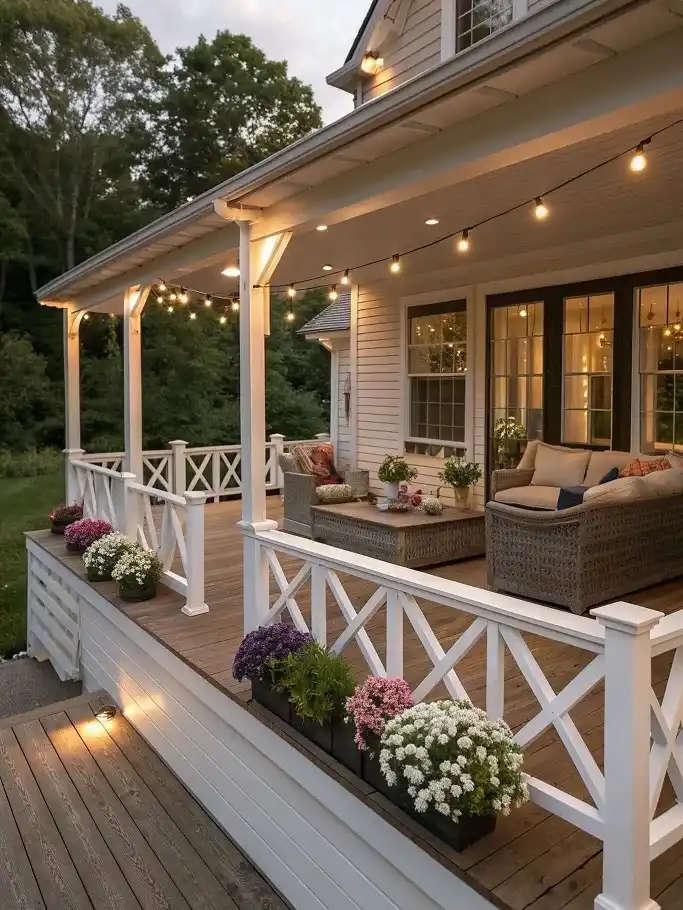
A long porch like this one needs light at more than just the seating area. Small recessed lights are tucked directly into the deck stairs here, glowing at foot level so anyone walking up after sunset can actually see where the steps end.
Overhead, built-in can lights handle the general porch lighting, while string lights strung diagonally between the posts add a softer, more social layer over the furniture.
It is a three tier system: function at the stairs, ambient overhead, and warmth over the sitting area.
Most people light the porch and forget the approach to it. That gap is exactly what trips guests.
Subscribe to DIY Craft Bloom
Get updates on the latest posts and more from DIY Craft Bloom straight to your inbox.
10. Repeat One Simple Fixture Down the Whole Wall Instead of Mixing Styles
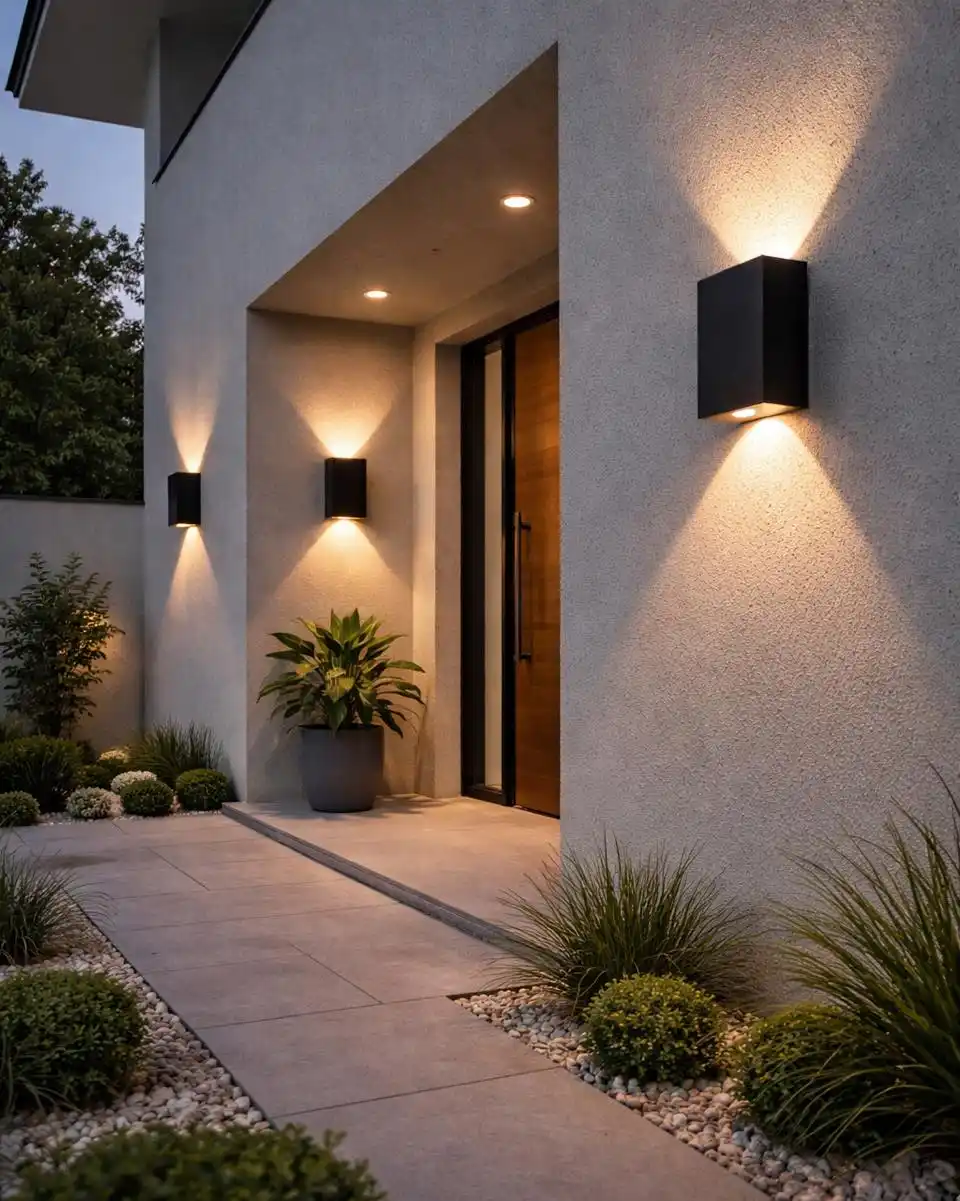
Minimalist homes benefit from restraint more than variety. Along this walkway, the same square up-down sconce repeats three times on the same wall, spaced evenly as guests walk toward the door, with recessed ceiling lights handling the covered alcove overhead.
No lanterns, no warm brass, no decorative shapes competing with the clean stucco.
Each fixture throws light both up and down the wall in a tight beam, which reads as architectural rather than decorative, and the repetition itself becomes the design statement.
Space the sconces evenly using the same interval each time, ideally lined up with a window or column so the placement looks planned rather than arbitrary.
Stick to one finish and one bulb temperature across every fixture on the wall, since even a slightly warmer or cooler bulb in one sconce will break the clean, uniform line this look depends on.
On a modern facade, one fixture repeated is a design choice. Three different fixtures is clutter.
11. Let Greenery Frame the Lanterns Instead of Fighting Them
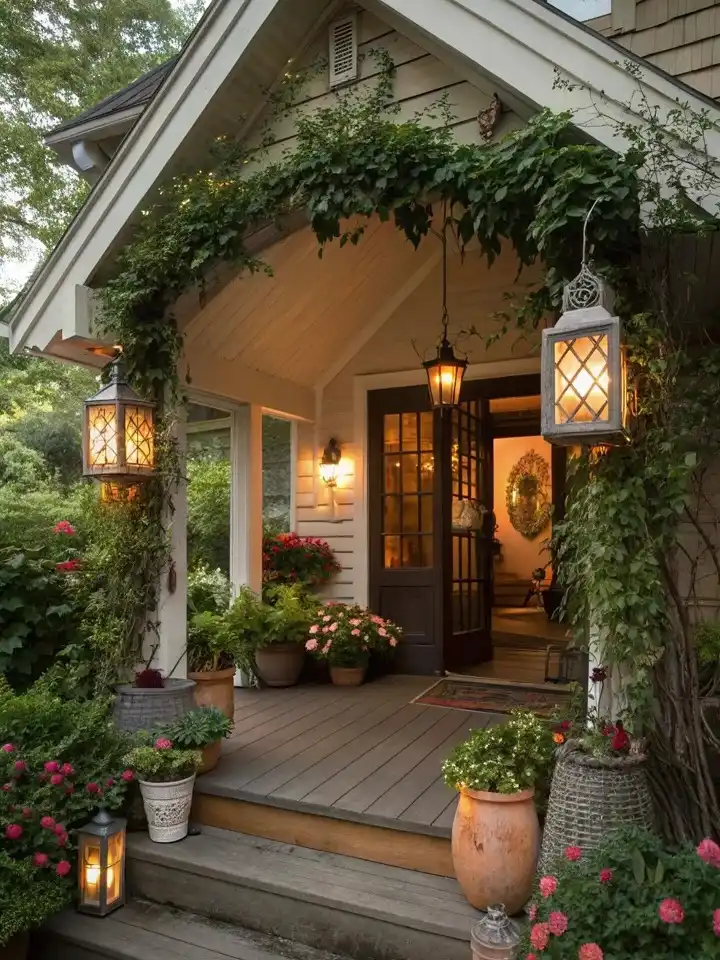
Climbing vines and an overgrown gable turn what could be ordinary porch lanterns into something that feels grown into the house.
A diamond-paned lantern hangs from each post here, one more glows at the center of the doorway, and a small matching piece sits low on the steps, so the eye travels naturally from the yard up to the door.
The trick is choosing fixtures with weathered, slightly rustic finishes so they hold their own next to all that ivy instead of getting visually swallowed by it.
- Weathered metal and diamond glass panes read as garden fixtures, not house fixtures, so they blend with the vines
- Multiple small lanterns at different points do more for a cottage feel than one big fixture would
- Leave the vines untrimmed around the lanterns; a little wildness is the whole point of this style
Rustic finishes let lanterns disappear into greenery by day and glow through it by night.
12. Stack Varying Lantern Heights on the Steps Themselves
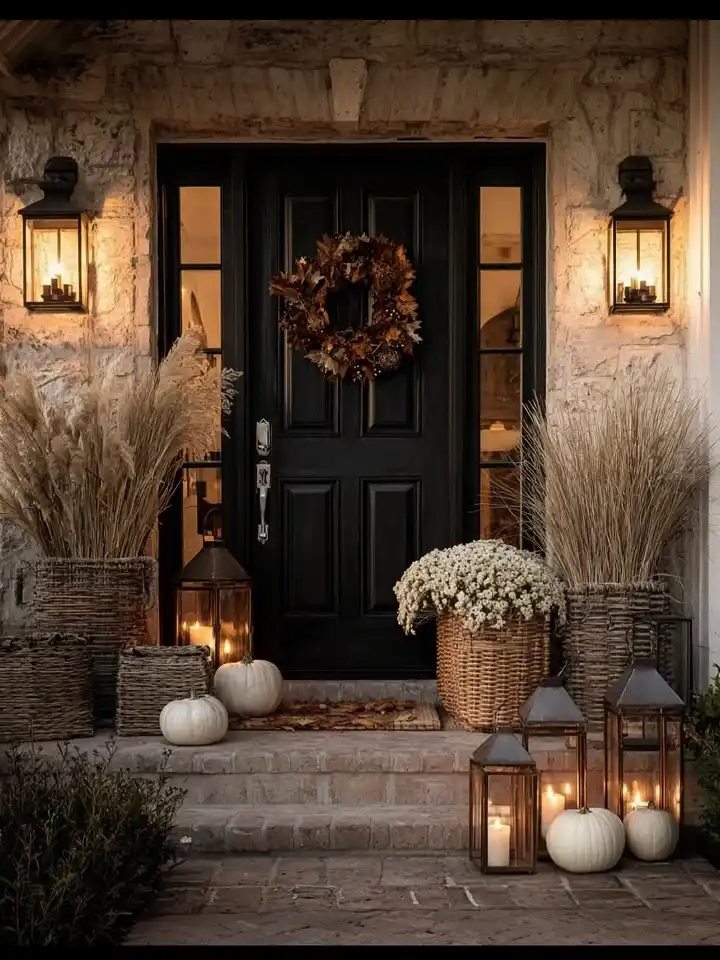
Wall sconces only handle half the job on a deep set of stone steps like these. Three lanterns of different sizes sit directly on the stairs here, from a tall pillar candle lantern down to two smaller ones tucked among white pumpkins, while a matched pair of black wall lanterns frame the door up top.
The two light sources are not competing, they are dividing labor. The wall fixtures announce the entrance from a distance, and the step lanterns light the actual path guests walk to get there.
Place the tallest lantern on the lowest or widest step so it does not block the walking path, then work smaller pieces upward or to the side as the steps narrow.
Battery or solar candles make this arrangement easy to rearrange with the seasons, since nothing needs to be near an outlet.
| Wall lanterns | Step lanterns |
|---|---|
| Fixed and symmetrical, framing the door | Movable, grouped in an uneven cluster |
| Signals the entrance from the yard | Lights the actual steps underfoot |
| Stays the same year round | Easy to swap seasonally with the decor |
13. Use One Fixture Family Across Two Walls and the Ceiling to Frame a Tunnel Entry
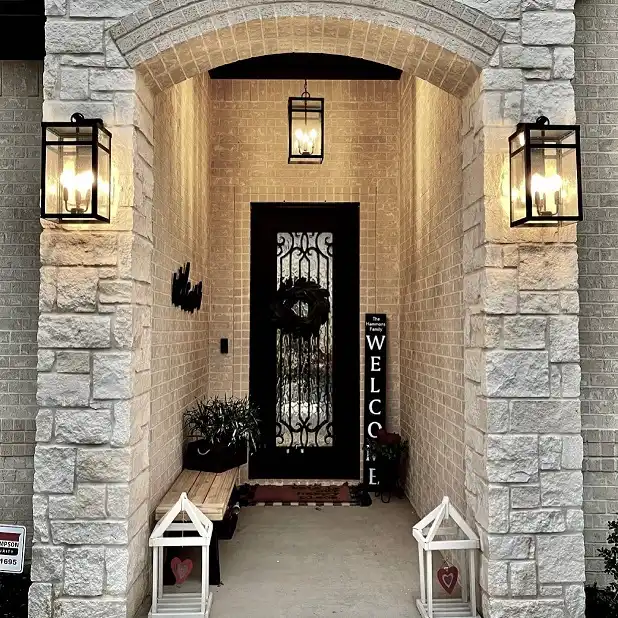
Deep, arched entries like this one need light pulling guests through the whole passage, not just glowing at the door.
Two matching black lanterns sit on the stone walls partway down the tunnel, and a smaller version of the same fixture hangs from a chain dead center above the door, so all three pieces read as one family instead of three separate purchases.
The identical finish across wall and ceiling mounts is what keeps a long brick passage like this from feeling like a dark hallway before it opens up.
Measure the tunnel length and place the wall lanterns at roughly the halfway point on each side, so light meets in the middle rather than leaving a dim gap before the door.
The ceiling pendant can run a size smaller than the wall fixtures since it hangs closer to eye level, and keeping the chain short prevents it from swinging into the doorway traffic below.
14. Space Three Identical Sconces Unevenly for a Farmhouse Rhythm
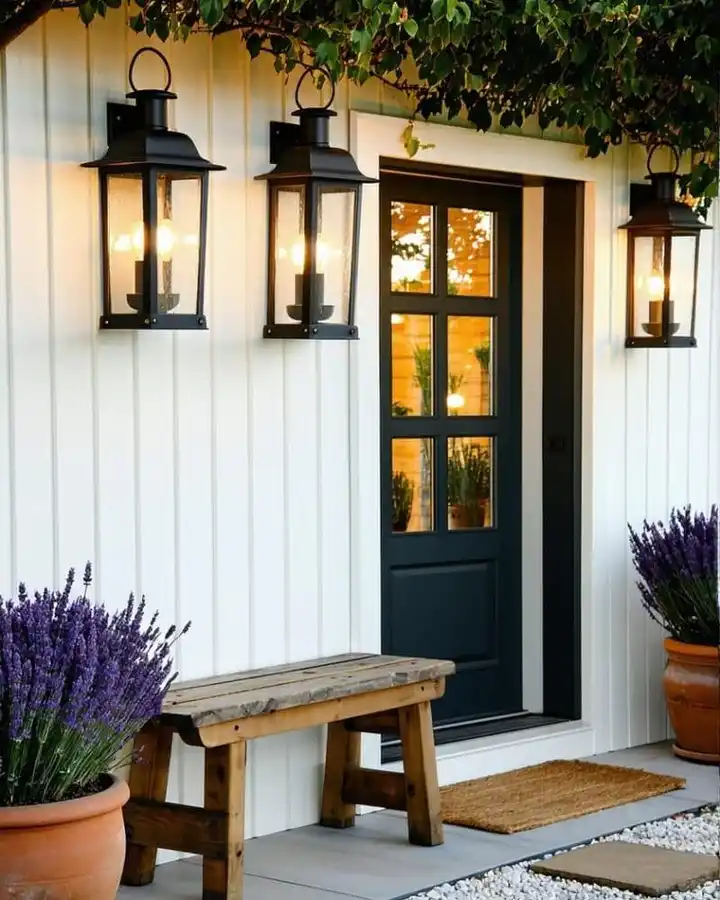
Three matching candle lanterns line this board and batten wall, but they are not spaced in a neat, even row.
Two sit close together on one side of the door while the third stands alone further down, and that asymmetry is what keeps the wall from looking like a hallway in a hotel.
Exposed candle bulbs inside clear glass give off a flicker that feels closer to real candlelight than a frosted or amber bulb would, and it plays well against the crisp white siding and lavender pots below.
Mount the paired fixtures roughly two to three feet apart so they read as a deliberate cluster rather than a mistake, then leave four or five feet of open wall before the third.
Keeping all three at identical height is what sells the asymmetry as intentional instead of uneven.
Conclusion
A porch rarely needs a total overhaul to feel warmer at night. Sometimes it’s one lantern swapped for something with more presence, or a single string of lights wound around a post that was already there.
The porches in this roundup all share the same trick: they use more than one light source, at more than one height.
Pick two or three front porch lighting ideas from this list that fit your house, not all 14, and let the rest wait for next season.
Save this for the next time you’re standing on your porch after dark wondering what’s missing.