16 Macrame Bracelet Patterns for Beginners

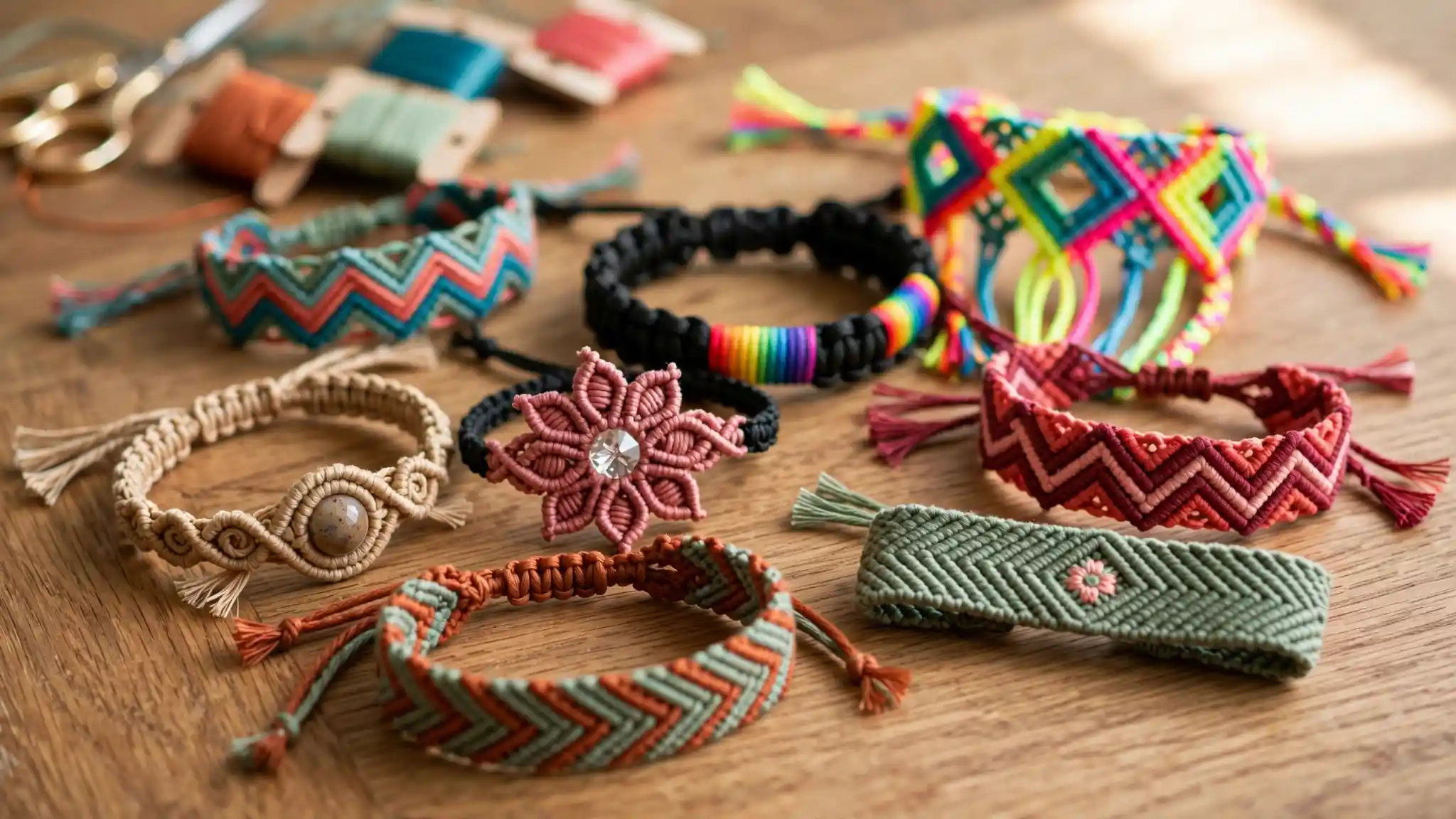
Learning to knot your first bracelet can feel a lot bigger than it needs to be. Between the cord math, the closures, and the sheer number of pattern names floating around online, it is easy to stall out before you even pick up your first cord.
That is exactly the gap this roundup fills. These macrame bracelet ideas for beginners start with the simplest possible builds, a single color, one repeating knot, no beads required, and work their way up to patterns that use color gradients, natural stones, dimensional flowers, and dangling charms.
You do not need every skill on this list before you start. Pick one pattern that matches where you are right now, whether that is a plain spiral with a single stone or a full stacked friendship bracelet set, and build from there.
A few of these are meant to be made in matching sets, a few lean minimal, and a few are here purely because the color work is worth studying even before you try it yourself.
Work through them in any order, and let your thread stash decide which one you tackle first.
16 Macrame Bracelet Patterns for Beginners
1. Two-Tone Herringbone Bracelet in Berry and Blush
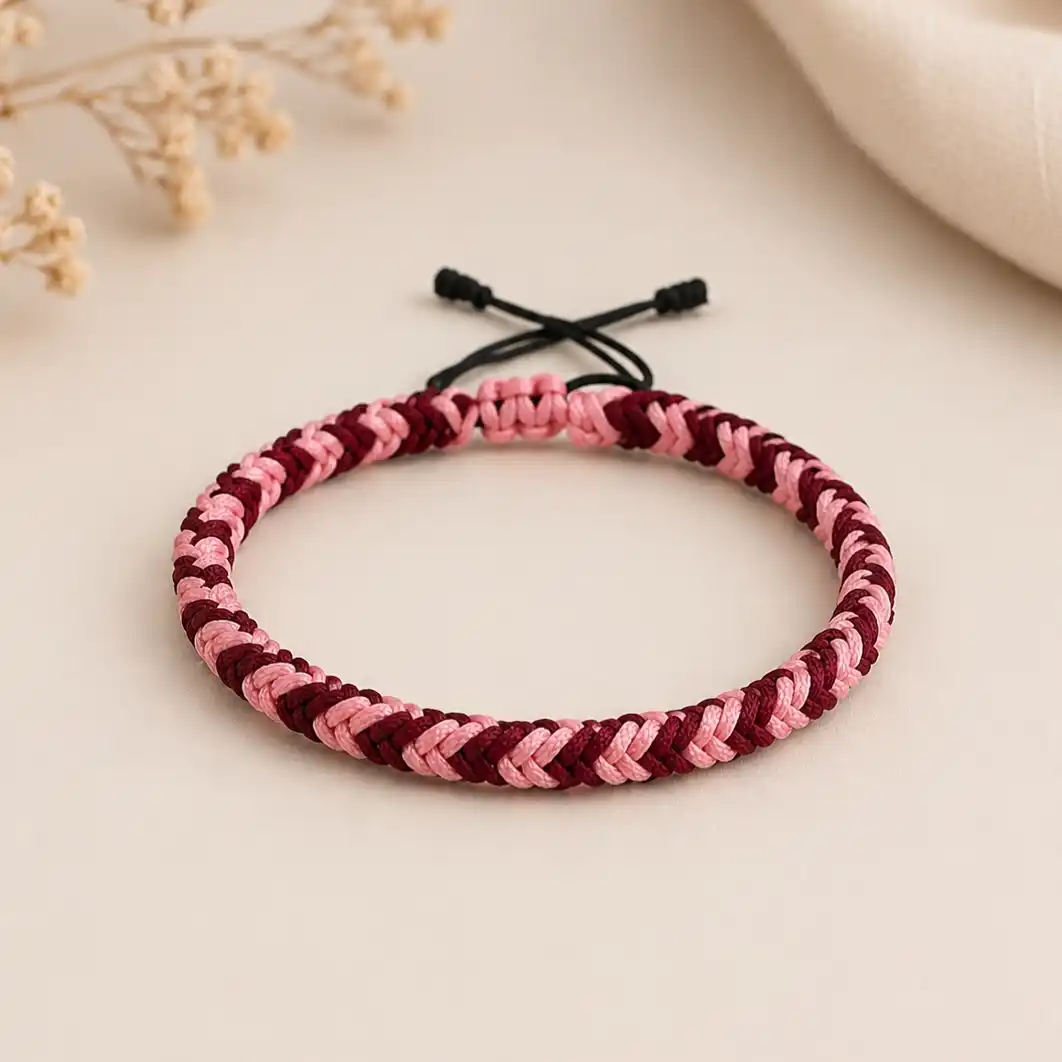
This is the pattern to start with if you have never touched a macrame cord before. The braid uses two colors, a deep berry and a soft pink, twisted together in a tight herringbone weave that looks far more advanced than it actually is.
What makes this one work:
- The two-color contrast does most of the visual work, so your knots do not need to be perfect
- A sliding knot closure with two black cord ends means no clasp to buy or attach
- The tight, even weave comes from keeping steady tension, not from complicated knots
- Small beads capping the cord ends add a finished, store-bought look
Start with two colors that sit close on the color wheel, like this berry and blush pair, so any small mistakes blend in rather than stand out.
2. Single-Cord Sage Bracelet with Sliding Silver Beads
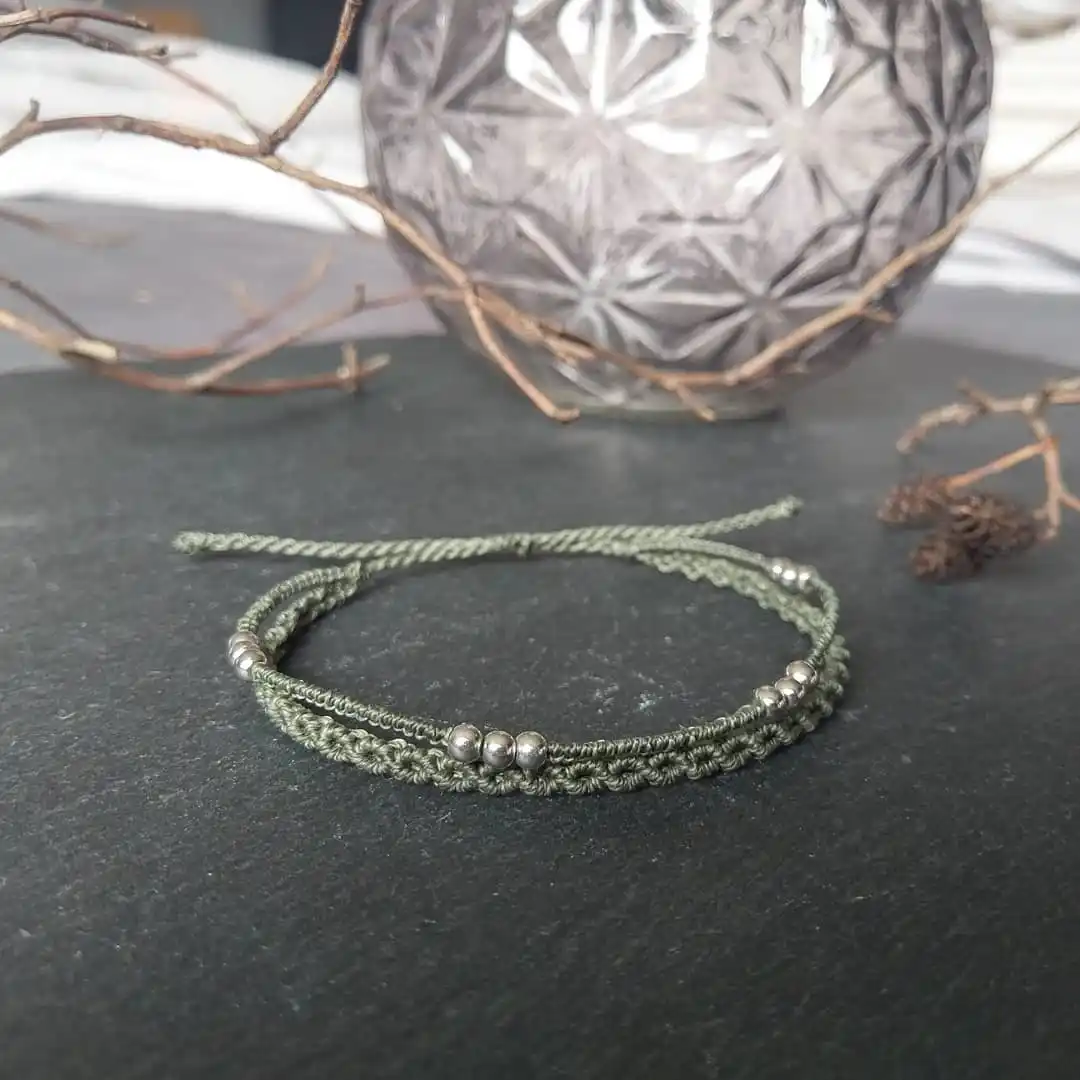
One color, one cord, and a row of small silver beads is all it takes to get this look. The knotting stays simple and repetitive down the front, while the long uncut tails do double duty as the closure.
To recreate it:
- Pick a matte cord in a muted color like this sage green so the beads stand out without competing.
- Work a basic square knot or half hitch chain along the front, sliding a bead into the cord every few knots.
- Leave both ends long instead of trimming them, then tie an adjustable knot so the bracelet has no clasp at all.
The uneven bead spacing here is not a flaw. Slightly irregular placement actually reads as more handmade than a perfectly even row.
3. Ombre Spiral Bracelet Set with a Focal Bead
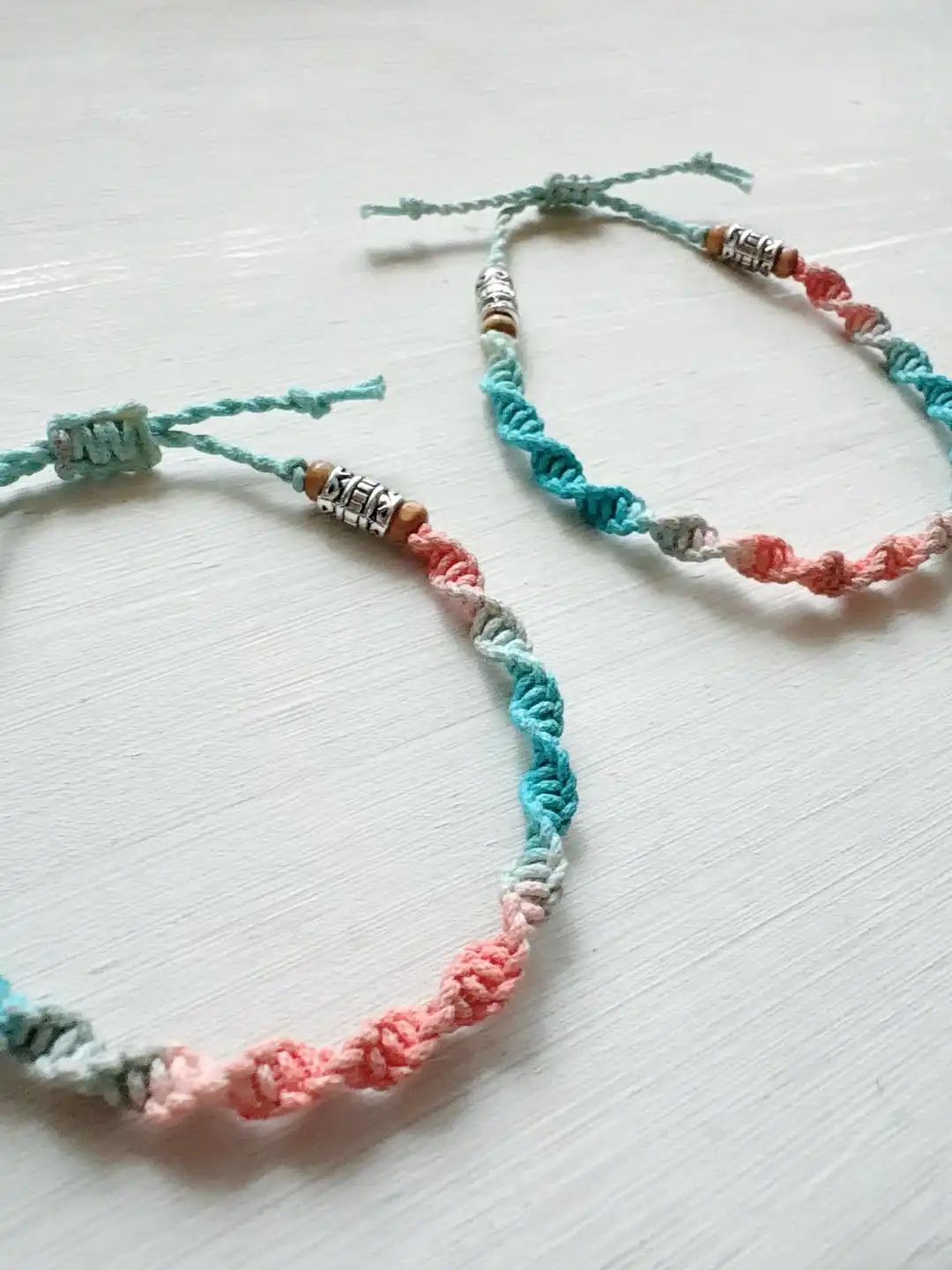
Spiral knots twist on their own as you tie them, which is what gives this pair their candy-cane coil texture without any extra effort.
The real trick here is in the color plan: each bracelet fades gently from cool tones into coral, so the spiral reads like a gradient instead of stripes.
What’s doing the work in this pair:
- Three or four thread colors, arranged light to dark or cool to warm, so the transition feels gradual
- A single oversized silver focal bead placed off-center, not in the middle, which keeps the eye moving
- Small wood spacer beads on either side of the focal bead to give it room to breathe
- Matching but not identical color palettes across the two bracelets, so they read as a set without being twins
Making two at once from the same color family is an easy way to turn one pattern into a stack-friendly gift.
4. Wide Flat Band with a Tiny Embroidered Icon
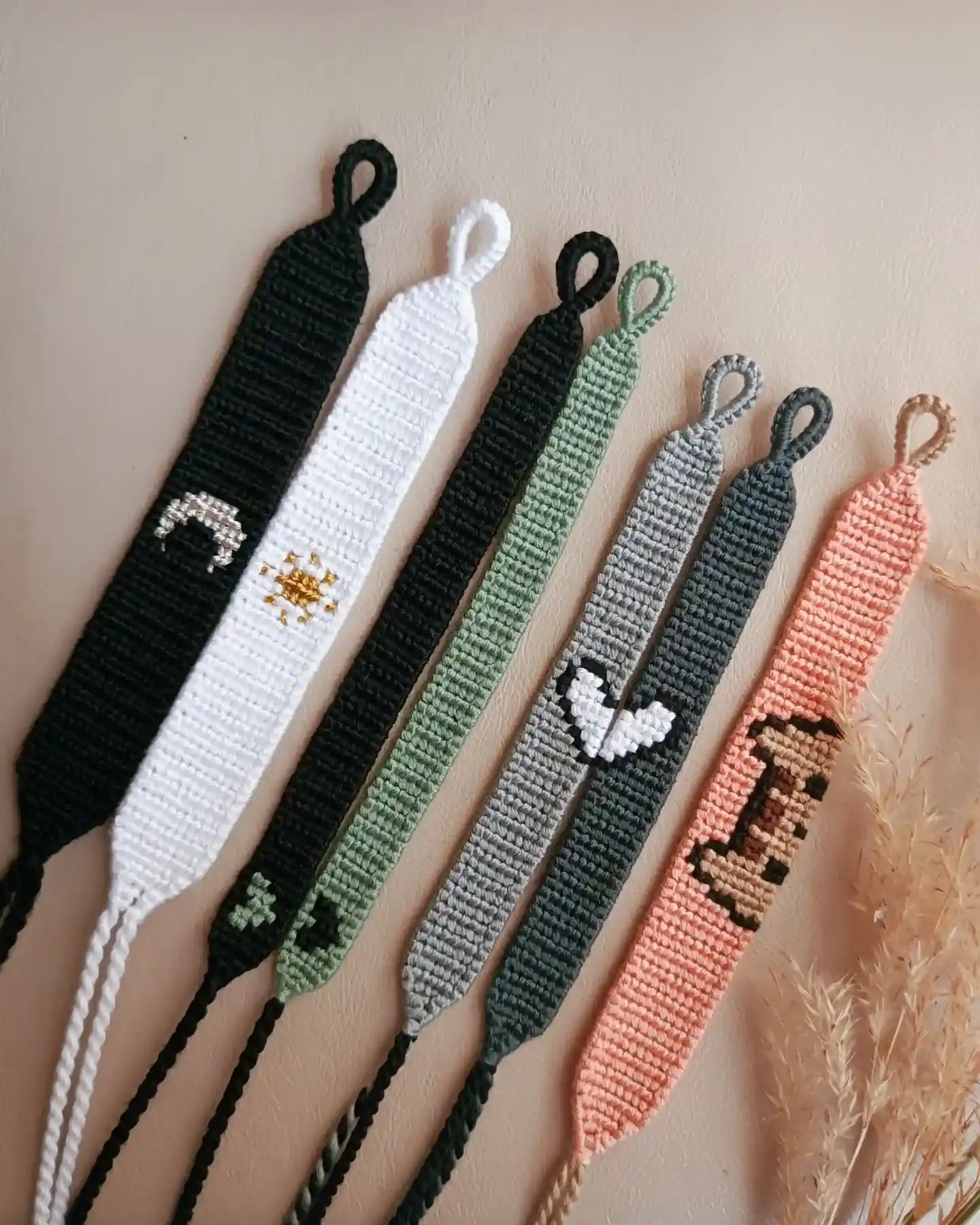
Skip the round cord entirely for this one. It uses a flat woven band, worked wide and solid in a single color, then finished with one small pixel-style icon stitched on in a contrasting thread. A loop and long tail take the place of a clasp.
What’s carrying this design:
- The base band stays in one solid, neutral color, which is what lets the tiny icon actually stand out
- Icons stay small and simple, a moon, a sun, a heart, a paw, something that reads clearly at a glance
- A woven loop at one end pairs with a long braided tail at the other for the closure
- Fringe is left long and unfinished rather than trimmed even, giving it a relaxed, handmade edge
If you are working from a chart or pattern for the icon, count your rows twice before you start stitching it in. Pulling out embroidery on a finished band is far harder than pulling out a knot.
A calm, single-color band lets the small icon do all the talking.
A tiny icon like a moon or a heart is stitched in after the band is woven.
A woven loop on one end and a long braided tail on the other tie the fit.
5. Bold Two-Tone Chain Bracelet for a Masculine Look
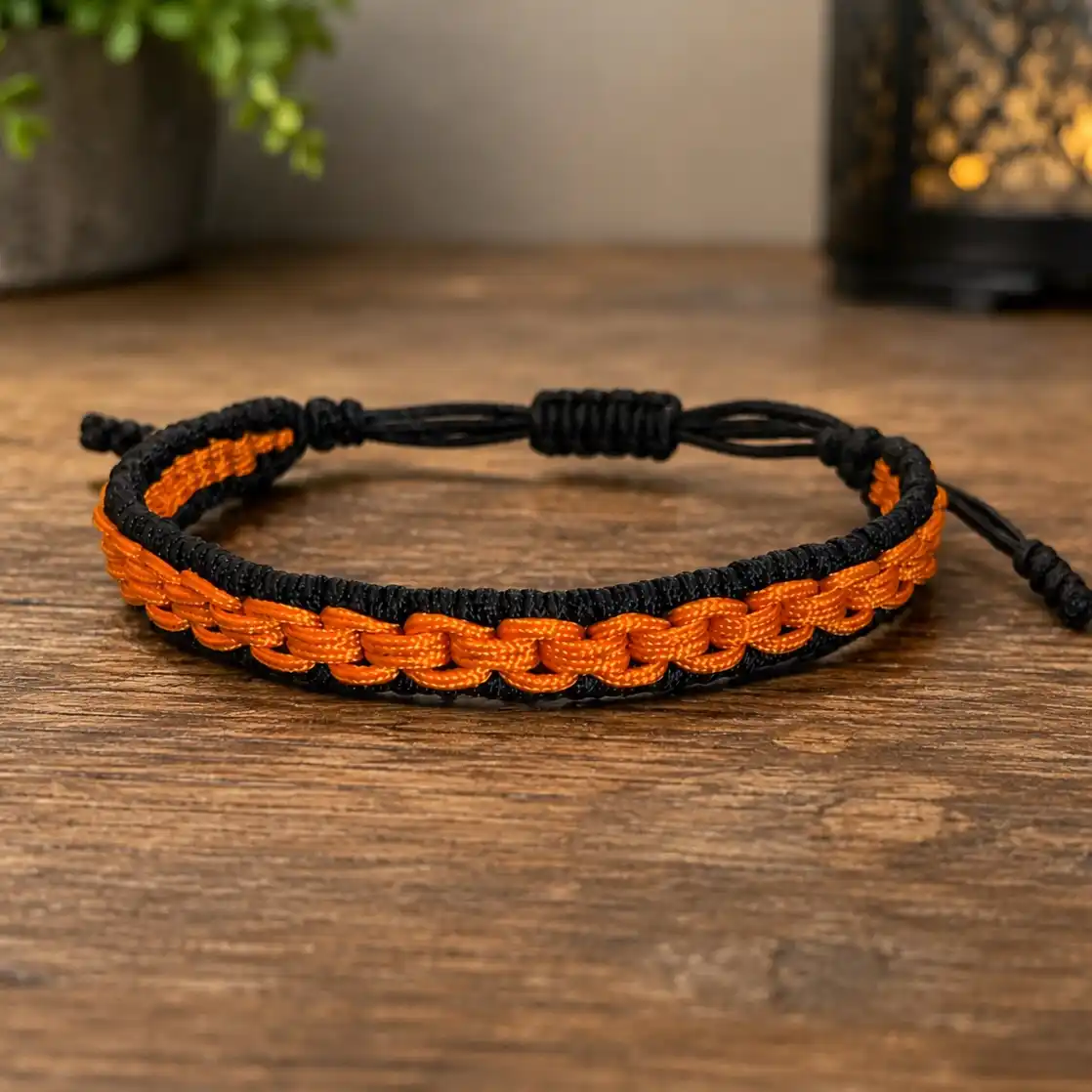
Not every macrame bracelet needs to look delicate. This one leans rugged with a chunky, chain-link style weave in black and burnt orange, worked in a thicker paracord-style cord instead of thin embroidery thread. The slider closure keeps the whole thing simple to size.
A few things set this apart from a softer, more feminine pattern:
- Thicker cord gives the weave more visible texture and a heavier, sturdier look
- High contrast colors, here a matte black against a bright orange, read as bold rather than pastel
- The chain-link knot pattern creates raised, interlocking loops instead of a flat woven surface
- A sliding knot closure with no beads or charms keeps the finished piece simple and unfussy
Pick a color pairing with real contrast, like black against orange or navy against mustard, if you want this one to read masculine on a gift table.
Subscribe to DIY Craft Bloom
Get updates on the latest posts and more from DIY Craft Bloom straight to your inbox.
| Embroidery thread | Paracord-style cord |
|---|---|
| Thin, soft, drapes gently against the wrist. | Thicker and firmer, holds its shape on its own. |
| Best for delicate, pastel color palettes. | Best for bold, high-contrast color palettes. |
| Knots stay flatter and more subtle. | Knots stay raised and chunkier, like this chain look. |
6. Multi-Color Zigzag Chevron Bracelet Trio
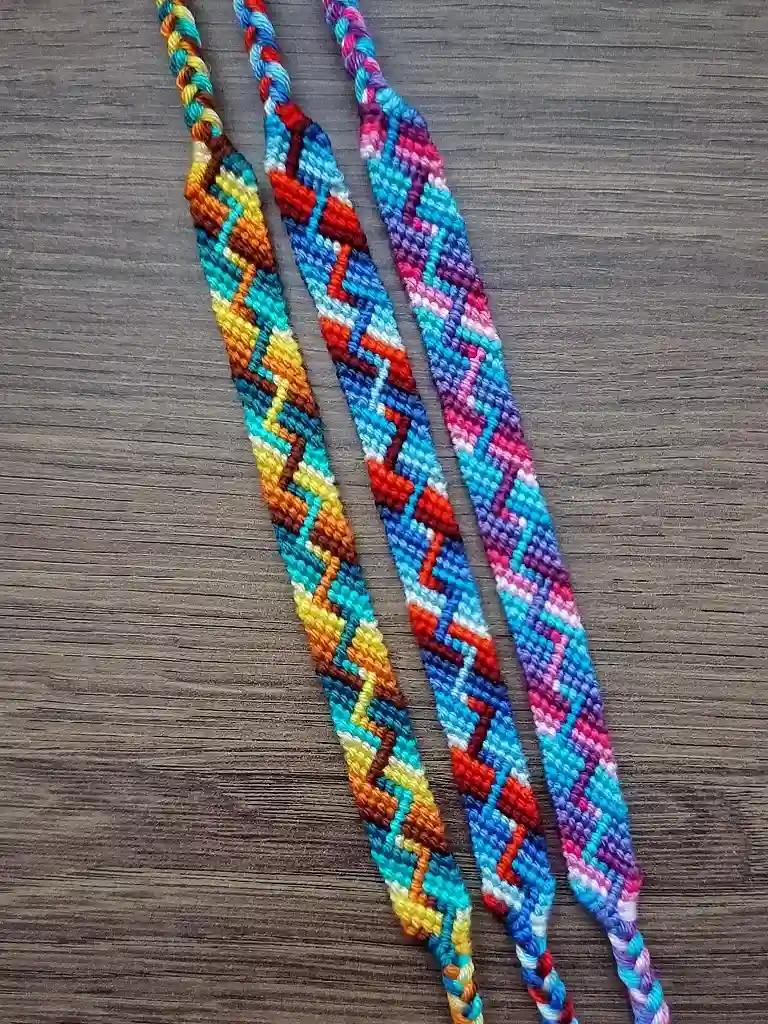
Zigzag chevron patterns are one of the most recognizable macrame looks, and this trio proves how far the same stitch pattern stretches with a different color story.
Each band uses the same tight, wide chevron weave, but the palette shifts the whole feel, from earthy and warm to bold and cool to soft and jewel toned.
A few things happening across the set:
- The zigzag comes from alternating diagonal rows, so the pattern naturally breaks the palette into repeating color blocks
- Each bracelet mixes four or five thread colors instead of two, which is what gives the weave that busy, friendship bracelet texture
- Both ends finish in a simple twisted braid, no beads, no clasp hardware, just cord
- Working all three from a shared thread stash but in different color combinations turns one pattern into a whole matching set
Once you have the chevron stitch down, swapping the color order is the easy part. The pattern does not change at all.
7. Coastal Blue Bracelet Set with a Woven Loop Closure

Seven bracelets, one shared trick: every single one on this beach photo closes with the same woven loop and button knot, so the whole stack goes together even though the patterns are all over the place.
Diamond lattice, chevron, wavy ric rac, a row of navy polka dots, a plain key pattern in yellow and navy, they all read as one collection because the closure never changes.
A few details worth pulling out:
- The loop is worked right into the weave at the start, then the opposite end finishes in a simple overhand knot that slides through it
- Sticking to blue and white, with just one yellow accent piece, is what keeps seven different patterns from clashing
- A single cowrie shell threaded onto a plain twisted cord adds a beachy touch without needing a whole pattern
- Mixing tight geometric weaves with looser wavy ones in the same palette keeps a big stack from looking repetitive
Once you have the loop and knot closure down, it works on almost any pattern in this list, not just this one.
One repeatable loop and knot closure lets seven totally different patterns still read as a matching stack.
8. Ombre Chevron Arrow Bracelet in a Single Color Family
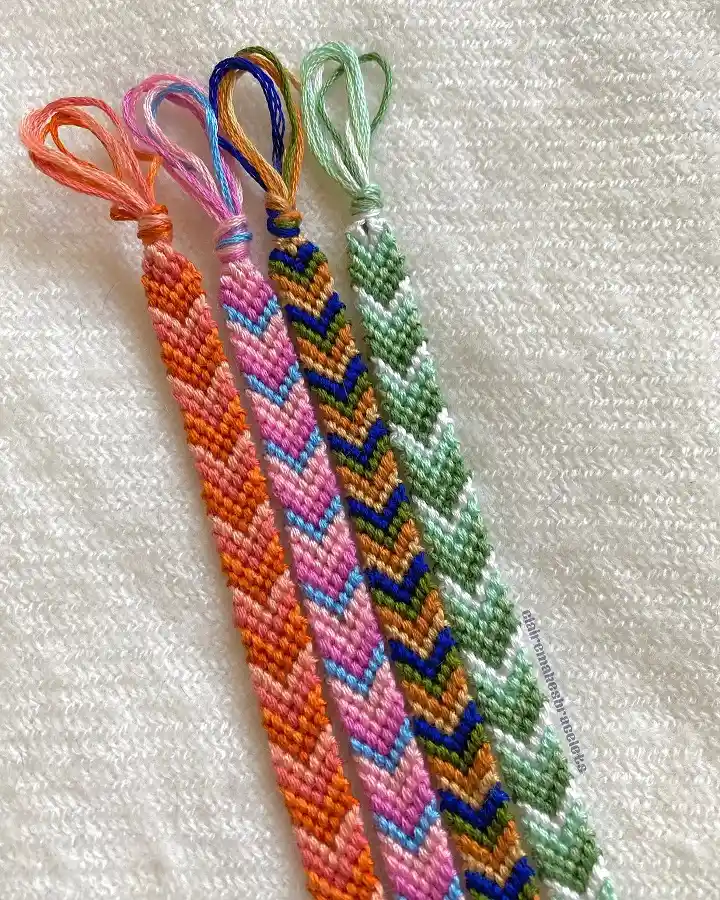
Four bracelets, four color families, one shared arrow motif running straight down the center. Coral fades into peach, pink shifts into blue, navy moves through olive into tan, sage settles into white.
Instead of mixing several unrelated colors like a chevron zigzag, each one stays inside a single family and lets the shade do the gradient work.
Here’s the formula behind it:
- A repeating V or arrow stitch worked straight down the middle, all pointing the same direction
- Three to five shades from one color family, lightest near the bottom and deepest near the top
- One thin accent line in a contrasting color, like the blue or navy stripe cutting through each arrow
- A loose, untrimmed loop of thread gathered and knotted at the top instead of a tight braid
The loop finish at the top does double duty. It is decorative on its own, and it becomes the closure once you loop it over a button knot at the other end.
9. Wave and Scallop Bracelet with Concentric Color Bands

This pattern is a step up from a straight chevron. The scalloped, feather-like shape comes from a spiral knot worked in tight repeating waves, and each little scallop holds three or four concentric bands of color instead of just one, like a tiny rainbow ring nested inside the weave.
What sets this one apart:
- Each scallop repeats the same color order, dark on the outside fading toward a lighter center, so the whole strip reads as a pattern rather than random stripes
- Small gold beads sit right at the center point of every scallop, catching the light without adding bulk
- An adjustable closure made from a sliding knot and a few stone or wood beads finishes both ends
- Running the same wave pattern across four totally different palettes, from muted sage to full rainbow, shows how much one technique can flex
This one takes more patience than the earlier patterns on this list, so it is worth practicing the scallop shape on scrap cord before committing to your good thread.
10. Dimensional Flower Bracelet on a Striped Base Band
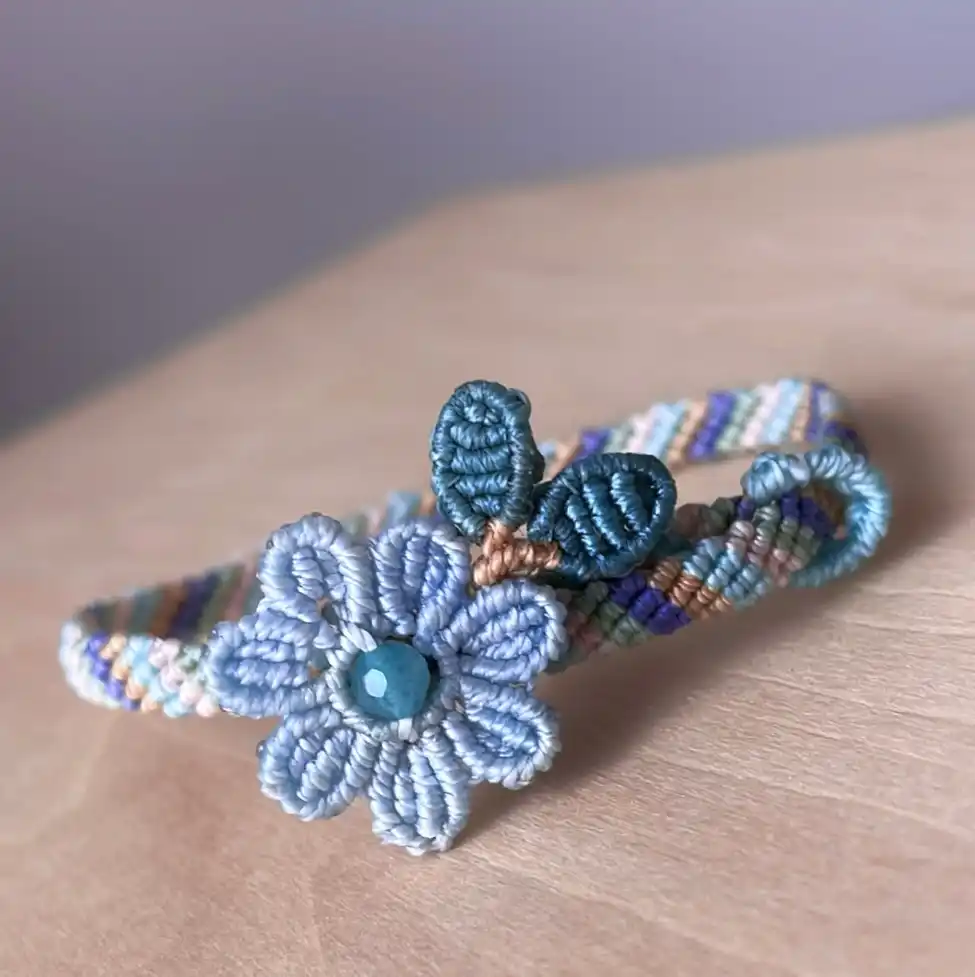
This one moves past flat weaving entirely. The five-petal flower and its two little leaves are built up in raised, three-dimensional macrame, stitched separately and then anchored onto a simple striped cord band.
It’s the most advanced technique on this list, but the payoff is a piece that looks closer to embroidery jewelry than a typical friendship bracelet.
A quick breakdown of what’s going on:
- Each petal is worked as its own small raised shape, then joined at a center point so they fan out like a real flower
- A single faceted bead sits at the flower’s center, doing the job a French knot would in embroidery
- Two leaf shapes in a contrasting teal add shape without competing with the flower itself
- The base band underneath stays thin and evenly striped, so the dimensional flower reads as the clear focal point
Try this pattern only after you’re comfortable with basic flat knots. The petal shaping takes real patience the first few times.
11. Single-Cord Spiral Bracelet with an Off-Center Stone
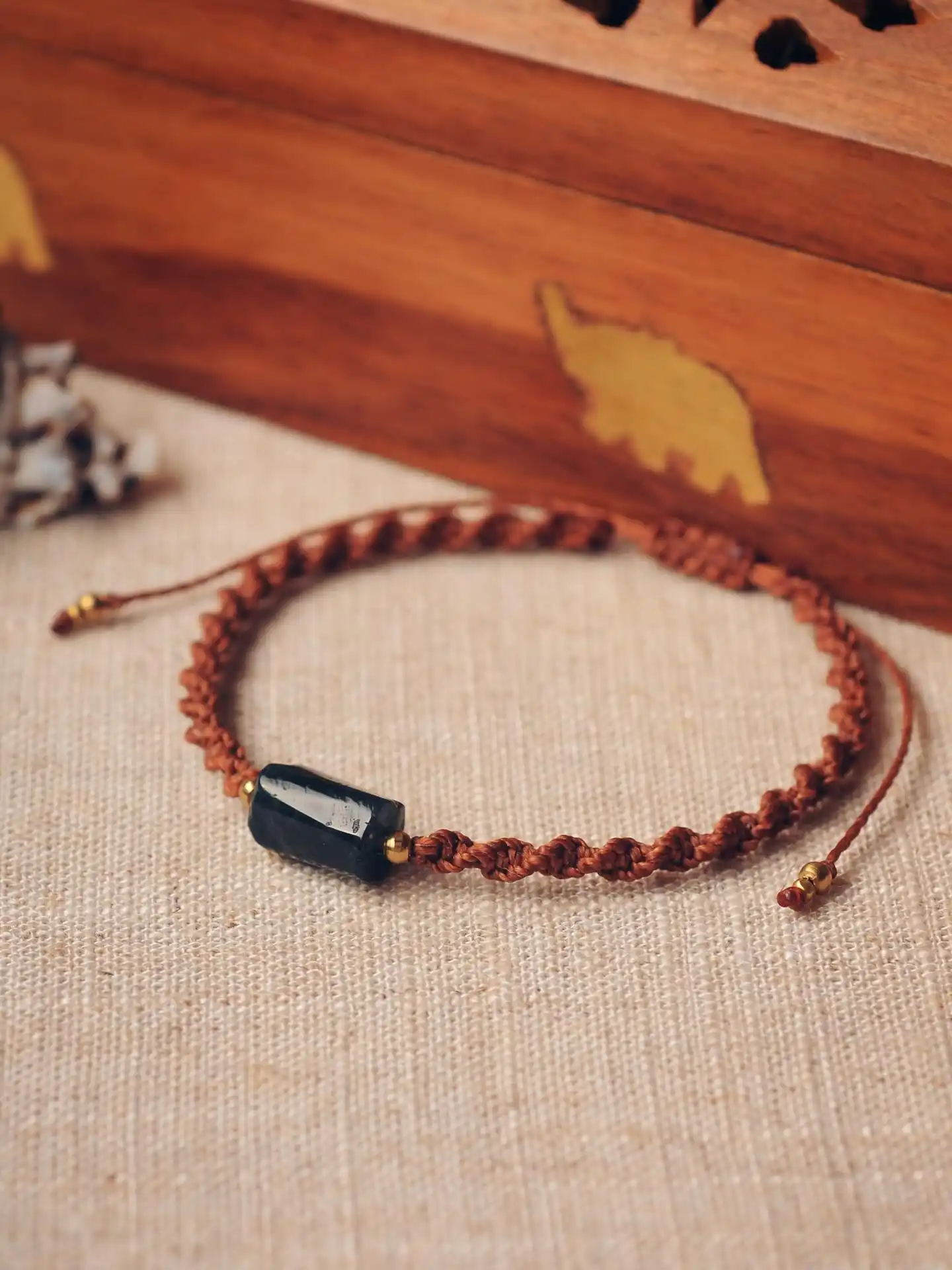
Minimal does not have to mean plain. This one uses one cord color worked in a continuous spiral knot, so the whole length twists like a barber pole without ever switching thread.
What gives it personality:
- A single natural stone bead, placed off to one side instead of dead center, breaks up the spiral just enough
- Small gold spacer beads flank the stone so it sits with a little breathing room on both sides
- The spiral knot itself creates texture without any color changes, which keeps the piece from looking plain
- Thin cord tails finish in tiny gold and accent beads, adjustable enough to fit almost any wrist
Rust brown against a natural stone reads earthy and low key, but the same spiral works just as well in black, navy, or any cord color you already have on hand.
12. Plain Braided Cord with a Dangling Charm
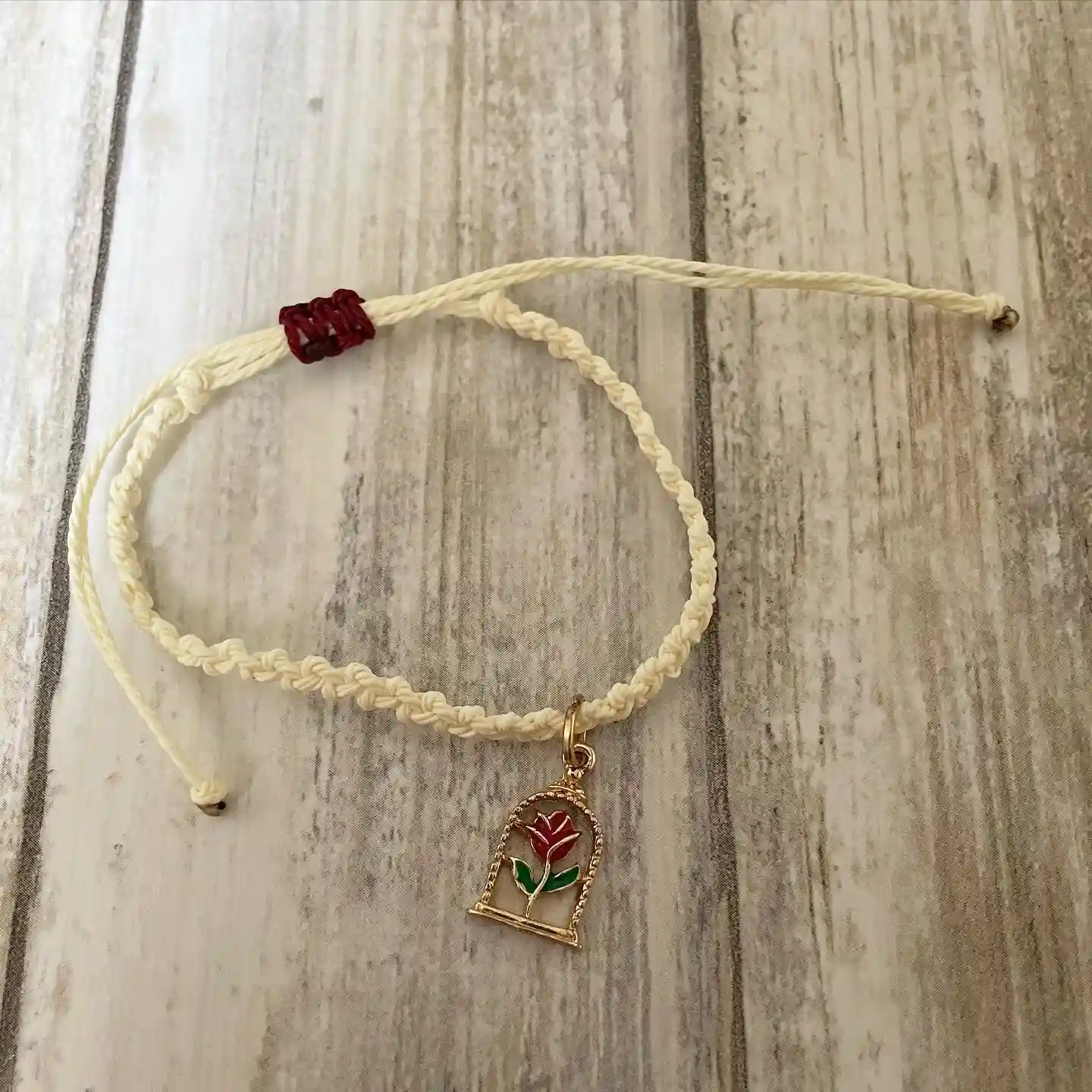
Sometimes the bracelet is just the setup, and a small metal charm is the whole point.
Subscribe to DIY Craft Bloom
Get updates on the latest posts and more from DIY Craft Bloom straight to your inbox.
This one keeps the braid itself dead simple, a soft cream cord worked in a basic braid, so a tiny enamel rose charm hanging from a gold ring gets all the attention.
A few reasons this pairing works:
- A plain, single-color braid acts like a blank canvas instead of competing with the charm
- One small burst of red thread knotted near the slider adds just enough color to echo the charm without repeating it
- The charm hangs from a jump ring rather than being woven in, so it swings and catches light
- Small metal beads finish both adjustable ends, keeping the hardware minimal and consistent
If you’re adding a charm to a simple braid, resist the urge to add beads or extra color along the band. Let the charm be the only detail doing the talking.
Keep the braid one plain color so the charm stands out.
Use one small color accent, like a knot or bead, that echoes the charm.
Adding beads or a patterned weave along the band.
Choosing a charm in a color that competes with the cord.
13. Cowrie Shell Bracelet Set in Tonal Brown Spirals
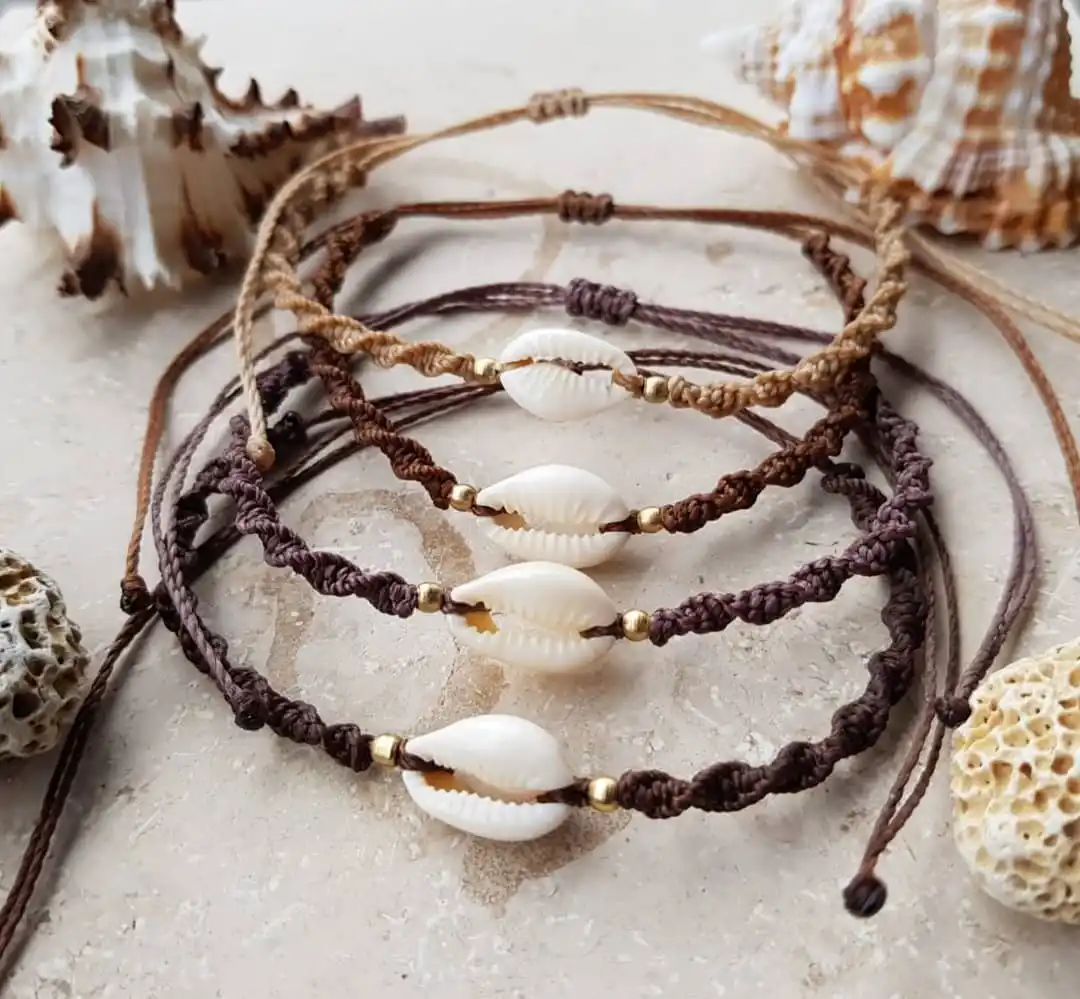
Real cowrie shells thread right onto the spiral cord in this set, which is why the actual material is doing more of the work here than any knot pattern.
Four shades of brown, from pale tan down to almost black, use the exact same spiral twist and shell placement, just shifted a shade at a time.
Details worth copying:
- A single cowrie shell sits centered on the cord, with small gold beads bracketing it on either side
- The spiral knot repeats the same twist across all four bracelets, so the only variable is thread color
- Moving from light to dark across the set creates a natural stacking order for the wrist
- Both ends finish in a simple overhand knot, kept loose enough to slide and adjust
Sourcing a few natural shells ahead of time is the real prep work here. Once you have them drilled and ready, the knotting itself moves fast.
Keep the knot pattern identical across a set and let the thread color do all the changing.
14. Framed Stone Bracelet with Alternating Frame Sizes
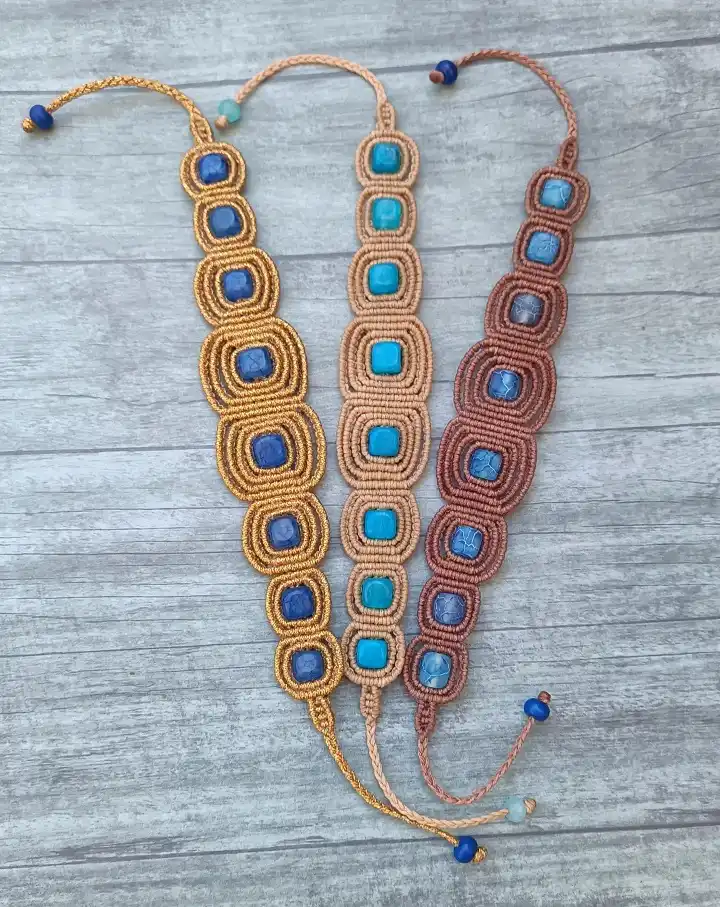
Each stone in this trio gets its own individual macrame frame, wrapped tight in matching cord and lined up in a row like a beaded necklace turned into a bracelet.
What keeps it from feeling repetitive is the size shift, small frames near the ends grow into larger ones toward the center, so the eye travels along the piece instead of stalling.
What’s built into this design:
- Every stone sits inside its own square or round frame worked in the same cord color as the band
- Frame size increases gradually toward the middle, then tapers back down near the ends
- Cord color shifts across the three, gold, blush, and dusty mauve, while the blue stone tone stays consistent
- Braided adjustable ties finish both ends with a couple of small accent beads
This pattern takes longer than a straight weave since every stone gets wrapped on its own, but the payoff is a piece that looks closer to fine jewelry than cord craft.
| Smaller frames | Larger frames |
|---|---|
| Sit near the ends, easing into the pattern. | Cluster toward the center as the focal point. |
| Take less cord and less time to wrap. | Show off a bigger, bolder stone. |
| Keep the wrist edge lighter and more flexible. | Give the middle of the band more visual weight. |
15. Thick Cord Bracelet with a Center Knot and Rainbow Wraps

Not every design needs multiple knots or beads to feel finished. This one relies on a single thick round cord, worked plain except for one bold overhand knot sitting dead center, with two thin bands of rainbow thread wound tightly around the cord on either side.
A few things happening here:
- The thick paracord-style cord gives the whole piece weight and structure without any weaving pattern at all
- One prominent knot in the center acts as the entire design statement, no charm or bead needed
- Small wrapped color bands, not beads, add just a hint of color at two symmetrical points
- An adjustable sliding closure with two small black bead ends keeps it simple to size
This is the pattern to reach for when you want something that reads clean and low key but still has a small personal detail built in.
16. Bold Diamond Lattice Bracelet in Neon Multicolor
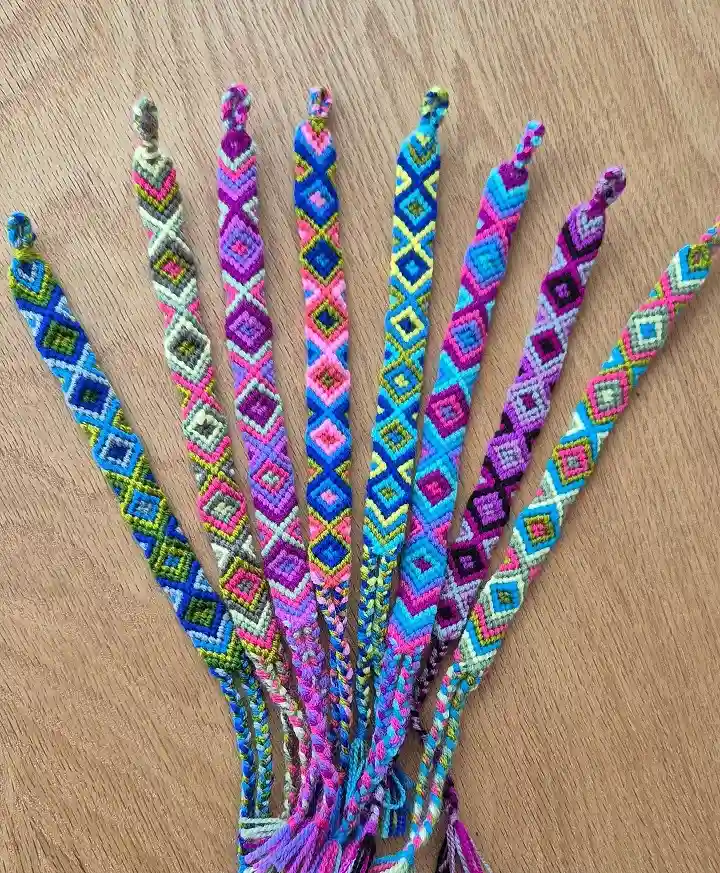
If the earlier patterns on this list felt a little quiet, this is the one that goes all in. Eight bracelets fan out here, each packed with a repeating diamond lattice using six or more neon and jewel tone threads at once, no muted shades in sight.
What makes the maximalist approach actually work:
- The diamond pattern itself stays identical across all eight, so the busy color changes never feel chaotic
- Neon and jewel tones sit side by side with almost no neutral space between them
- A tight, dense weave keeps every diamond crisp even with that many color changes happening
- Fringe finishes loose and braided at both ends, letting all those thread colors show off one more time
This is the pattern for using up scrap thread from every other project on this list. The more colors you throw in, the more it works.
Conclusion
There is no single right way into macrame, and that is really the point of a list this wide.
A tight herringbone weave and a loose paracord knot both count as a real bracelet, and both are worth having in your back pocket depending on the day and the thread you have on hand.
Start with whichever pattern above felt the most doable, keep your tension steady, and let the rest come with practice.
Save this for the next time you want fresh macrame bracelet ideas to work through.