How to Make a Paracord Emperor Buddy: Parabuddy Zipper Pull

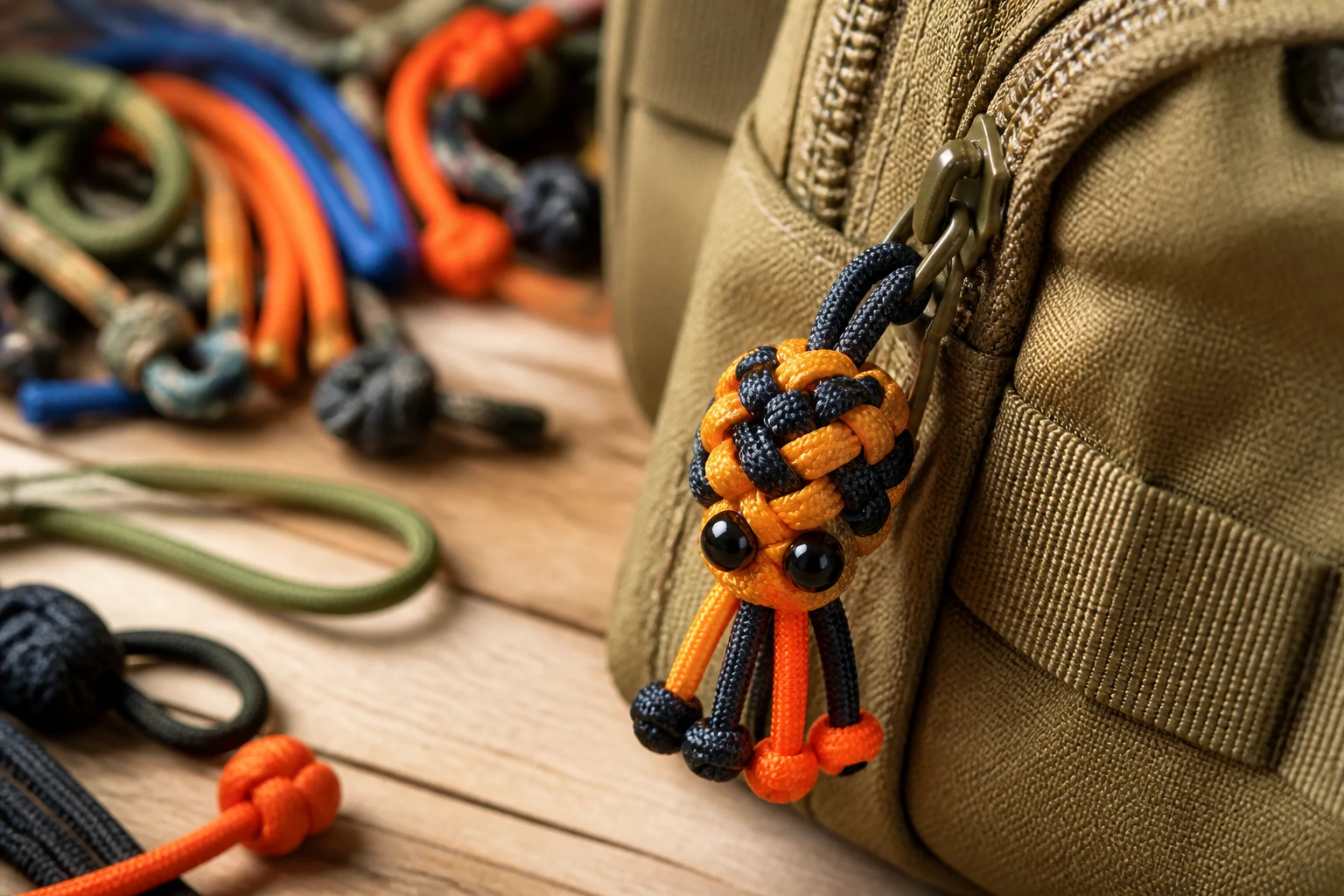
A Paracord Emperor Buddy (or Parabuddy) is a small decorative figure made from paracord using diamond and snake knots.
It is commonly used as a zipper pull, keychain, or lanyard decoration and can be made in about 15 minutes using leftover paracord scraps.
Looking for a quick paracord project that’s both practical and cute? The Emperor Parabuddy (or para buddy, if you’re feeling casual) is your answer.
This is a clever design that transforms basic knots into something that actually looks like a tiny paracord creature.
What You’ll Need to Get Started
Before we dive into the knotting madness, let’s gather our supplies. The good news? You probably already have everything you need lying around.
- One piece of paracord (scrap pieces work great for this)
- Sharp scissors
- A lighter or torch for melting ends
- A dotting tool or flat surface for pressing melted ends
- Your hands (obviously)
The beauty of this project is that it’s perfect for using up those random paracord scraps you’ve been hoarding. You know the ones—too short for a bracelet but too long to throw away. Now they finally have a purpose.
Step One: Starting with the Diamond Knot Head
Every good para buddy needs a head, and we’re going to create one using a diamond knot. First things first: find the midpoint of your paracord. This is going to be the top of your little buddy.
Here’s how to tie the diamond knot:
- Place the midpoint on your hand
- Make a loop with the right strand and lay it over the left strand
- Take the left strand behind the right strand
- Thread it underneath the middle strand to form a Carrick’s Bend
- Take the right strand counterclockwise, going past that first strand and through the middle opening from back to front
- Do the same with the other strand, going counterclockwise and through the middle from back to front
Now cinch that baby up. The loop you leave at the top is totally up to you. Want a longer loop for attaching to zippers? Leave more space. Prefer a shorter loop for keychains? Pull it tighter. You’re the boss here.
Don’t Panic If the Diamond Knot Feels Tricky
Look, the diamond knot can be a bit mind-bending the first time around. If you’re struggling, there are dedicated tutorials out there just for this knot.
Watch one, practice a few times, and you’ll get it. We’ve all been there, fumbling with cords and wondering if our fingers are broken.
Step Two: Creating the Body with an Emperor Snake Knot
Now that you’ve got your head sorted, it’s time to build the body. This is where the Emperor snake knot comes in, and it’s what makes this design special.
Start with a single snake knot. Take the right strand and bring it around the left strand to make a loop. Then take the left strand, bring it to the right, and thread it through that loop you just created. Simple enough, right?
Here’s where it becomes an Emperor snake knot: take the right strand and bring it up through the right side loop of that snake knot, making sure it passes in front.
Subscribe to DIY Craft Bloom
Get updates on the latest posts and more from DIY Craft Bloom straight to your inbox.
Then do the same on the left side, but this time the strand passes on the backside. Pull it down and cinch everything up nice and firm.
Adding the Middle Section
Now you’re going to tie two single snake knots right below that Emperor snake knot. This forms the body of your para buddy and gives it some length.
For each snake knot:
- Take the right strand and make a loop around the left
- Bring the left strand behind and thread it through from the front
- Tighten it up and repeat for the second knot
Stack them right on top of each other, and boom—you’ve got yourself a little paracord body. At this point, your creation should be starting to look like an actual thing rather than a random blob of knots.
Step Three: Giving Your Buddy Some Feet
What’s a para buddy without feet? Incomplete, that’s what. Luckily, the feet are stupidly easy to make using basic overhand knots.
Take the right strand and tie a simple overhand knot—you know, the kind you’ve been tying since kindergarten.
Make a loop with the strand, put it behind, pull it through, and tighten. Position this knot right up against the body or leave some space if you want dangly feet. FYI, I think the dangly feet look pretty cute.
Mirror the same process on the left side. Now you’ve got two little feet, and your para buddy is really coming together. You can adjust the length of these “legs” to match whatever vibe you’re going for.
Step Four: Finishing Touches
You’re in the home stretch now. Grab your scissors and clip off the excess paracord below each foot. Don’t leave too much—just enough to melt and seal.
Fire up your lighter and carefully melt each end. Once it’s melted, use your dotting tool (or honestly, the flat part of your lighter if you’re careful) to press the melted end flat. This creates a clean finish and prevents your paracord from fraying.
Safety note: Melted paracord is hot. Like, really hot. Don’t touch it with your bare fingers immediately after melting unless you enjoy minor burns.
What Can You Actually Do with These Things?
Now that you’ve created your adorable paracord creature, what’s it good for besides looking cute?
Zipper Pulls
These guys are perfect for jacket zippers, backpack zippers, or even tent zippers. The loop at the top makes them easy to attach, and they give you something substantial to grab onto when you’re dealing with those tiny zipper tabs.
Keychains and Lanyards
Attach one to your keys for a pop of color and personality. They also work great on knife lanyards if you’re into EDC gear. Plus, they’re conversation starters—people will definitely ask you about your weird little paracord buddy.
Gifts That Don’t Suck
IMO, these make excellent small gifts. They’re handmade, practical, and don’t cost much to make. String a few together in different colors, and you’ve got birthday party favors or stocking stuffers sorted.
Subscribe to DIY Craft Bloom
Get updates on the latest posts and more from DIY Craft Bloom straight to your inbox.
Tips for Making Your Para Buddy Even Better
Once you’ve mastered the basic technique, you can start experimenting. Try using different colored paracord for a two-tone effect. Mix and match colors for the body and feet.
Some people even add tiny beads for eyes, though that’s getting into advanced territory.
The knot tension matters more than you might think. Keep everything consistent and snug, but not so tight that your knots look strangled.
You want a neat, uniform appearance that shows off the structure of each knot.
Wrapping It Up
The Emperor Parabuddy is one of those rare projects that’s quick, easy, and actually useful.
Whether you’re a paracord veteran or someone who just discovered that you can make things besides bracelets, this tutorial gives you something fun to try.
Start with one, get comfortable with the process, and soon you’ll be cranking these out while watching TV.
They’re perfect for using up scraps, practicing your knot skills, and creating little gifts that people actually appreciate. Plus, there’s something oddly satisfying about creating a tiny paracord creature with personality.
Frequently Asked Questions
How much paracord do I need for one Emperor Parabuddy?
You don’t need much at all—this is a great scrap project. Generally, a piece around 12-18 inches should be plenty, depending on how long you want your loop and feet to be. If you’re just starting out, cut a slightly longer piece so you have room to work with while you’re learning the knots.
Can I make these with other types of cord besides paracord?
Absolutely! While paracord is the traditional choice and works great, you can experiment with other cordage like micro cord, hemp rope, or even leather lacing. Just keep in mind that different materials will behave differently when you tie and tighten the knots. Stiffer materials might be harder to work with but will hold their shape better.
My diamond knot looks messy—what am I doing wrong?
Diamond knots take practice, and everyone struggles with them at first. The key is patient, even tightening. Don’t just yank everything tight at once. Instead, work the slack out gradually, adjusting each part of the knot as you go. If it’s really giving you trouble, watch a dedicated diamond knot tutorial a few times and practice on scrap cord until it clicks.
How do I make the feet symmetrical?
Symmetry comes down to tying your overhand knots at the same distance from the body on both sides. Before you tighten each knot completely, hold both strands together and compare the positioning. Adjust as needed, then tighten them down. It’s easier to fix before you commit than to untie and redo everything.
Can I make these bigger or smaller?
Sure! The size depends on your cord thickness and how tight you tie your knots. Using thicker cord will give you a chunkier buddy, while micro cord creates tiny versions. You can also add more snake knots to the body section to make it longer, or skip one to make it shorter. The basic structure stays the same regardless of size.
Do I have to melt the ends, or are there alternatives?
Melting is the standard method for paracord because it seals the ends and prevents fraying. However, if you’re using a material that doesn’t melt well (like cotton rope), you can use a small dab of fabric glue or even whip the ends with thread. For paracord though, melting is definitely your best bet for a clean, professional-looking finish.