18 Farmhouse Wreath Ideas for the Front Door

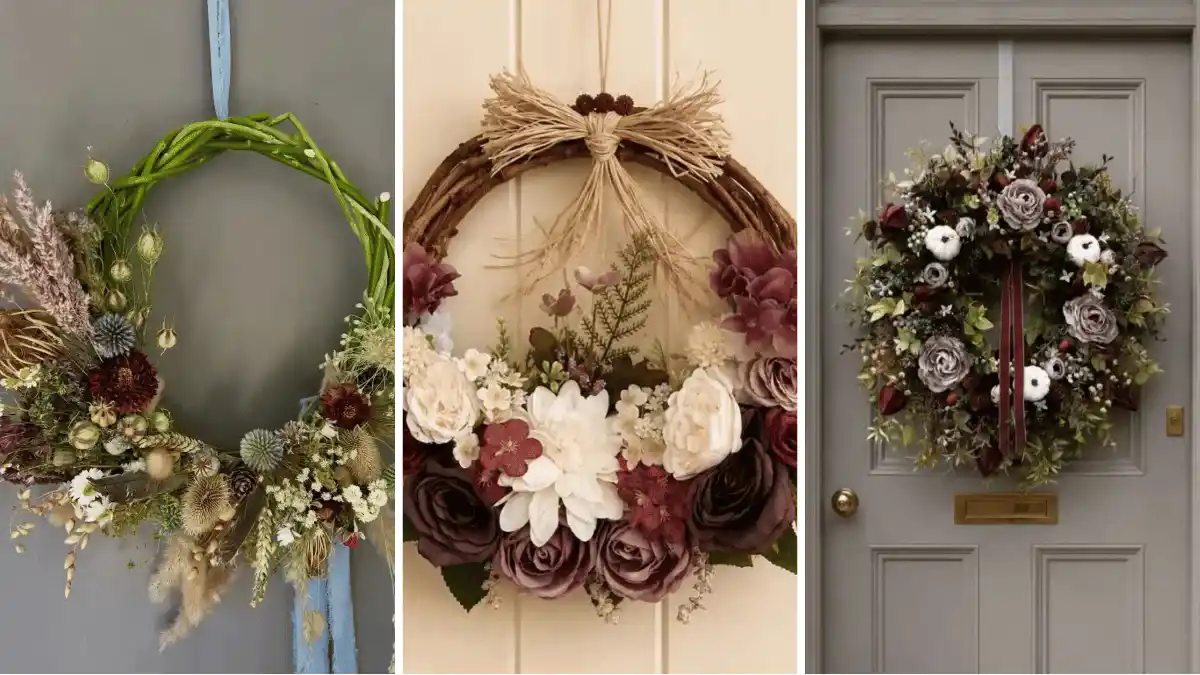
If your front door has had the same wreath for three seasons running, this list is the nudge to switch it up.
A great farmhouse wreath ideas doesn’t have to mean the same tight circle of faux greenery everyone else is hanging.
Some of the best ones here lean into a fully bare base, letting grapevine or woven willow show through instead of covering every inch.
Others go all in on texture, mixing dried thistle with pampas grass, or trade flowers entirely for wood slices, ribbon bows, or hanging metal hearts.
There’s a version here for a warm wood door, a slate grey one, and everything painted in between, plus a few that skip petals altogether in favor of foliage, berries, or foraged branches.
Whether your style leans wild and gathered or tight and symmetrical, there’s a shape and color story in this roundup that will actually suit your entryway instead of just filling the space on it.
18 Farmhouse Wreath Ideas for the Front Door
1. A Wildflower Wreath Piled with Peonies and Lavender
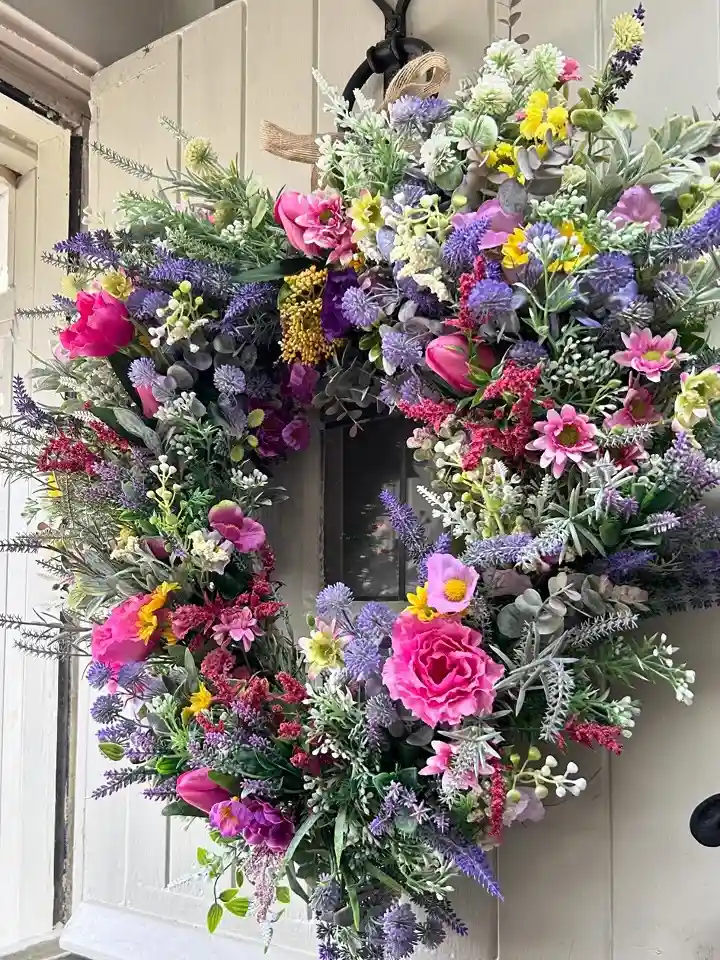
This one leans into abundance instead of restraint. Hot pink peonies and ranunculus sit shoulder to shoulder with trailing lavender, soft yellow accents, and loose eucalyptus greenery, built up so full that almost no base shows through.
What makes it work on a front door:
- The color mix stays in one family (pink, purple, yellow) so it reads as one wreath, not a clash of leftover stems
- Sage-toned greenery breaks up the bright blooms and keeps it from looking too sweet
- A simple jute ribbon at the top hanger stays out of the way and lets the florals do the talking
- Works best against a plain painted door, since the pale wood background here lets every color pop
If your door already has a lot going on, echo just two of these colors instead of all three, so the wreath still feels intentional rather than busy.
2. An All-White Baby’s Breath Wreath for a Soft, Airy Look
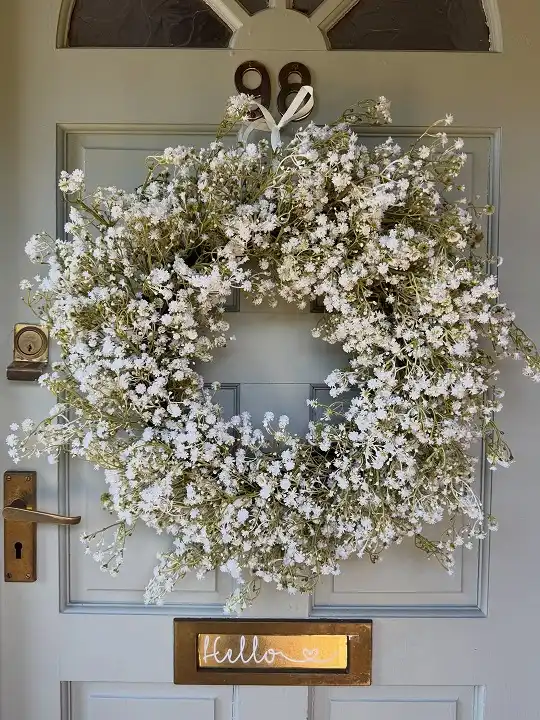
Nothing but tiny white blooms here, and that restraint is the whole point. The stems spray out unevenly instead of sitting in a tight circle, giving it a wild, just-picked feel against the sage green door and brass hardware.
How to get this look:
- Start with a wire or grapevine base. It needs to hold weight without bulking up the silhouette.
- Add baby’s breath in loose clusters, not a single layer. Layering front to back is what gives it that fluffy depth.
- Let some stems escape the circle. A few sprigs trailing past the edge is what keeps it from looking store bought.
- Finish with a plain ribbon. White or ivory disappears into the wreath instead of competing with it.
This style photographs beautifully but wilts fast if it’s real, so most farmhouse versions use faux stems to keep the look year round.
Wire or grapevine holds shape without adding bulk.
Clusters, not a single flat layer, is what creates the fluffy depth.
Stems trailing past the circle keep it from looking too neat.
White or ivory blends in rather than pulling focus.
3. A Half-Wreath Design That Leaves the Top Open on Purpose
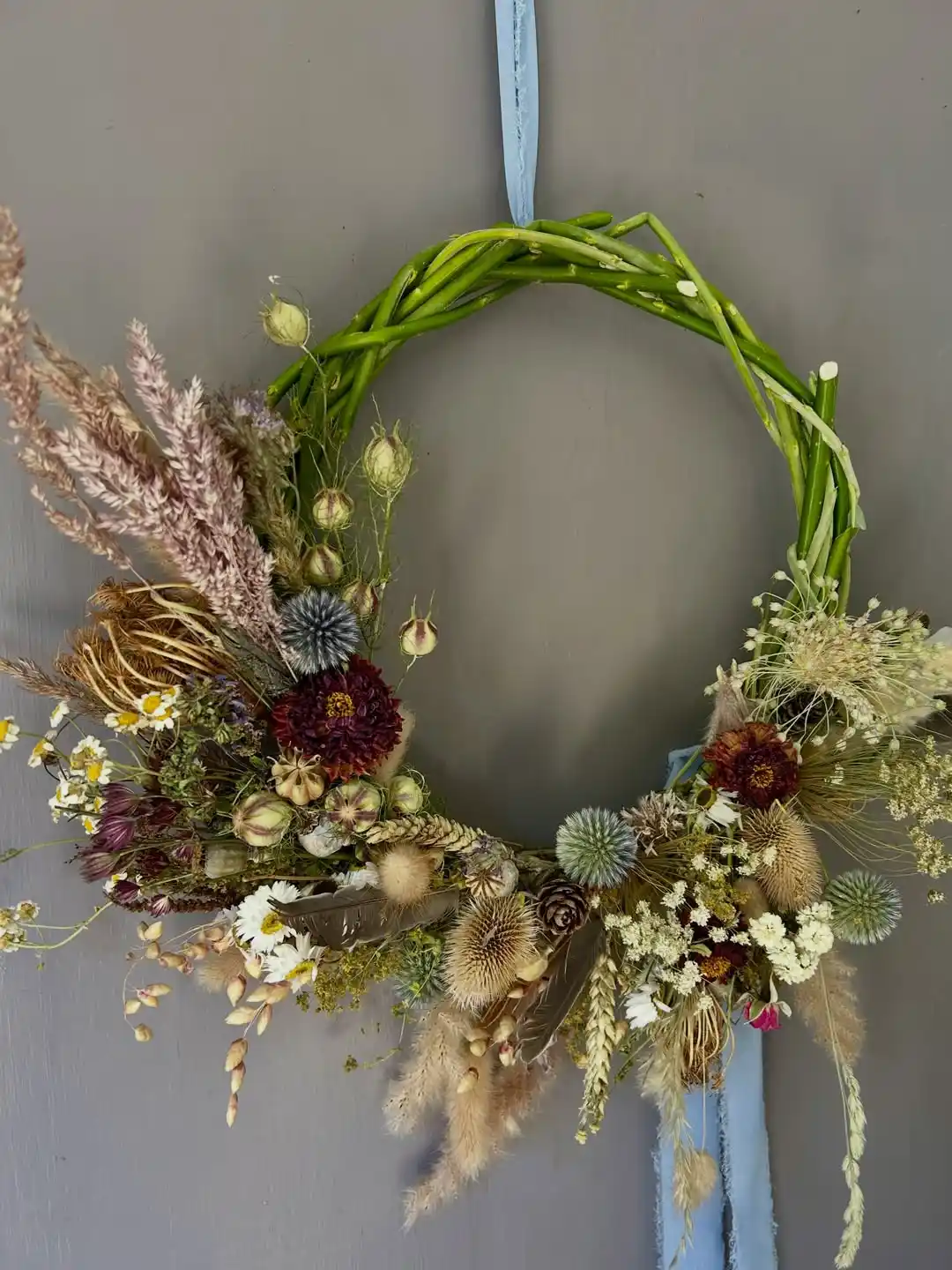
Skip the idea that every inch needs to be covered. This wreath uses a bare green vine base up top and piles everything else, dried thistle, dark red zinnias, pampas plumes, feathers, into a heavy cluster along the bottom third.
The open top gives the eye a place to rest, so the busy, textured bottom section never feels overwhelming.
Texture does more of the work than color here, fluffy pampas, spiky thistle, and papery seed pods play off each other while the dusty blue ribbon and real dried wheat and feathers give the whole thing a foraged, one of a kind feel.
One thing worth knowing: this style sheds a little over the season, so it holds up better on a covered porch than one that takes direct rain.
Bare vine at the crown balances the dense bottom cluster.
Pampas, thistle, and seed pods carry the interest more than any bright bloom.
Wheat and feathers give it a gathered, imperfect quality faux stems don’t replicate.
4. A Bubble Wreath Made from Rolled Burlap Ribbon
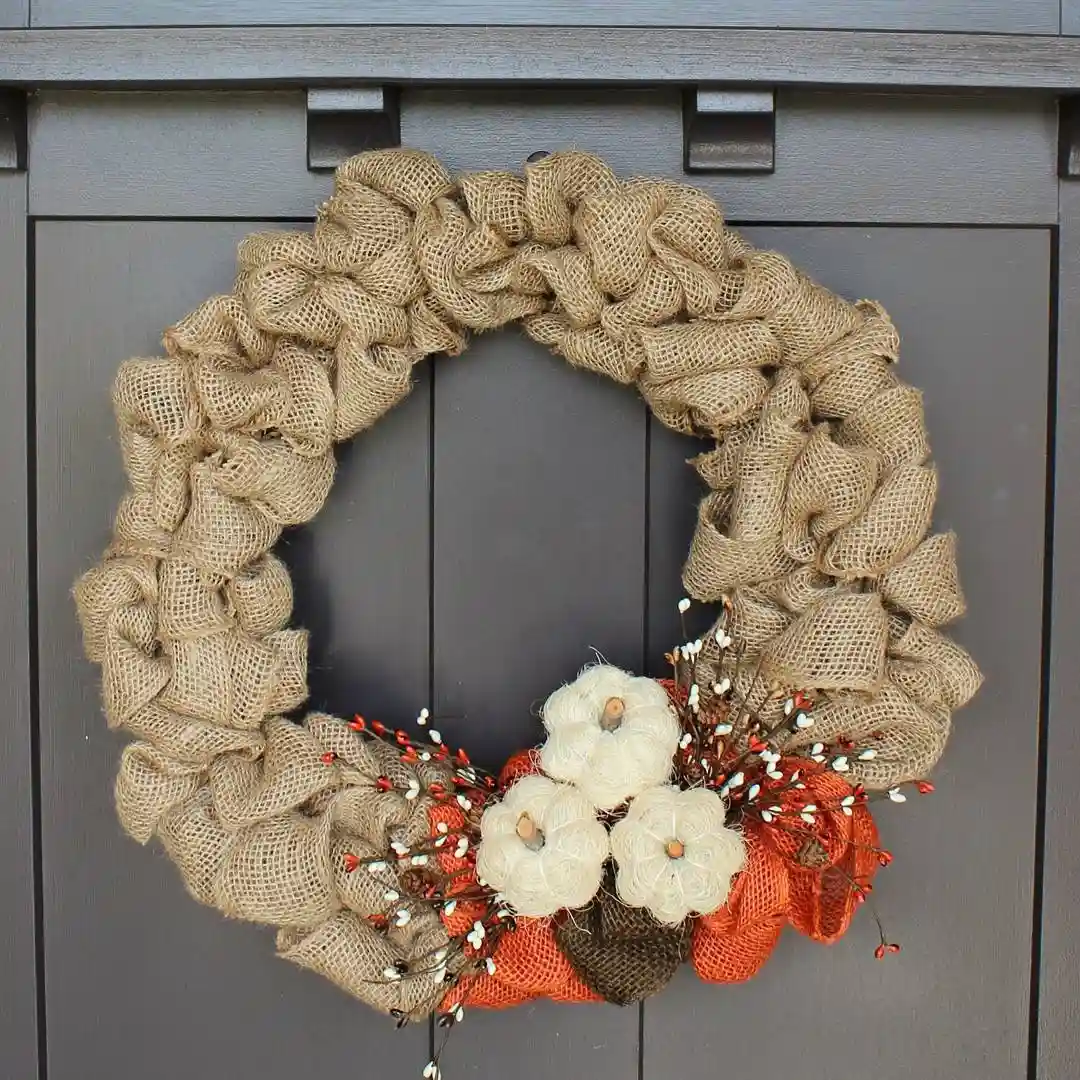
This one skips fresh or faux stems entirely and builds the whole base out of poufed burlap ribbon, gathered into loose bubbles until it reads as one full, textured ring.
A cluster of cream sola wood pumpkins and orange mesh sits low at the bottom as the only real accent.
Burlap-only wreaths like this are forgiving to make, since the fullness comes from how the ribbon is scrunched, not from precise floral placement.
A cordless drill with a floral pick attachment speeds up the bubbling, though it’s just as doable by hand over an evening.
Against a dark painted door, the tan burlap stands out clean and warm without needing any extra color.
Use wired burlap ribbon so the loops hold their poufed shape.
Keep the accent cluster small so the burlap stays the star.
Subscribe to DIY Craft Bloom
Get updates on the latest posts and more from DIY Craft Bloom straight to your inbox.
Unwired ribbon, it flops instead of holding a bubble.
Overcrowding the front with too many mixed accents.
5. A Jewel-Tone Rose Wreath on a Bare Vine Base
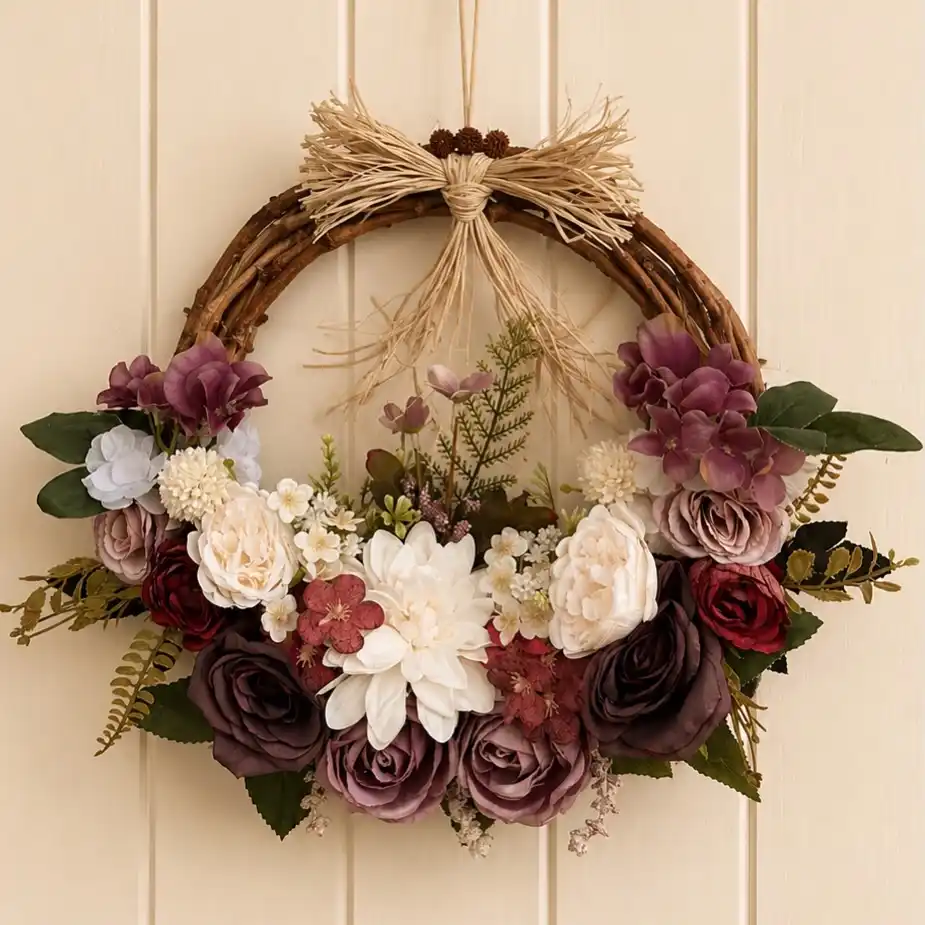
Deep plum, wine, and dusty mauve roses cluster along the bottom half of an exposed grapevine ring, with cream dahlias breaking up the darker tones and a loose raffia bow left undone at the top instead of tied tight.
Leaving so much of the grapevine bare is what gives this one a handmade, gathered look rather than a full store-bought wreath.
The floral cluster stays weighted low and to one side, which reads as more natural than a perfectly centered arrangement, and the raffia bow’s loose, frayed ends echo the wildness of the vine itself.
A jewel-tone palette like this works year round, not just in fall, so it’s a good pick if you want one wreath that doesn’t scream a single season.
6. A Full, Even Wreath of White Blooms and Green Foliage
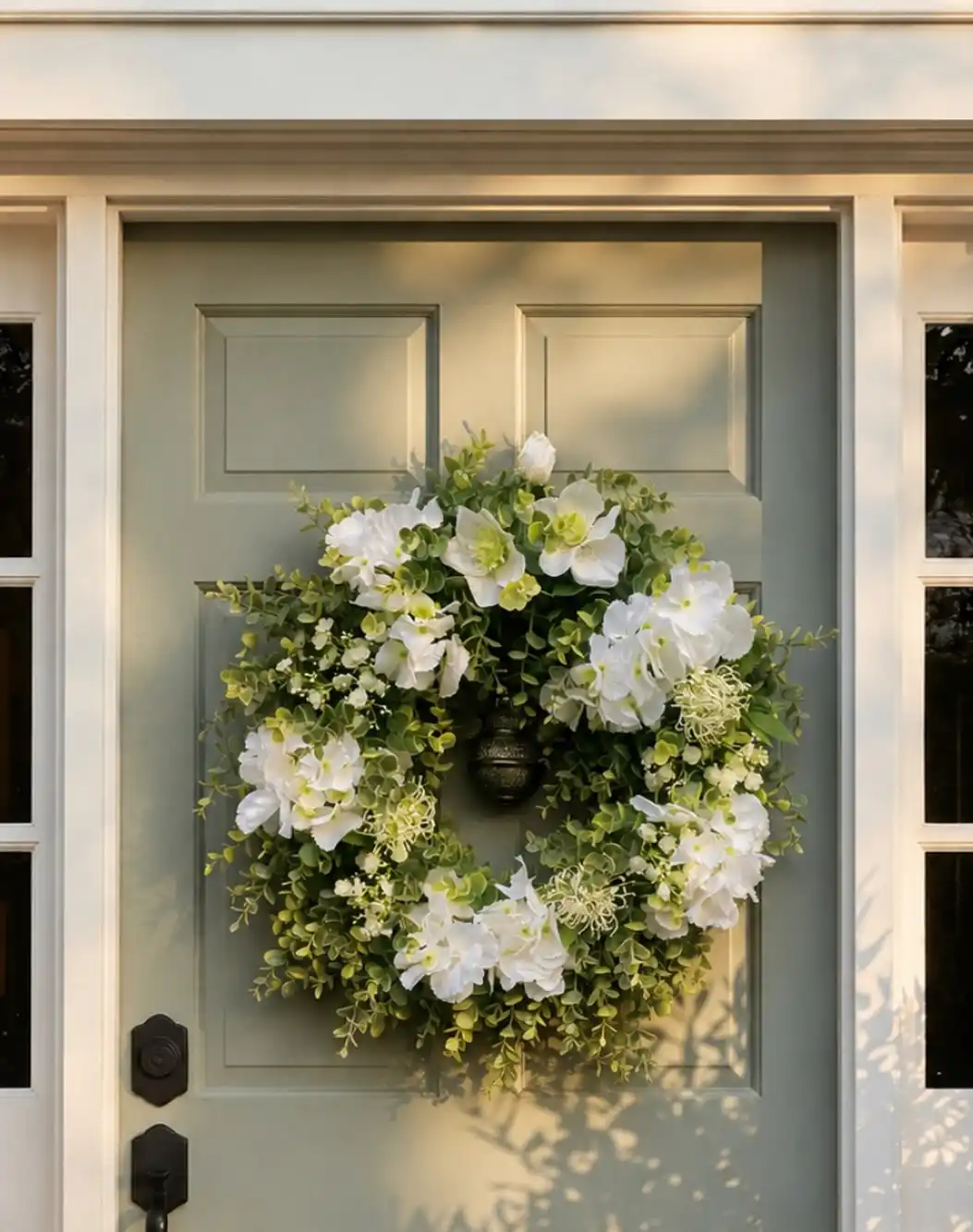
Unlike the loose, one-sided arrangements so far, this wreath keeps its shape tight and symmetrical, with soft eucalyptus greenery filling in evenly all the way around and white hellebores and hydrangea heads spaced out at regular intervals.
The even coverage is the point here. There’s no bare vine peeking through and no heavy cluster pulling to one side, so it reads as classic and put together against a sage green door in a way the wilder styles don’t.
Hydrangea heads add bulk and softness while the smaller white blooms fill gaps without crowding the greenery underneath.
7. A Mauve and White Pumpkin Wreath with a Long Trailing Ribbon
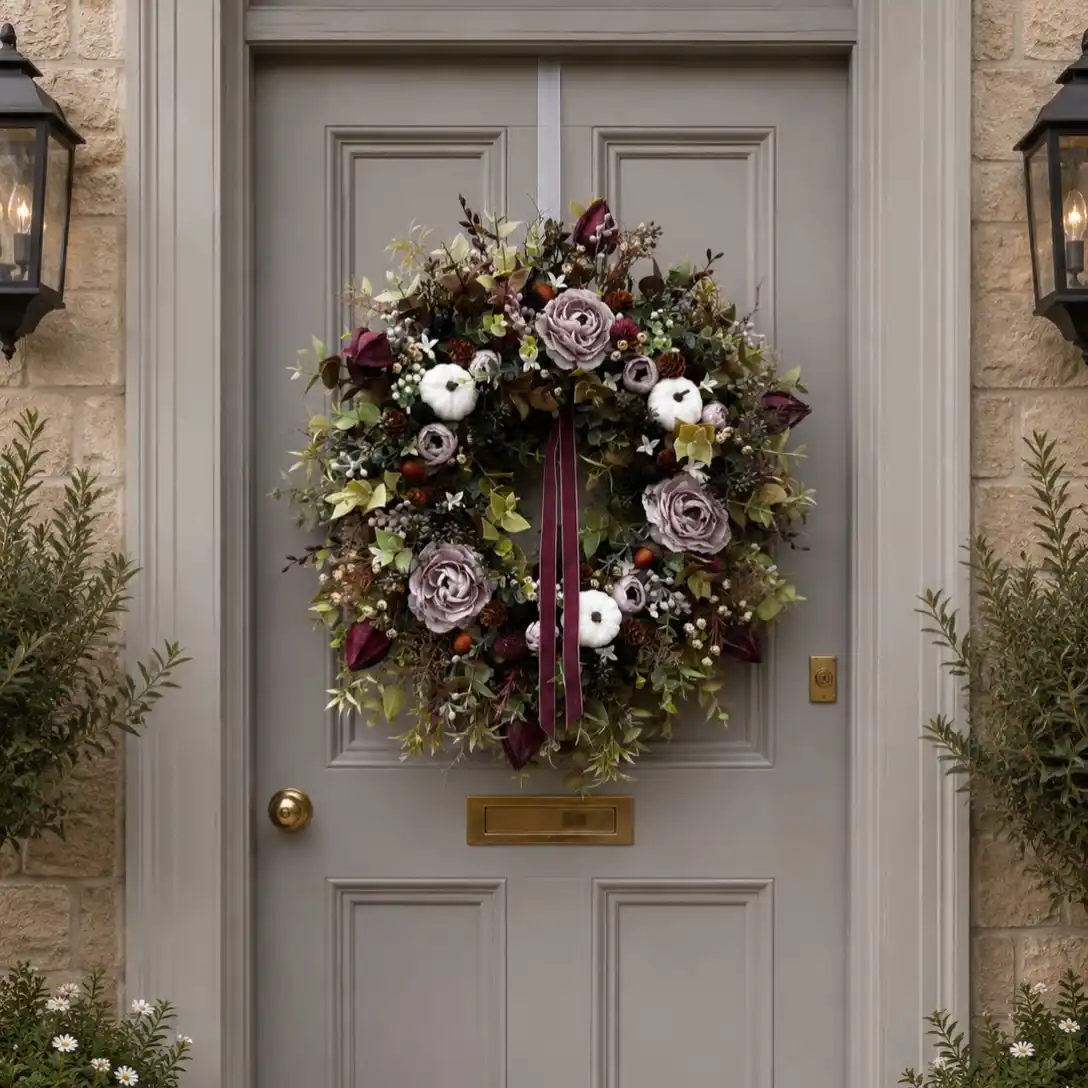
Dusty mauve roses and ranunculus mix with small white pumpkins, dark burgundy leaves, and loose eucalyptus, but what sets the whole look apart is the wide velvet ribbon left long enough to hang well past the wreath itself.
Trading a bow for one long ribbon drop changes the proportions of the whole door. It draws the eye downward, past the flowers and toward the mailbox and knob, so the wreath feels tied into the rest of the door instead of floating above it.
Against warm stone and a soft grey door, the wine-colored ribbon also pulls out the darker burgundy tones hiding in the greenery.
A long ribbon drop pulls the whole door together, not just the wreath.
8. A Bare Twig Wreath with Trailing Ivy and Hanging Metal Hearts
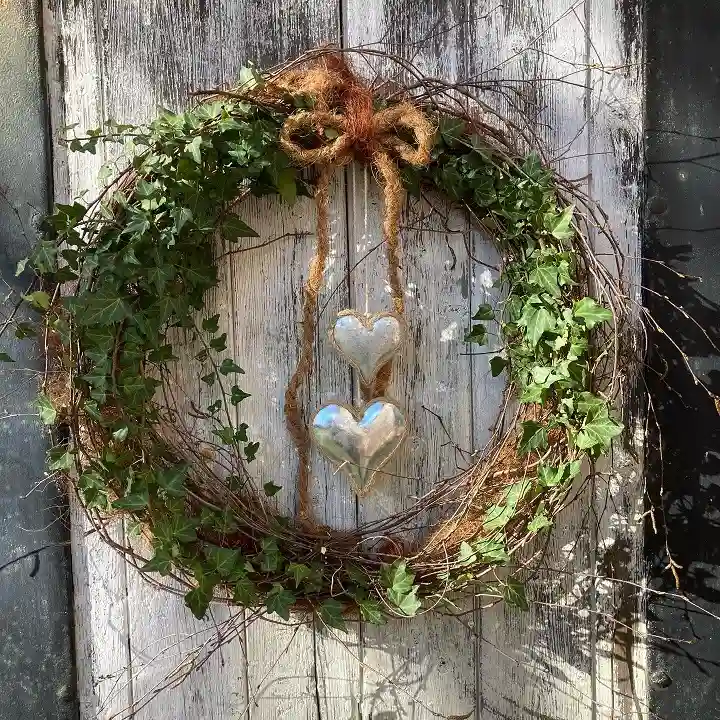
Green isn’t the main event on this one, the twisted twig base is left mostly exposed, with loose ivy trailing through only part of the ring and two galvanized metal hearts hung on jute twine down the center.
This is about as pared back as a farmhouse wreath gets, and that’s exactly what makes it feel at home on a weathered wood door.
The metal hearts add the only real focal point, dangling low enough to hang over the door’s own texture rather than getting lost against the wreath. A rough jute bow at the top keeps the whole thing from feeling too polished.
9. A Foliage-Heavy Wreath That Uses Flowers as the Accent, Not the Focus
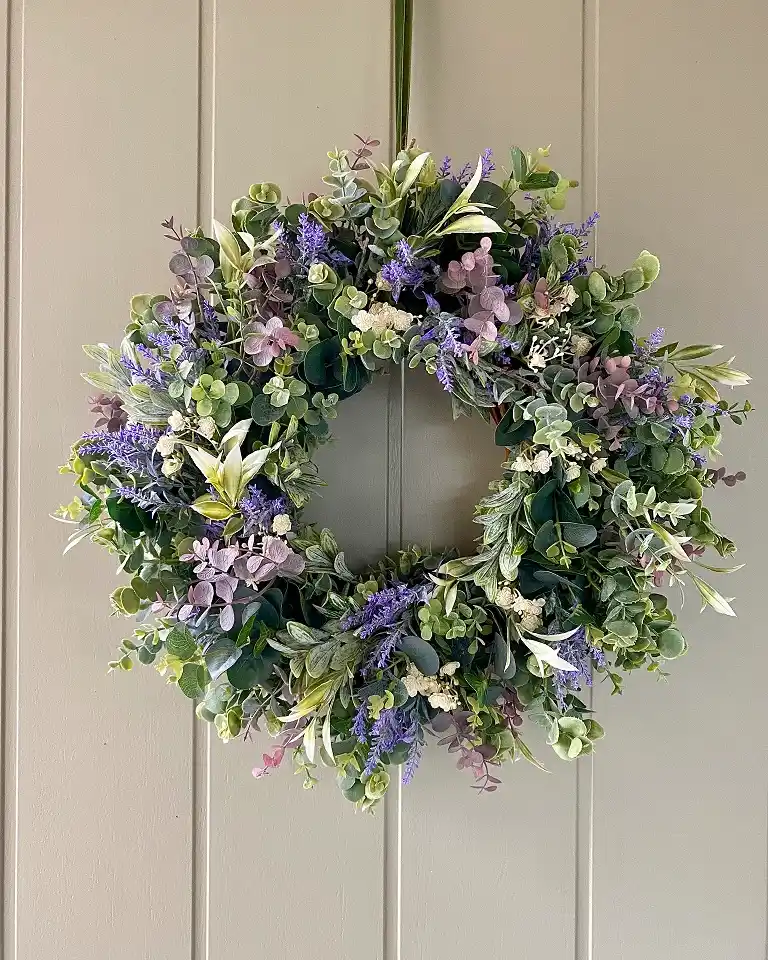
Eucalyptus, boxwood, and trailing greenery in five or six different leaf shapes make up most of this wreath, with lavender sprigs and a scattering of dusty pink blooms tucked in almost as an afterthought rather than the main draw.
Building green-first instead of flower-first is what gives this one such texture and depth.
The variety in leaf size and shade, from silvery eucalyptus to deep boxwood, does the visual heavy lifting, so the touches of lavender and pink read as a quiet finishing detail rather than the point of the whole thing.
It’s a style that holds up well against a neutral door, since the mixed greens already carry enough visual interest on their own.
10. A Buttery Yellow and Cream Rose Wreath on a Warm Wood Door
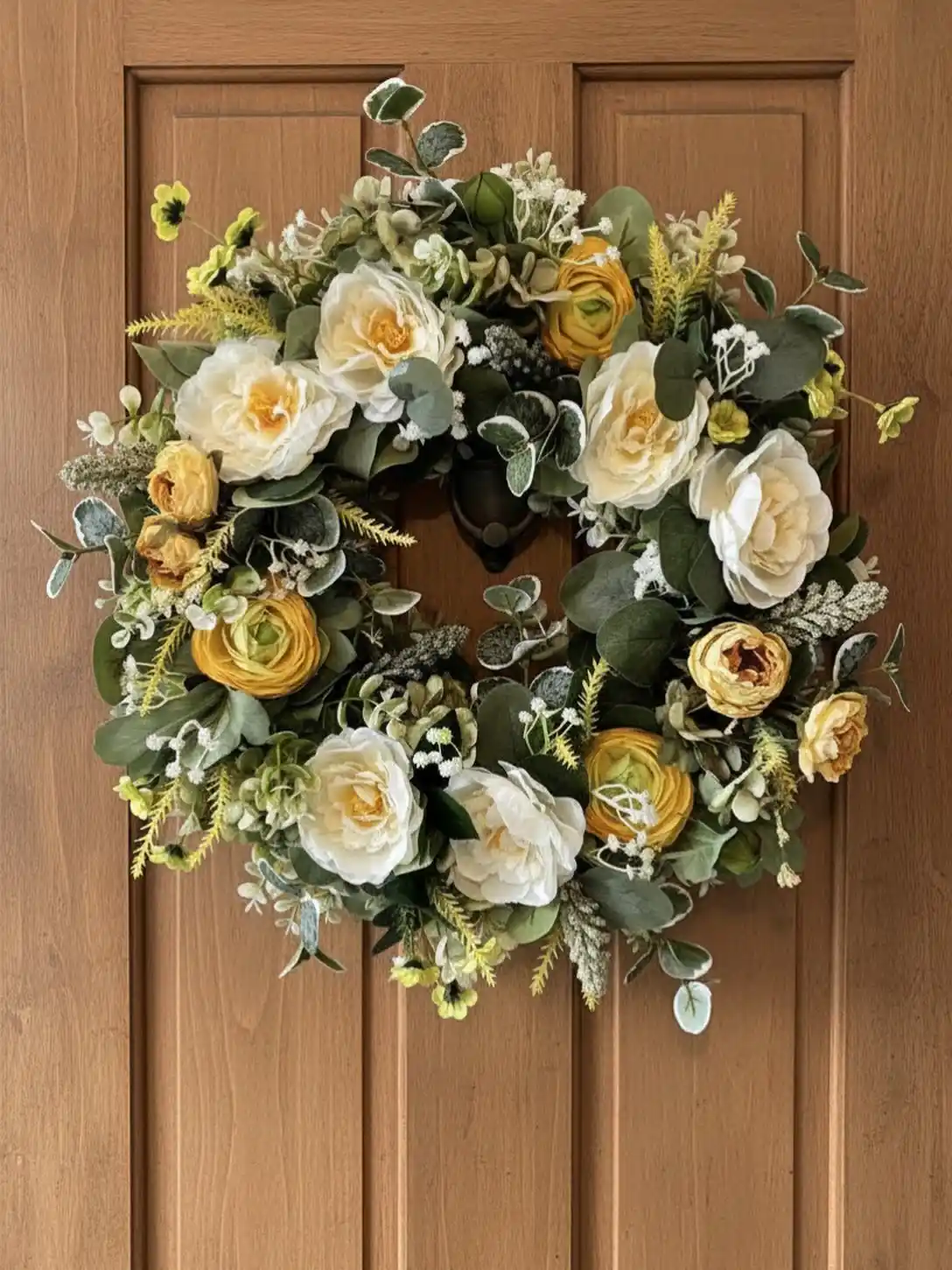
Ranunculus in warm mustard tones sit alongside full cream garden roses and frosted eucalyptus, with sprigs of yarrow and small green accents filling out the gaps.
It’s the warmest color story in the bunch so far, and it’s built to match rather than contrast with the honey-toned wood door behind it.
Pairing a yellow-and-cream palette with a wood door like this only works because the tones stay close instead of clashing, the wreath reads as an extension of the door’s warmth rather than something layered on top of it.
Frosted, silvery eucalyptus leaves are doing quiet work here too, cooling the palette down just enough that it doesn’t tip into overly sweet.
11. A Boho Wreath That Mixes Bright Pink with Muted Dried Grasses
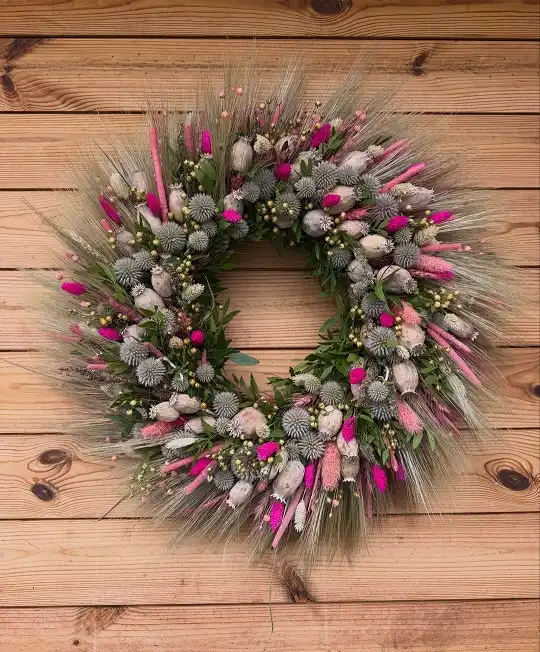
Hot pink protea and thistle-like blooms punch through a wreath built mostly from soft grey-green dried grasses and wispy plumes, with tiny yellow buds scattered in for a bit of extra brightness.
The trick with this one is restraint on the bright color. Pink is the loudest thing here, but it only shows up in small clusters against a much larger neutral base, so it reads as boho and playful instead of overwhelming.
Set against a warm wood plank door, the mix of textures, spiky, feathery, and fuzzy all at once, keeps the eye moving around the whole ring instead of stopping in one spot.
| Neutral base | Pink accents |
|---|---|
| Dried grasses and grey-green plumes | Hot pink protea clusters |
| Covers most of the ring | Scattered, not clustered in one spot |
| Keeps the look grounded | Adds the playful, boho punch |
12. A Layered Green Wreath with Ferns, Eucalyptus, and Tiny White Sprays
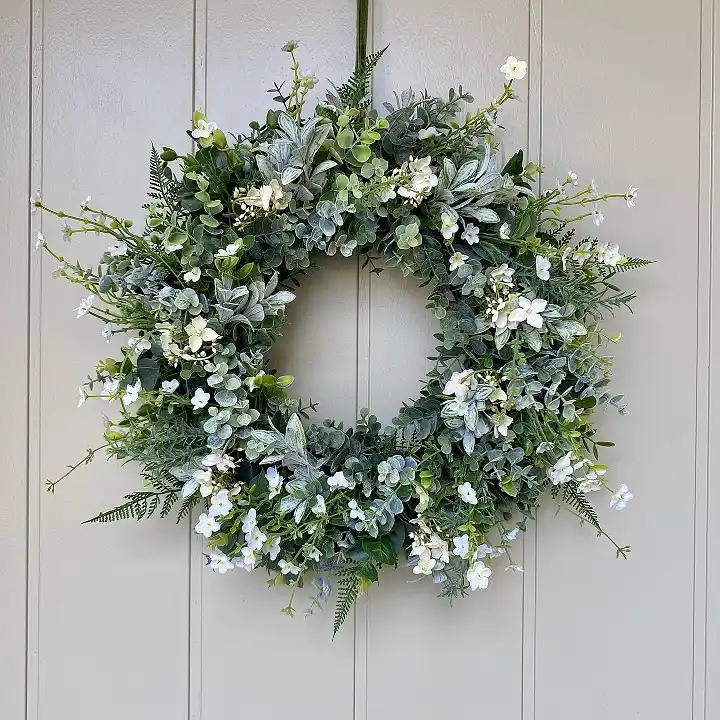
Delicate ferns curl out past the edges of this one, mixed with frosted eucalyptus, small leafy stems, and loose sprays of tiny white blossoms scattered rather than clustered.
Nothing here reads as a single focal flower, the whole wreath is built from layered greenery instead.
Against a pale grey-green door, the effect is soft and almost wild, like something gathered from a garden edge rather than arranged for a wreath.
Subscribe to DIY Craft Bloom
Get updates on the latest posts and more from DIY Craft Bloom straight to your inbox.
The mix of leaf shapes, fern fronds, rounded eucalyptus, small serrated leaves, gives it depth without needing a single bold bloom to anchor it, and the wispy white sprays that escape the main shape keep it from looking too tidy.
13. A Wooden Snowflake Wreath Piled with Plaid Ribbon Bows
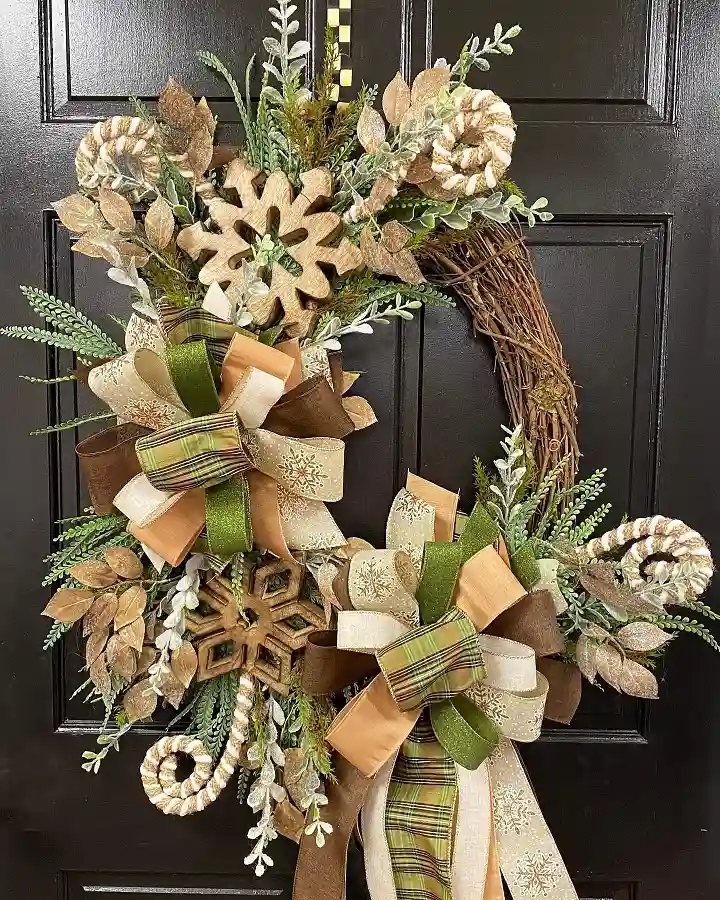
This one turns the ribbon into the main event. Layered bows in olive, tan, ivory, and plaid cascade down one side of a grapevine base, with wooden cutout snowflakes tucked between them and curled paper ribbon standing in for greenery accents.
The arrangement stays deliberately lopsided, heavy on one side and nearly bare on the other, which is what gives the ribbon room to cascade instead of bunching up.
Stacking three or four bows in different widths and patterns is what makes it read as layered and gift-wrapped rather than like one bow was just tied on.
This style reads more winter farmhouse than any wreath so far, and it holds up especially well against a dark painted door, where the tan and olive tones stand out clean against the black.
14. A Foraged-Look Wreath with Blue Thistle and Dark Berry Clusters
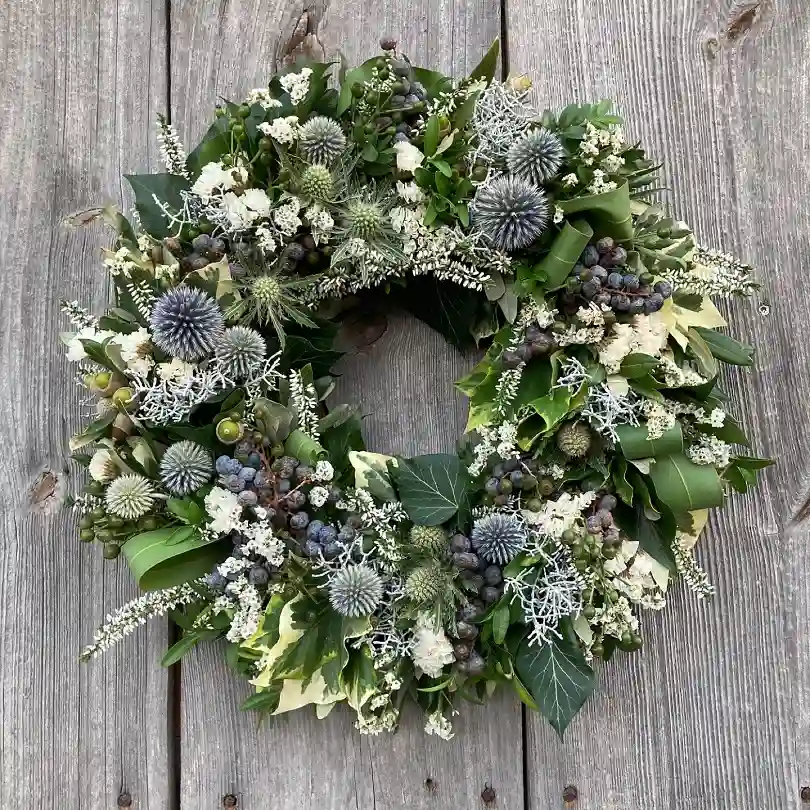
Broad ivy leaves and variegated foliage form the base of this one, but the real draw is the smoky blue thistle spheres and clusters of dark, almost black berries scattered throughout, alongside sprays of small white blossoms that read almost like frost.
Nothing about this wreath looks purchased. The mix of leaf shapes, some glossy, some matte, some edged in cream, plus the unusual blue-grey thistle balls, makes it feel like it was cut straight from a hedgerow.
Against a weathered wood plank door, the muted palette of green, silver-blue, and near-black berries blends right into the grain instead of standing apart from it.
If you’re using real ivy and berries, keep this one out of reach of pets and small kids, since several common berry varieties used in foraged-style wreaths aren’t safe to eat.
15. A Woven Willow Wreath Left Bare on One Full Side
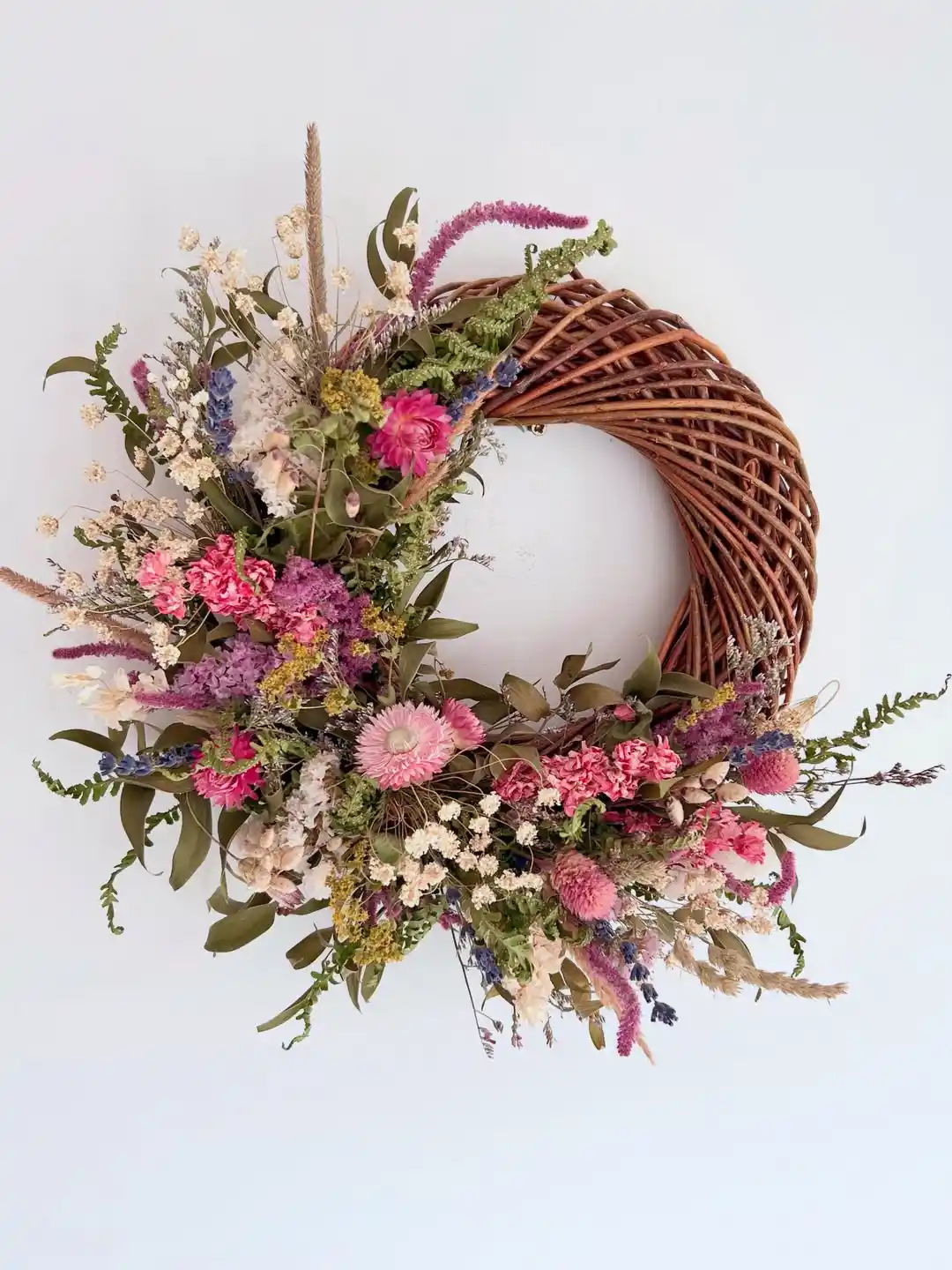
A tightly woven willow base takes up nearly half this wreath with nothing added at all, while pink strawflower, purple statice, and dried grasses pile into a dense, wild cluster along the other side and bottom.
This is the most extreme version of the bare-base look in the roundup so far, closer to fifty-fifty than the others that just leave a small gap at the top.
The visible willow weave adds its own texture and warmth, so it isn’t wasted space, it’s doing as much visual work as the florals themselves.
Dried strawflower holds its shape and color far longer than fresh blooms would, which makes this style especially practical for a wreath meant to last through a whole season.
Woven willow left completely bare, no filler or greenery.
Dense strawflower, statice, and dried grasses piled in.
16. A Loose, Uneven Wreath Built from Berries, Mistletoe, and Boxwood
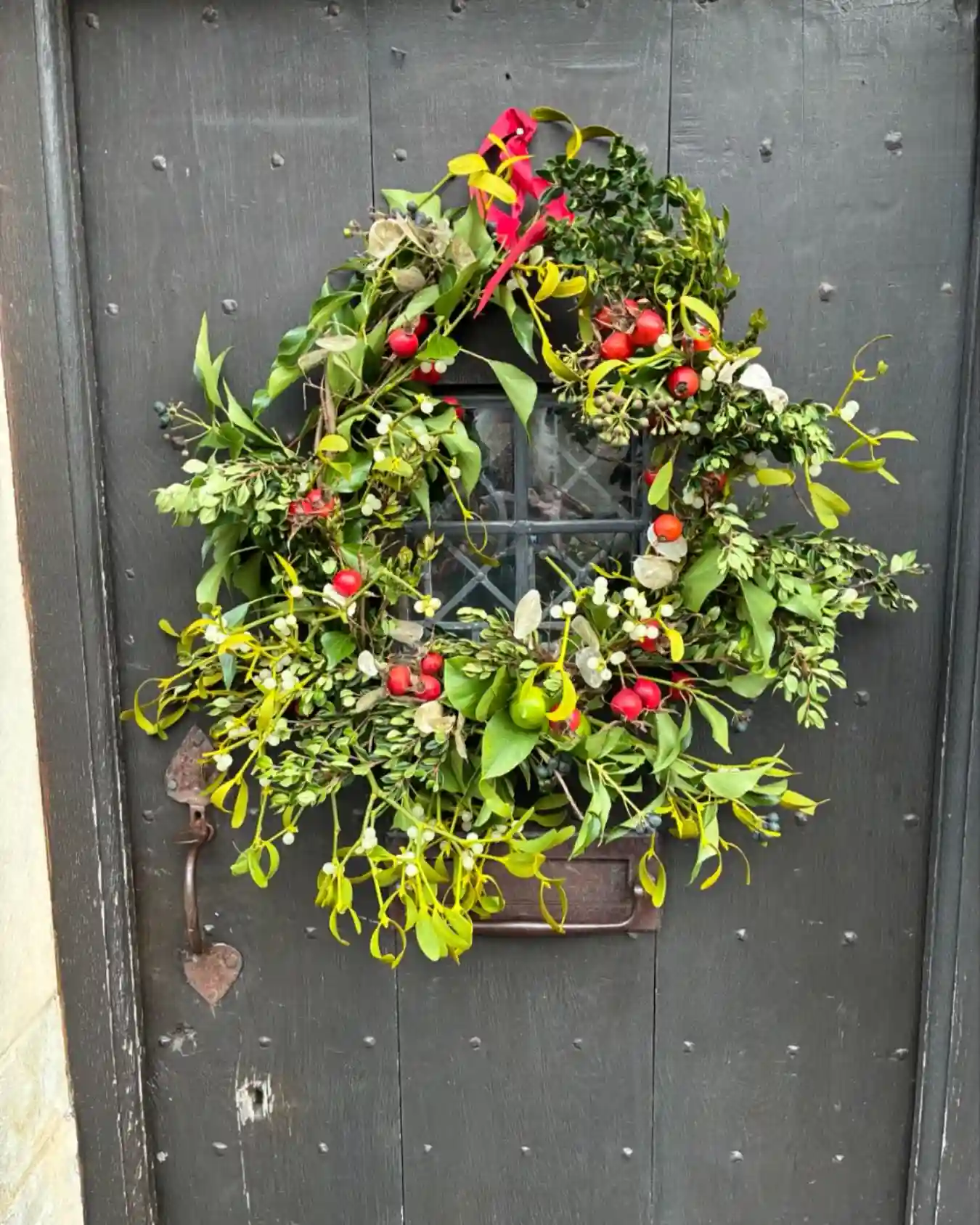
Sprigs of mistletoe with pale round berries hang loose past the edges here, tangled in with glossy boxwood, small trailing vines, and clusters of bright red rosehips that add the only real pop of color against all the green.
Nothing sits in a neat line on this one. The mistletoe trails down well past the bottom of the wreath, and the shape overall leans irregular, wider at the bottom, narrower at the top, more like something gathered from hedgerow cuttings than built on a symmetrical form.
A small red ribbon tucked at the top is the only nod to a finished touch, everything else is left to fall where it wants.
17. A Full, Symmetrical Wreath Built Entirely from Dried Botanicals
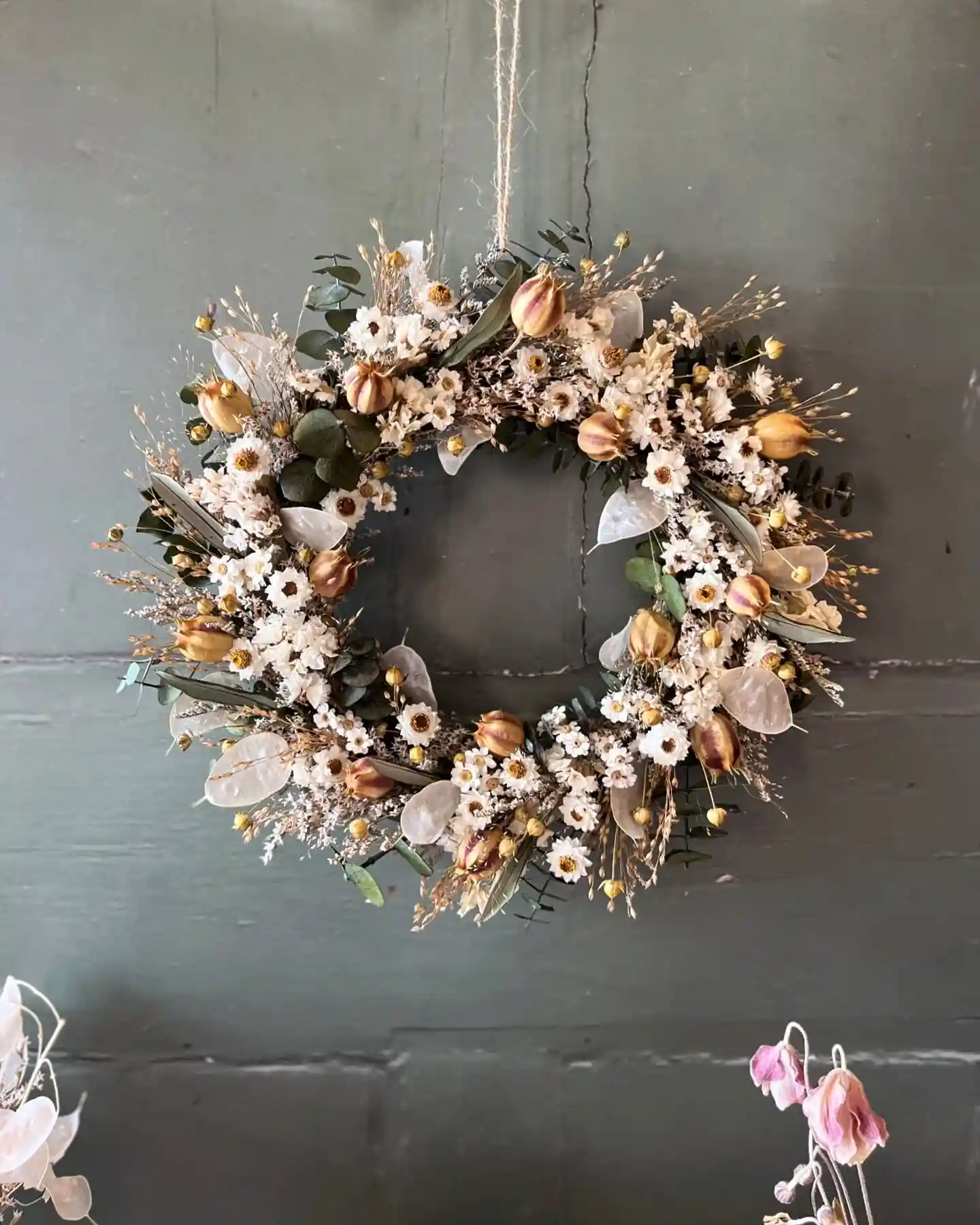
Tiny white daisy-like blooms, papery lunaria pods, and small poppy seed heads in warm rust and blush tones fill this wreath edge to edge, with silvery eucalyptus and delicate dried grasses woven through as the connective texture.
The symmetry sets it apart from the looser, one-sided styles earlier in this list. Every section carries roughly the same density of blooms and greenery, so it reads as polished and gallery-worthy rather than foraged.
Warm rust poppy pods against the cool grey-green door keep the palette from feeling flat, and because everything here is already dried, this is one wreath that will genuinely last a full season without wilting or fading much at all.
No bare patches or heavy clusters, blooms are spread edge to edge.
Rust poppy pods against silvery eucalyptus keep it from reading flat.
Fully dried materials hold their color and shape through a whole season.
18. A Wreath Made Entirely from Sliced Wood Rounds
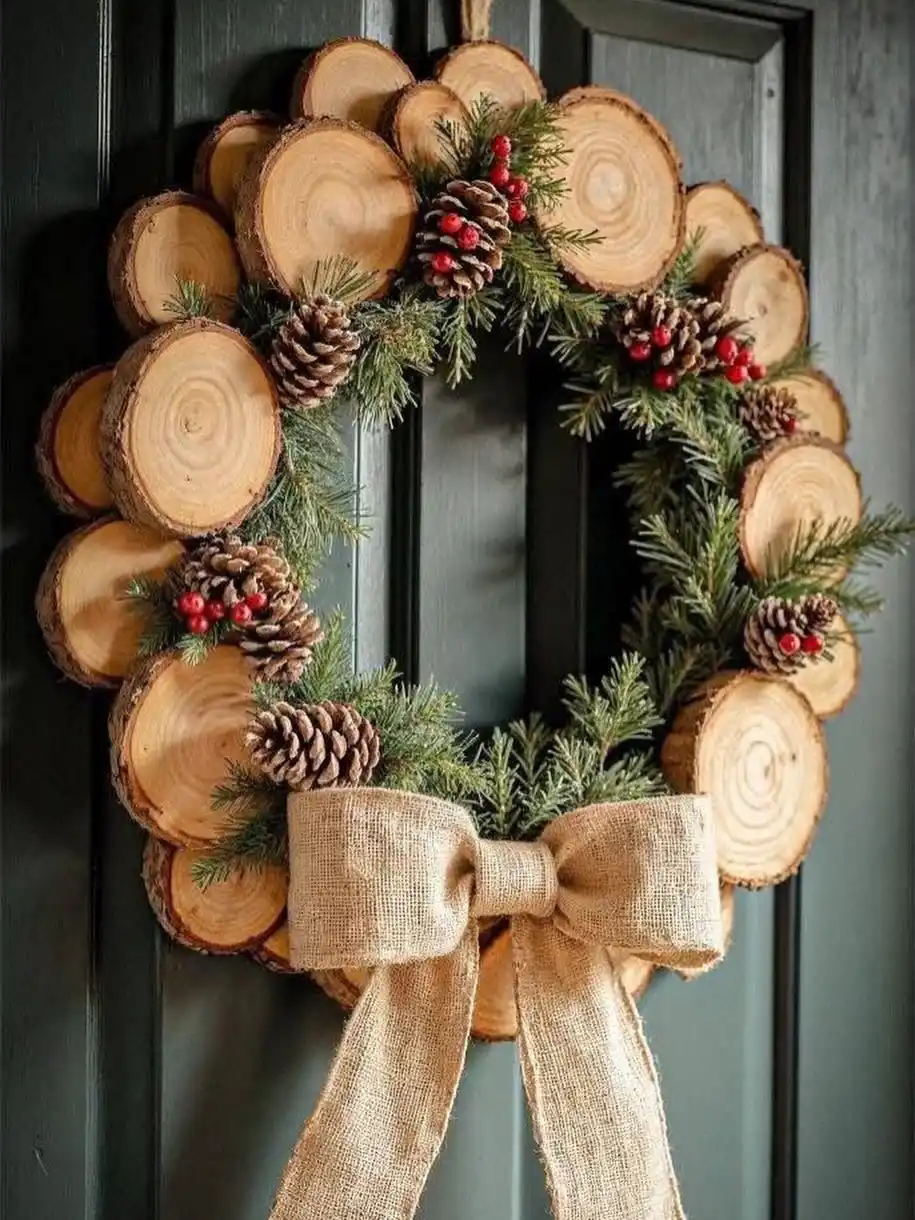
Small cross-cut wood slices, bark still on the edges, ring the whole base here instead of any greenery or vine, with pinecones, sprigs of pine, and clusters of red berries tucked into the gaps and a wide burlap bow anchoring the bottom.
This is the one true rule-breaker in the roundup, no florals, no fabric petals, just raw wood grain doing all the visual work.
The uneven sizing of the slices, some wider, some smaller, keeps it from looking machine-made, and the warm honey tone of the wood against a slate green door gives it a cabin-like feel that leans more rustic than farmhouse-pretty.
The burlap bow pulls in the only soft texture on the whole wreath, which is exactly why it works as the finishing touch.
conclusion
The wreaths that stand out most on this list aren’t the fullest ones, they’re the ones with a clear point of view, whether that’s a bare half of vine, a single long ribbon drop, or nothing but wood grain and pinecones.
Pick the one that actually fits your door’s color and your own patience for upkeep, and don’t be afraid to leave some of the base showing on purpose.
Save this for the next time you want fresh farmhouse wreath ideas for your front door.