18 Emotions Crafts for Kids That Make Big Feelings Easier to Talk About

Ask a four year old how they feel and you will probably get “fine,” “bad,” or a shrug. It is not that they feel very little. They feel a lot. They just do not have the words yet, and plenty of bedtime meltdowns are really feelings that never got a name.
That is where emotions crafts for kids earn their spot on the craft table. When a child bends a pipe cleaner mouth into a frown or picks the yellow rice monster for happy, they are practicing something hard in a way that feels like play. Their hands do the talking first. The words come later.
The 18 ideas below come from parents and teachers who make these with real kids.
You will find handprint faces and craft stick monsters, a paper plate wheel with a spinning arrow, sensory trays built around The Colour Monster, matching boards for toddlers, and self-love projects for older kids who need a reminder of what is good inside them.
Most use paper, bottle caps, clay, or pasta you already have at home. Pick one that fits your child’s age and mood, and start there.
How to Turn Any Feelings Craft Into a Real Conversation
The craft is only half the lesson. The other half happens in the small talk while the glue dries and the paint ends up everywhere. A few simple habits make that talk count.
- Make it on a calm day. Kids learn feeling words best when they are not in the middle of a big one. Practice now, and the words are ready when the hard moment comes.
- Name your own feelings out loud. Saying “I felt worried when we were running late” shows kids that grown ups have feelings too, and that naming them is normal.
- Ask “How can you tell?” When your child labels a face, ask what gave it away. The eyebrows, the mouth, a tear. This builds the habit of really looking at faces.
- Keep the finished craft in sight. A feelings wheel on the fridge gets used every day. One tucked in a drawer gets forgotten.
- Accept every answer. If your child says the angry monster looks happy, ask why. Their reason often tells you more than the right answer would.
1. Sweetheart Self-Love Board With Six Fill-In Hearts
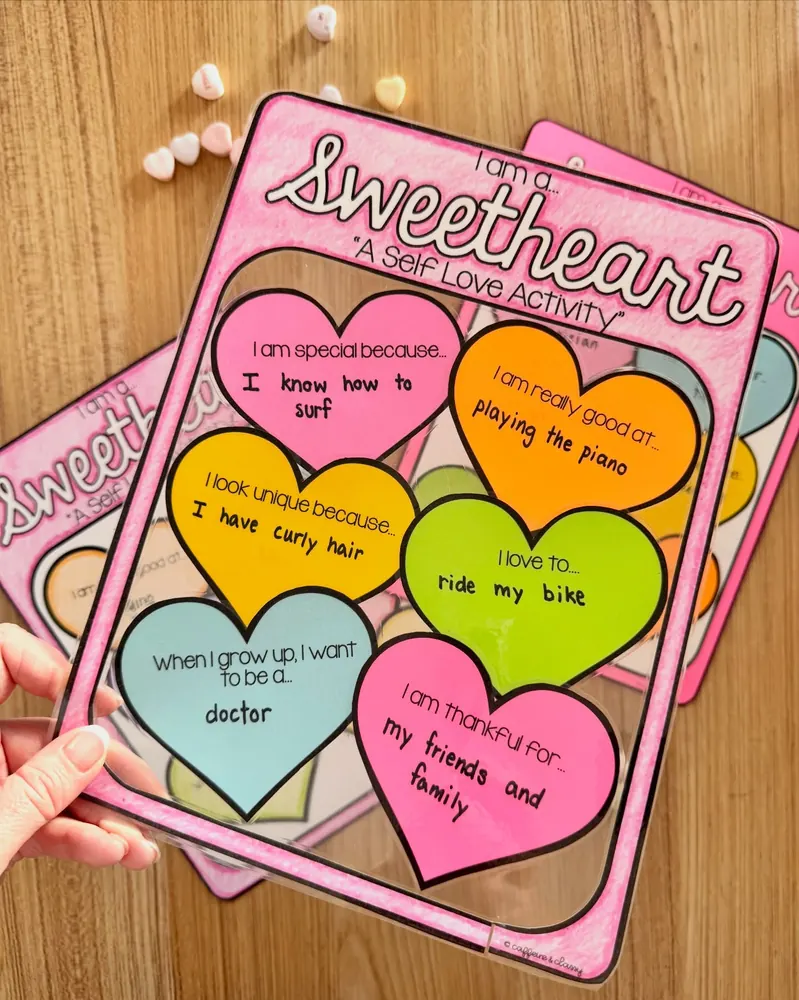
Some kids freeze when you ask, “What do you like about yourself?” This board gets around that by handing them the first half of the sentence.
Six colored hearts sit inside a pink frame, and each one holds a starter like “I am special because…” or “I am thankful for…” The child only has to finish the line.
On this board, one kid wrote that they know how to surf, love to ride a bike, and want to be a doctor someday. Small, real answers like that are the whole point.
- Cover the board or slip it in a sheet protector, then write with a dry erase marker so answers can change as your child grows.
- Read the hearts out loud together. Hearing their own words builds a quiet kind of pride.
- Scatter a few candy hearts on the table like the photo does. It makes the activity feel like a treat, not a worksheet.
2. Build-a-Face Feelings Station on an Art Easel Roll

Here is a setup that turns a plain paper roll into a feelings game. A blank face sits in the middle with a loose pile of eyes, brows, mouths, and little tear shapes beside it. Above it, five picture cards show sad, surprised, shy, grumpy, and happy.
What makes it work is the empty face. With nothing drawn on it, your child has to decide how the eyebrows tilt and which way the mouth curves. That small choice is real thinking about what a feeling looks like.
The handwritten “How do you feel?” on the paper matters too. It quietly turns a matching game into a question about them.
Your child chooses one feeling card and says the word out loud.
They copy it with the loose pieces. Start with brows and mouth, since those change the most between feelings.
Now you build a face in secret and let your child guess the feeling.
3. Sunshine of Kind Words With Bandage-Shaped Rays
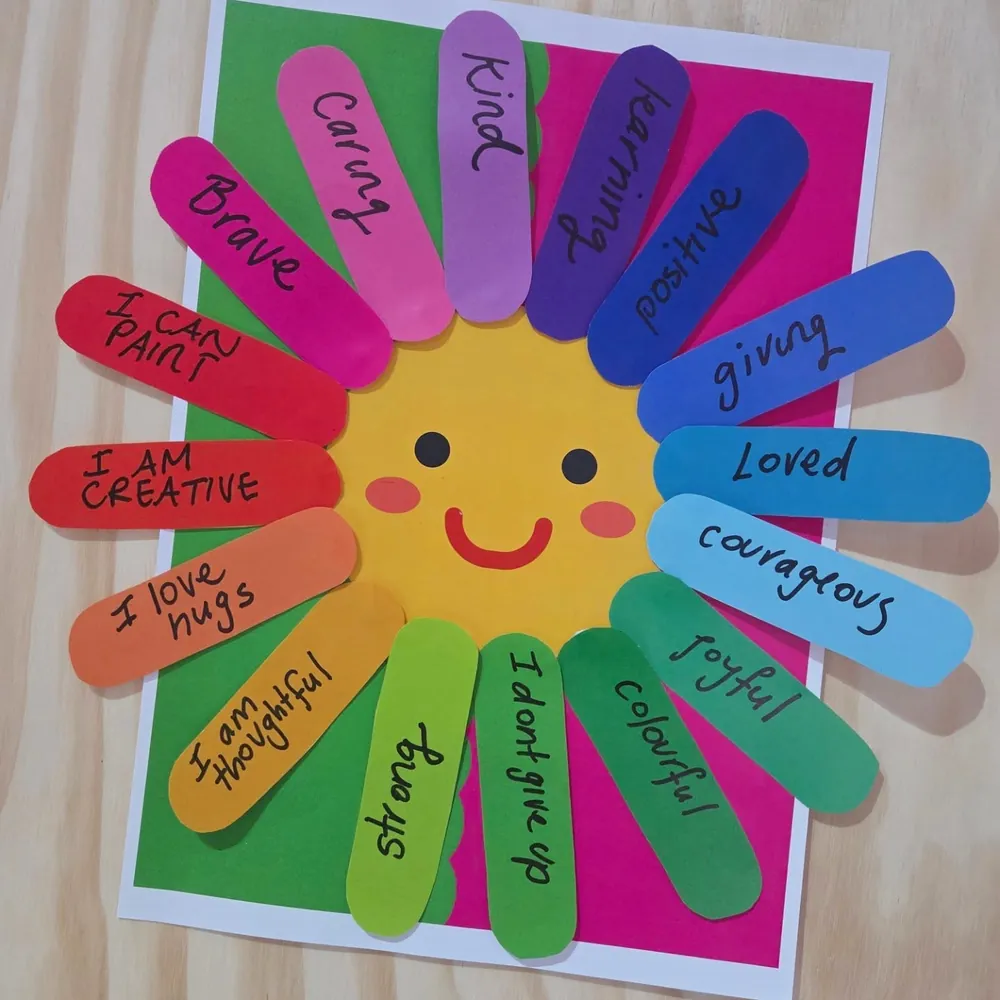
Every ray on this sun carries a word worth keeping.
Bright paper strips fan out around a smiling yellow face, each one marked with something like brave, loved, joyful, or “I don’t give up.” The strips have rounded ends, so they look a lot like bandages.
That fits nicely, since kind words can help a rough day heal a little. The rays also run in rainbow order around the circle, which makes the whole thing look finished even when small hands cut a bit crooked.
Let kids write their own words, wobbly spelling and all. “I love hugs” and “I can paint” in their own handwriting mean more than any printed list.
4. Clay Monster Faces Framed as a Feelings Family
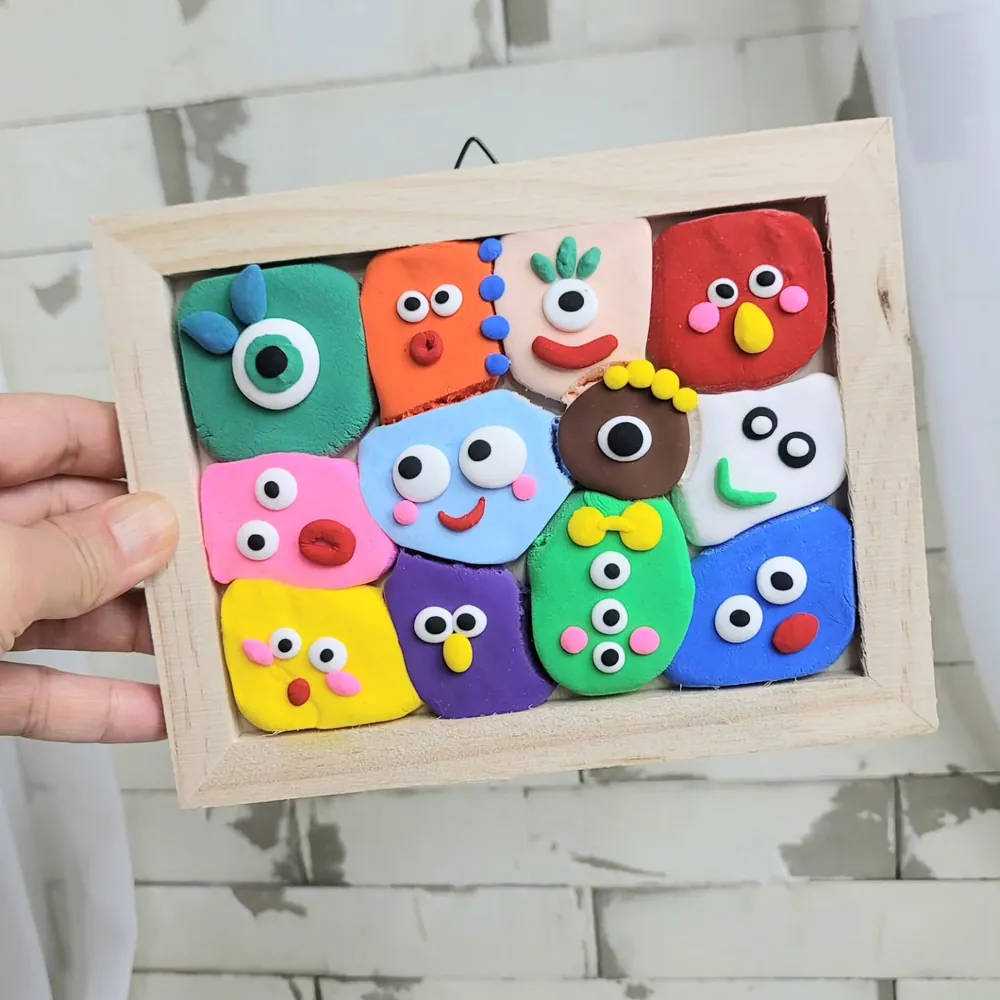
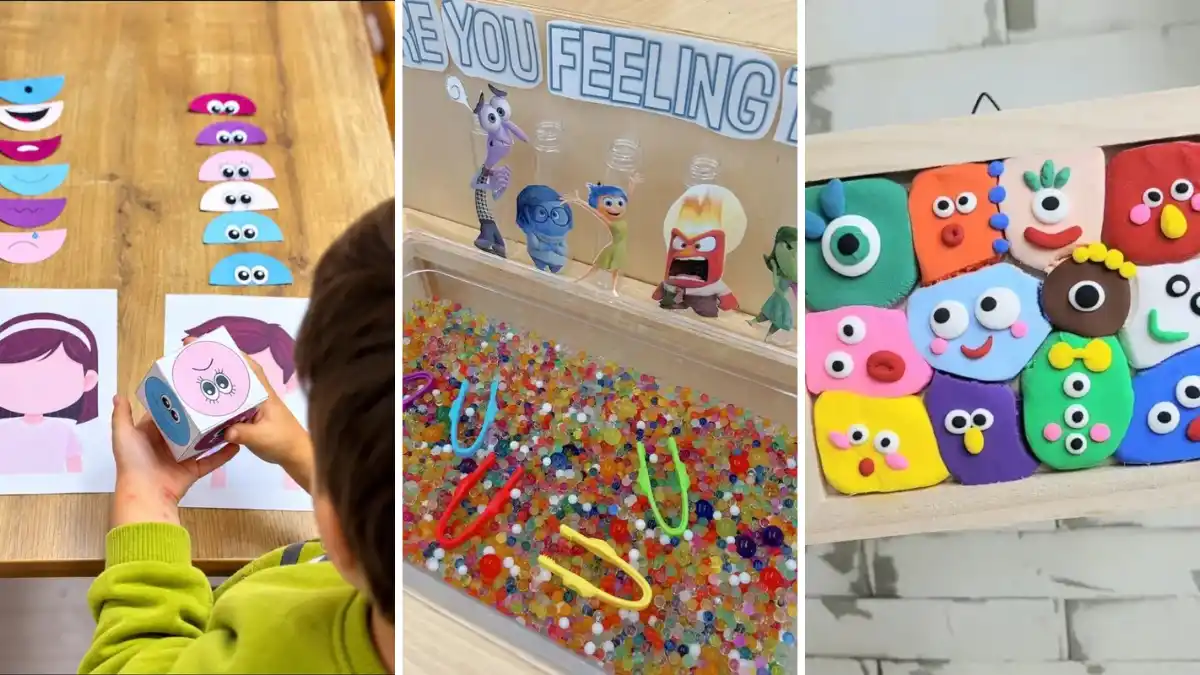
Twelve squishy clay monsters fill a small wooden frame, each with its own odd face. One has three eyes stacked up. One has a beak. Another has big pouty red lips.
None of them are labeled, and that is the fun part. Hand the finished frame to your child and ask:
- Which monster looks grumpy today?
- Who seems surprised? How can you tell?
- Which one feels most like you right now?
Kids read feelings into the tiniest details, like a small mouth or eyes set far apart. Let them be the expert here. There is no wrong answer, only a reason.
5. Colour Monster Rice Tray for Matching Feelings to Colors

Colored rice gets pressed into monster shapes on a big tray, each with oversized googly eyes and a simple drawn mouth.
Picture cards sit between them so kids can match every monster to its feeling word, and “emotions” is spelled out in white circles across the top.
It is based on the picture book The Colour Monster, where each feeling has its own color. Read the book first, then set this up:
- Dye rice in a few colors and let it dry fully.
- Shape each monster right on the tray with your fingers.
- Add the eyes and lay the feeling cards nearby.
Then let your child find the right card for each monster. Rice travels, so a sheet under the tray will save your floor.
| Color | Feeling | Ask your child |
|---|---|---|
| Yellow | Happy | What made you smile today? |
| Blue | Sad | What would help right now? |
| Red | Angry | Where do you feel it in your body? |
| Black | Afraid | What feels scary to you? |
| Green | Calm | Where do you feel most calm? |
| Pink | Loved | Who makes you feel loved? |
| Rainbow | Confused | Are you feeling two things at once? |
6. Inside Out Feelings Sorting Bin With Colorful Tongs
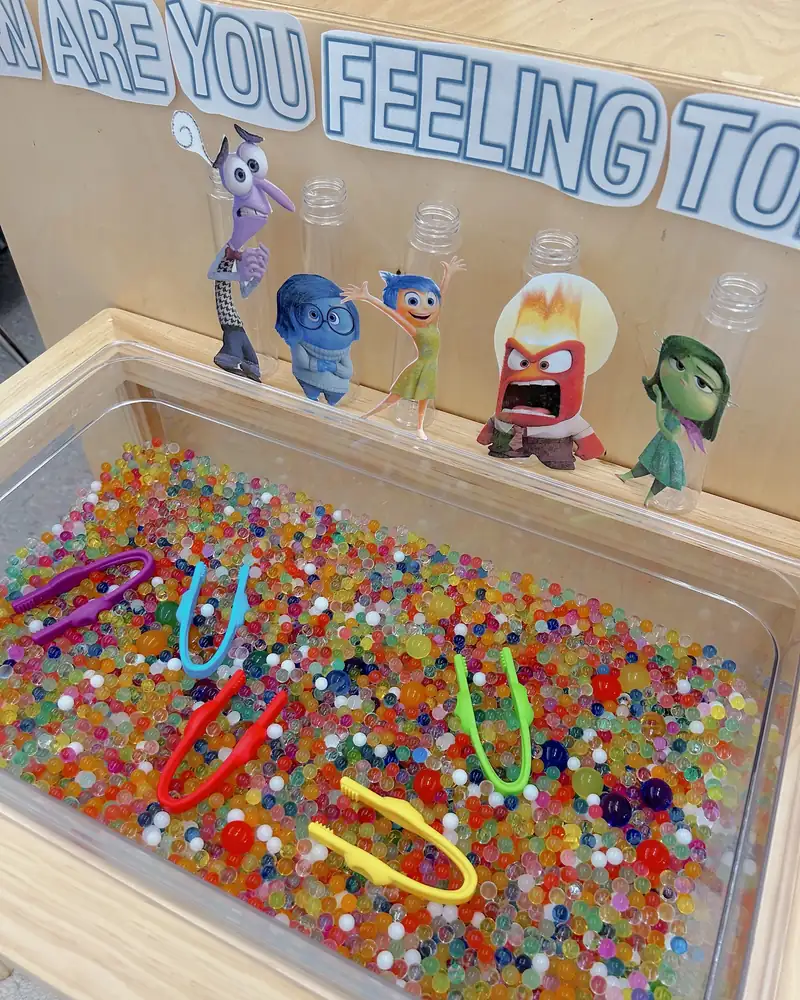
A clear bin full of tiny colored beads sits under a sign asking how you are feeling today. Behind it, five empty plastic tubes each wear a cutout of a character from the movie Inside Out: Fear, Sadness, Joy, Anger, and Disgust.
Kids grab a pair of bright tongs and drop beads into the tube that matches their mood. Purple for fear, blue for sad, yellow for joy, red for anger, green for disgust.
The tongs slow everything down, and that pause is useful. It gives a child a few extra seconds to think about the feeling while their hands stay busy.
Subscribe to DIY Craft Bloom
Get updates on the latest posts and more from DIY Craft Bloom straight to your inbox.
Leave the tubes up all week and they turn into a little chart. A tube that fills faster than the rest is worth a gentle chat.
The beads in this bin look like water beads. They swell up and are a serious danger if a child swallows one, and U.S. safety officials have warned parents about them. Fill your bin with dyed rice or big pom poms instead. The sorting game works exactly the same.
7. Craft Stick Monster Faces That Show How Feelings Look
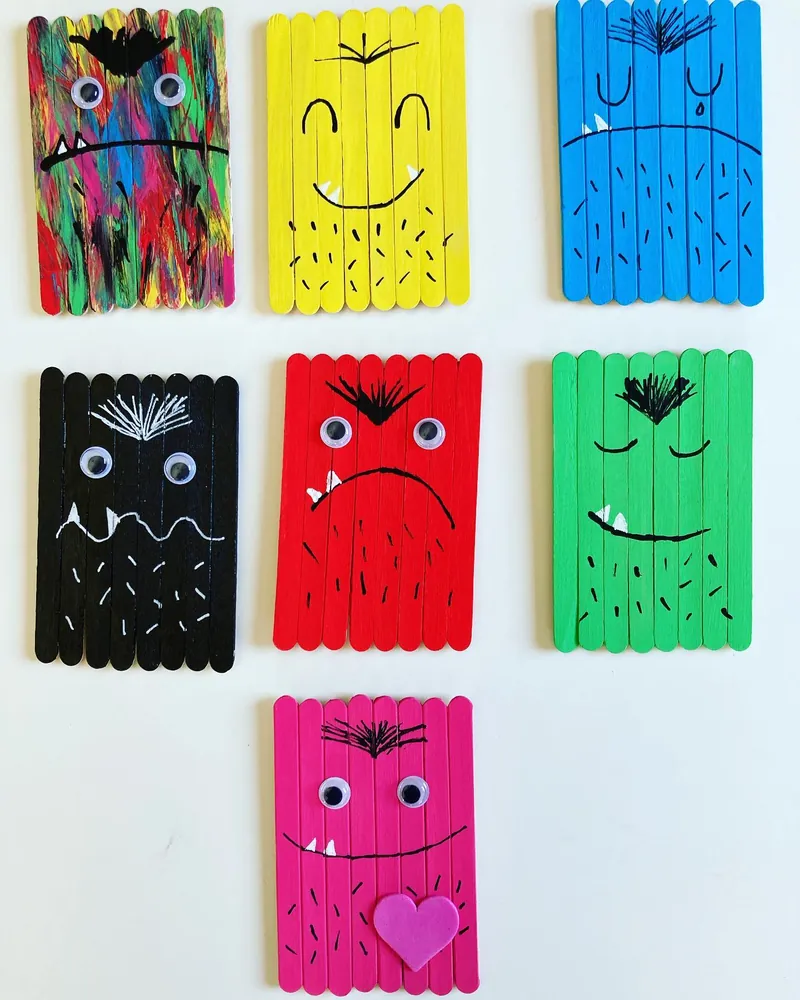
Seven little faces, each made from craft sticks glued side by side and painted one bold color. The rainbow swirl one looks mixed up. The blue one has a single tear. The pink one wears a foam heart on its chest.
Look closely and you will spot two kinds of eyes:
- Googly eyes on the mixed up, scared, angry, and loving faces. They are quick to add and kids love how silly they look.
- Drawn eyes on the happy, sad, and calm faces. Drawing lets kids show eyes squeezed shut, smiling, or crying, which googly eyes cannot do.
Offer both and let your child choose for each feeling. Deciding which eyes fit is a small lesson in how faces change.
Pointed down toward the nose looks angry. Spiky and raised looks scared. Kids can test both on their own face.
A frown, a wavy line, a wide grin. The mouth is usually the first clue kids notice.
A tear, a heart, tiny white fangs. One detail is enough to make the feeling clear.
8. Handprint Feelings Friends With Pom Pom Cheeks
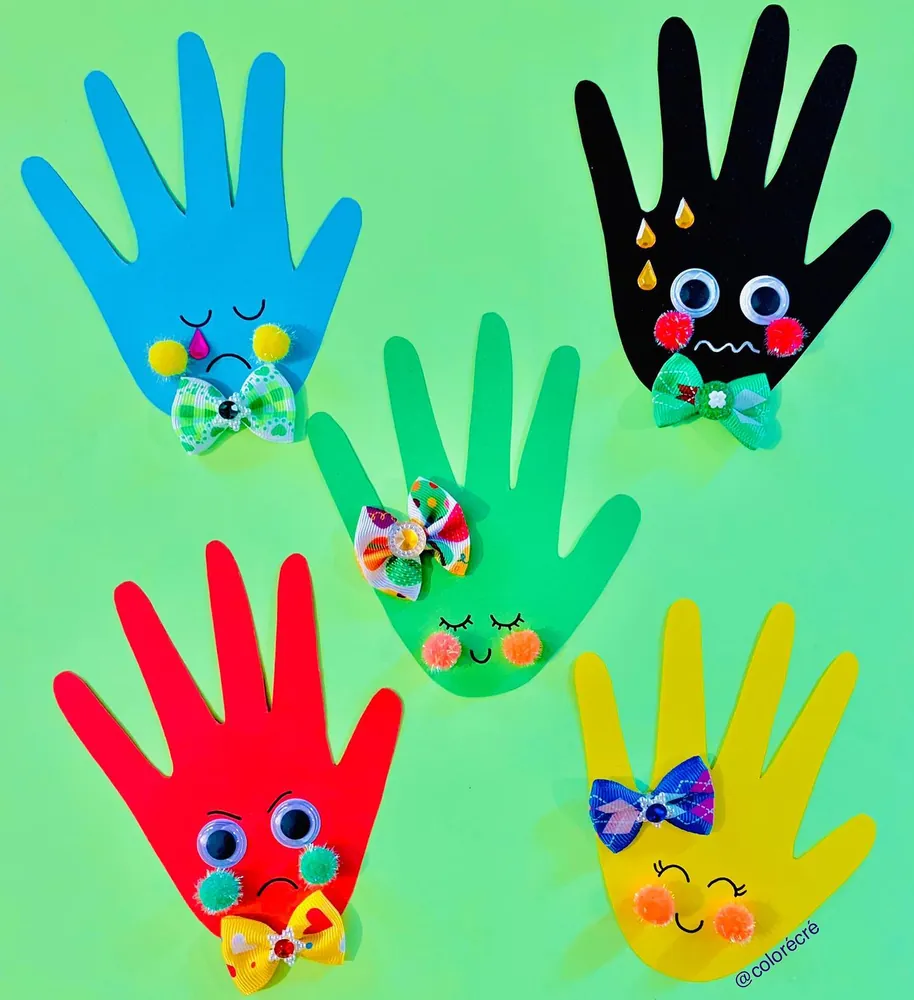
Trace your child’s hand, cut it out, and you suddenly have a face with five little hairs on top. Each of these five handprints got its own mood.
The black one steals the show. Googly eyes, a wobbly mouth, and three yellow drops of sweat make it look truly nervous.
The blue hand cries a single pink tear. Green has sleepy closed eyes and looks calm. Red frowns hard, and yellow grins with squinty happy eyes.
Fuzzy pom pom cheeks and a tiny ribbon bow give each one a personality. Kids also love that it is their own hand, so the feeling feels like theirs too.
Make one hand per feeling and line them up on the fridge. On a hard morning, your child can just point.
9. Spaghetti Monster Faces With a Mirror for Copycat Feelings
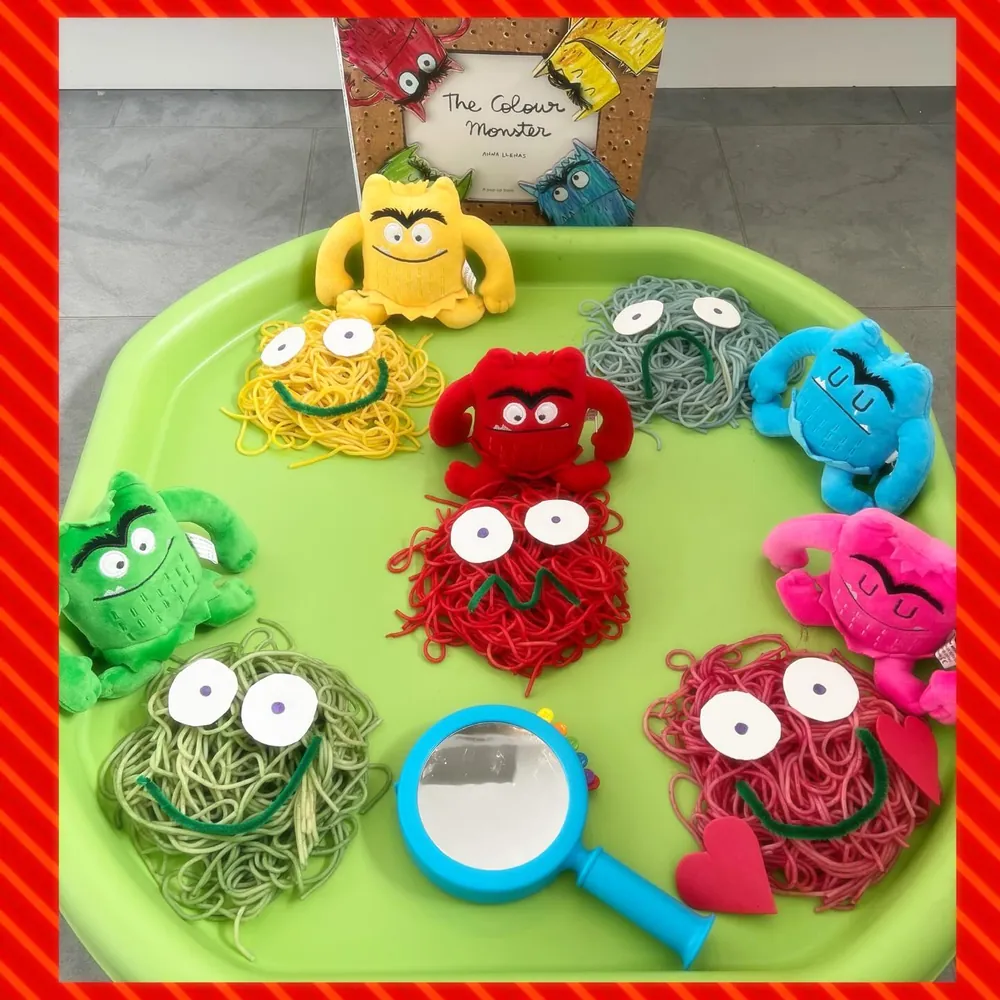
Cooked spaghetti, dyed in bright colors, becomes a pile of messy monster hair on this green tray. Each tangle gets two paper eyes and a pipe cleaner mouth. Soft Colour Monster toys sit right beside their noodle twins.
The best detail is easy to miss: a small hand mirror in the middle of the tray. Here is how to use it:
- Your child picks a noodle monster and names its feeling.
- They bend the pipe cleaner to change its mood, turning a frown into a smile or a smile into a wiggly worried line.
- Then they look in the mirror and make that same face themselves.
Seeing their own frown or grin connects the craft to their own body. That link makes a feeling easier to spot the next time it shows up for real.
Dye with food coloring so the noodles stay taste safe for little ones.
Rinse and cool the pasta so it is easy to shape.
Skip a lot of oil. Paper eyes slide right off slippery noodles.
Skip saving it for later. Cooked pasta spoils fast, so toss it after play.
10. Roll-a-Face Feelings Dice Game With Paper Cutouts

A paper cube with a face on every side turns feelings into a game of chance.
A little boy holds the cube over two printed girls with blank faces. Above them sit two neat rows of half circles, mouths on one side and eyes on the other.
He rolls, studies the face that lands on top, and hunts for the eyes and mouth that match.
- Splitting eyes and mouths teaches kids to read each part of a face on its own.
- The cube keeps turns fair, so there is less arguing.
- Two face sheets mean a sibling or friend can play along.
Once matching gets easy, flip the game. Your child builds any face they like, and you guess the feeling.
11. Play Dough Feelings Mats With Words to Trace
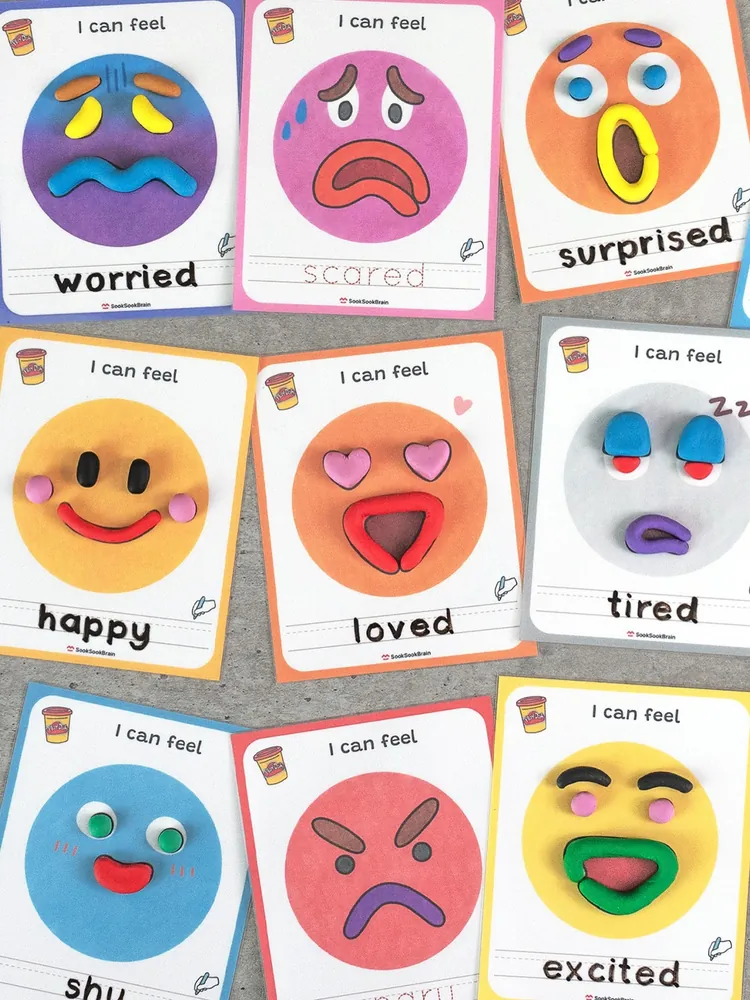
Each card says “I can feel” at the top, shows a big colored circle, and has the feeling word at the bottom on writing lines. Kids roll dough into snakes and little balls, then build the face right on the circle.
What stands out here is the range of words. Beyond happy and angry, these mats cover worried, scared, surprised, loved, tired, shy, and excited. Tired and shy are feelings kids have all the time but rarely have a name for.
Look at the “scared” card. The word is printed in light dotted letters, so kids can trace it and sneak in some writing practice. Slip the mats into sheet protectors and they wipe clean for the next round.
Something feels off, and your child says “I’m bad” or “I don’t know.”
They reach for a real word like tired, shy, or worried, and remember the face they built for it.
Subscribe to DIY Craft Bloom
Get updates on the latest posts and more from DIY Craft Bloom straight to your inbox.
12. How I Fill My Bucket Craft for Good Inside Feelings
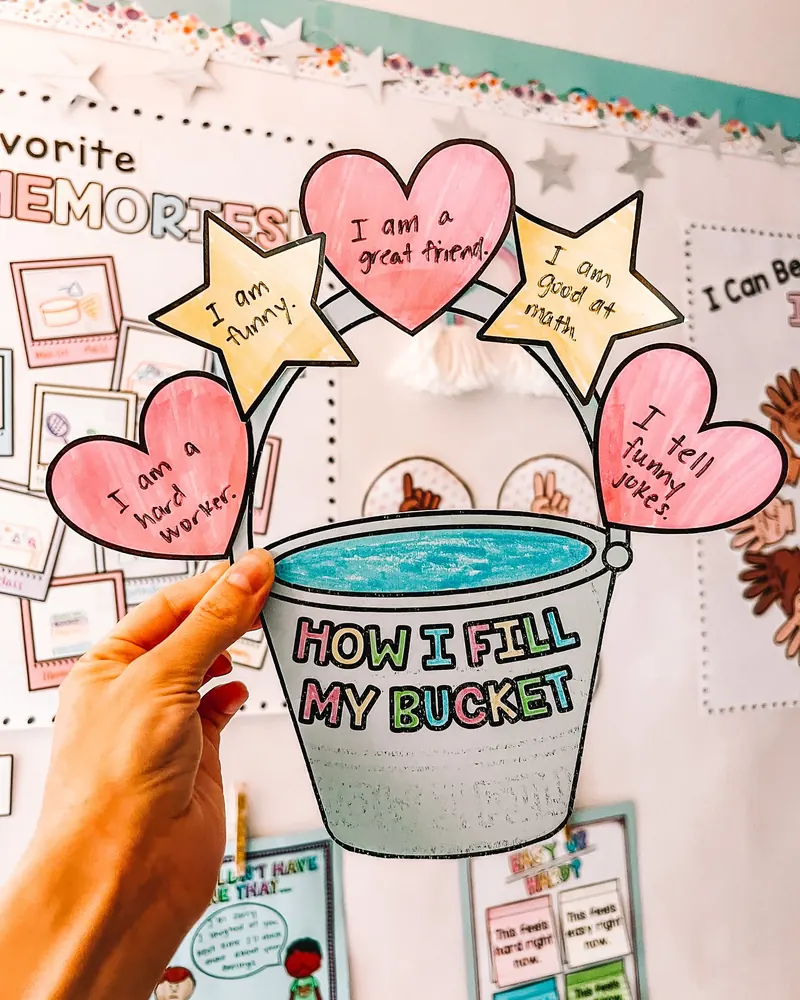
A gray paper bucket with blue water at the top reads “How I Fill My Bucket.” Above it, hearts and stars hold lines like “I am a hard worker,” “I am funny,” and “I tell funny jokes.”
What does bucket filling mean? It is a simple picture kids grasp fast. Everyone carries an invisible bucket of good feelings. Kind words and happy moments fill it up. Mean words and hard days empty it out.
Why turn it into a craft? Writing their own strengths gives kids something to look at on a low day. It is proof, in their own handwriting, that good things live inside them.
Ask one more question when you hang it up: how could you fill someone else’s bucket tomorrow?
A child who can name what is good about themselves has something steady to hold when a hard feeling shows up.
13. I Know Feelings Matching Board for Toddlers
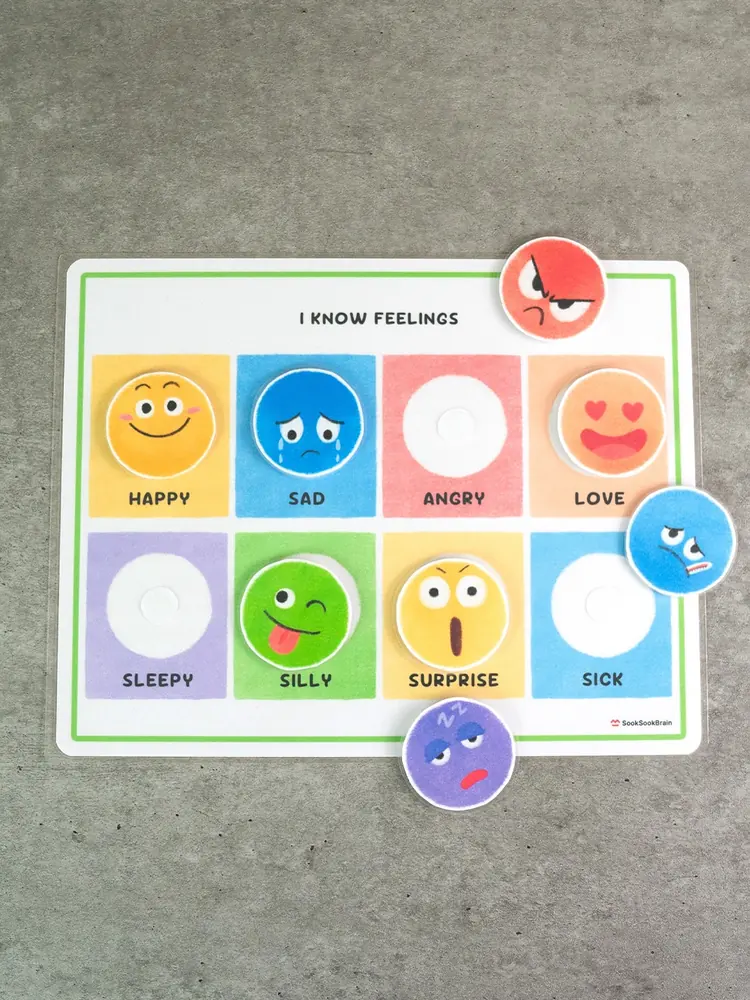
Eight colored squares, eight feeling words, and a pile of round faces to match. That is all this board needs, and for a toddler it is plenty.
The word list goes past the basics. Silly, sleepy, and sick are here too. That matters, because little kids often mix up feeling sick with feeling sad, or being sleepy with being grumpy. Giving each one its own square helps them sort it out.
Each square has a white dot where a face sticks on and peels off, so the game can be played over and over. Keep the loose faces in a zip bag clipped to the board. Lost pieces are the fastest way to retire a game like this.
14. Cardboard Feelings Jar for Sorting Colors Like the Book
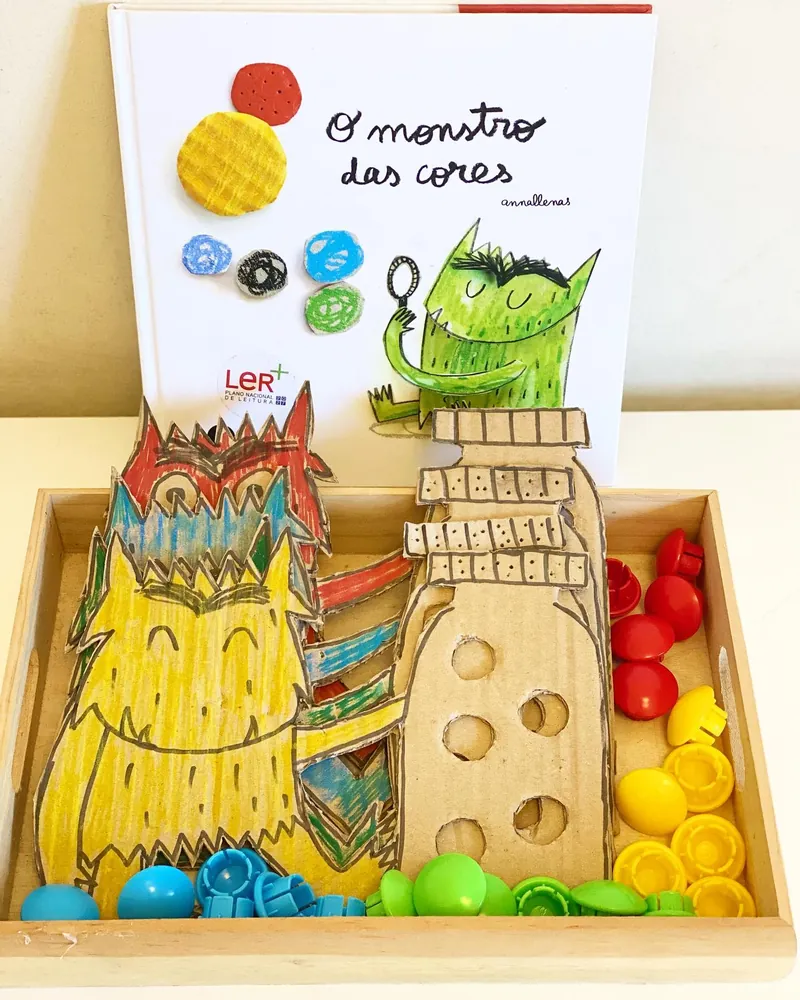
Plain cardboard, a few crayons, and a wooden tray. That is the whole budget for this one.
The monsters are cut from cardboard and colored in crayon, yellow, blue, and red layered one behind the other.
Next to them stands a cardboard jar with round holes cut in the front. Small plastic pegs in red, yellow, green, and blue fill the tray around it.
The idea comes from The Colour Monster, shown here in its Portuguese edition. In the story, the monster sorts his tangled feelings into separate jars.
Here, your child does the same with the pegs, pushing each one into a hole and naming the feeling as it goes in.
Big messy feelings get easier when you take them one at a time. This craft lets kids practice that with their hands.
15. Bottle Cap Mood Board for Daily Feelings Check-Ins

Saved bottle caps get a second life here. White caps get simple drawn faces, and a stack of plain caps becomes the head of a little paper kid.
The four photo steps make it easy to follow:
- Gather white caps, a sheet of brown cardboard, and a black marker.
- Draw a simple body with an empty circle for the head.
- Glue six face caps around the edge, each with its feeling word underneath, and glue a short stack of plain caps on the head.
- Keep a second set of face caps loose. Each day, your child sets the one that matches their mood on top of the head.
The words on this board are in Portuguese, and “Eu me sinto” means “I feel.” Write yours in whatever language your family speaks at home. Kids learning two languages get a feelings lesson and a vocabulary lesson in one.
| On the board | In English |
|---|---|
| Feliz | Happy |
| Bravo | Angry |
| Triste | Sad |
| Com medo | Scared |
| Surpreso | Surprised |
| Calmo | Calm |
16. Paper Plate Emotion Wheel With a Spinning Arrow
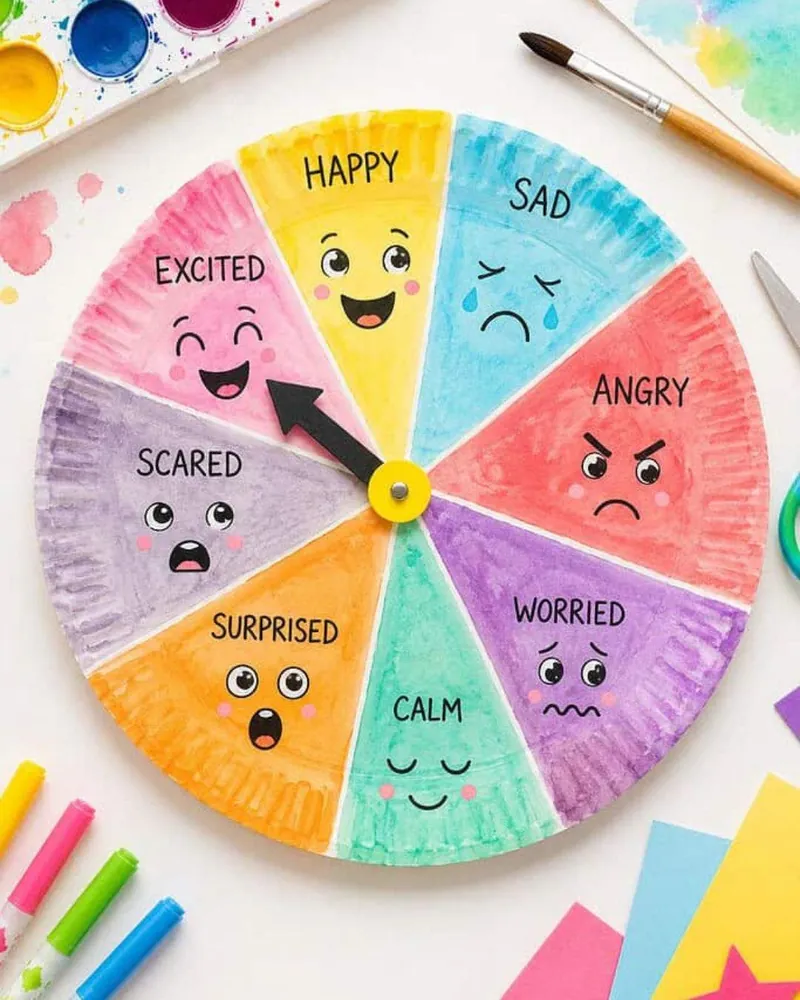
A plain paper plate, split into eight pie slices, becomes a feelings dial your child can turn any time. Each slice is washed in watercolor and gets a face and a word: happy, sad, angry, worried, calm, surprised, scared, and excited.
The spinning arrow is what makes it useful. A black paper pointer is pinned to the center with what looks like a brad fastener and a small yellow circle, so it turns freely. A child who cannot find the words yet can simply move the arrow and show you.
The watercolor helps too. Soft, uneven paint looks handmade and forgiving, so kids are not afraid of messing it up.
Hang it by the door and give it a spin together after school.
17. Emotion Hot Air Balloons Bulletin Board
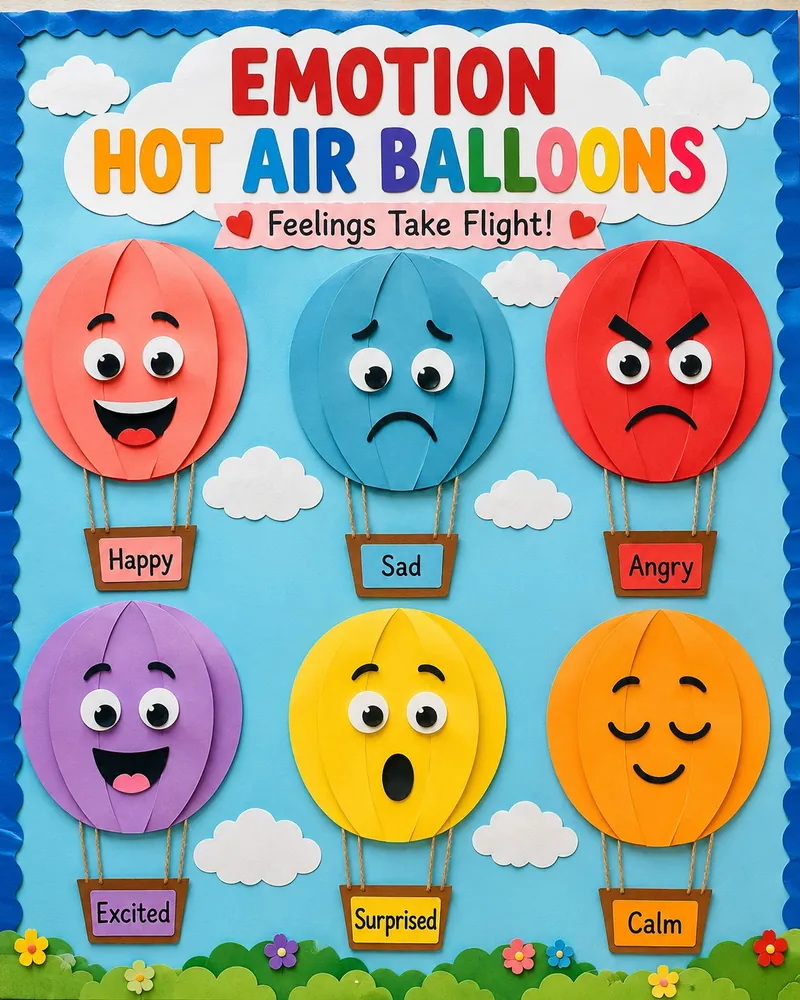
Six paper hot air balloons float across a sky blue board under the words “Feelings Take Flight.” Each one carries a different feeling: happy, sad, angry, excited, surprised, and calm. The faces are big and simple, so kids can read them from across the room.
Look at how the balloons are built. Curved paper pieces are layered on top of each other, which gives each balloon a little bit of depth.
Twine strings drop down to small brown paper baskets, and every basket holds the feeling word.
That basket is the part to put to work. Give each child a clothespin with their name on it. Each morning, they clip it to the basket that matches how they feel.
Teachers get a quick read of the room, and kids practice naming a feeling without having to say it in front of everyone.
Name the feeling first. Fixing the problem can wait a minute.
18. Window Feelings Drawing With a Daily Check-In Corner

A window turns into a giant feelings chart in this cozy setup. “Emotions” is written across the top in rainbow letters, with six round faces drawn below: tired, sad, excited, happy, worried, and angry. A big speech bubble asks, “How do you feel today?”
The sill underneath holds the rest of the corner:
- Wooden cards with simple drawn faces for words like embarrassed, shocked, and confused
- A tray of colorful felt balls for small hands to hold and sort
- A few picture books about kindness and big feelings
The drawing looks like window marker, so it wipes off when you want new faces. Start with the feelings your child struggles with most and leave them up for a week. Seeing “worried” every morning makes it a normal word in your house.