How to Make a DIY Feather Tree

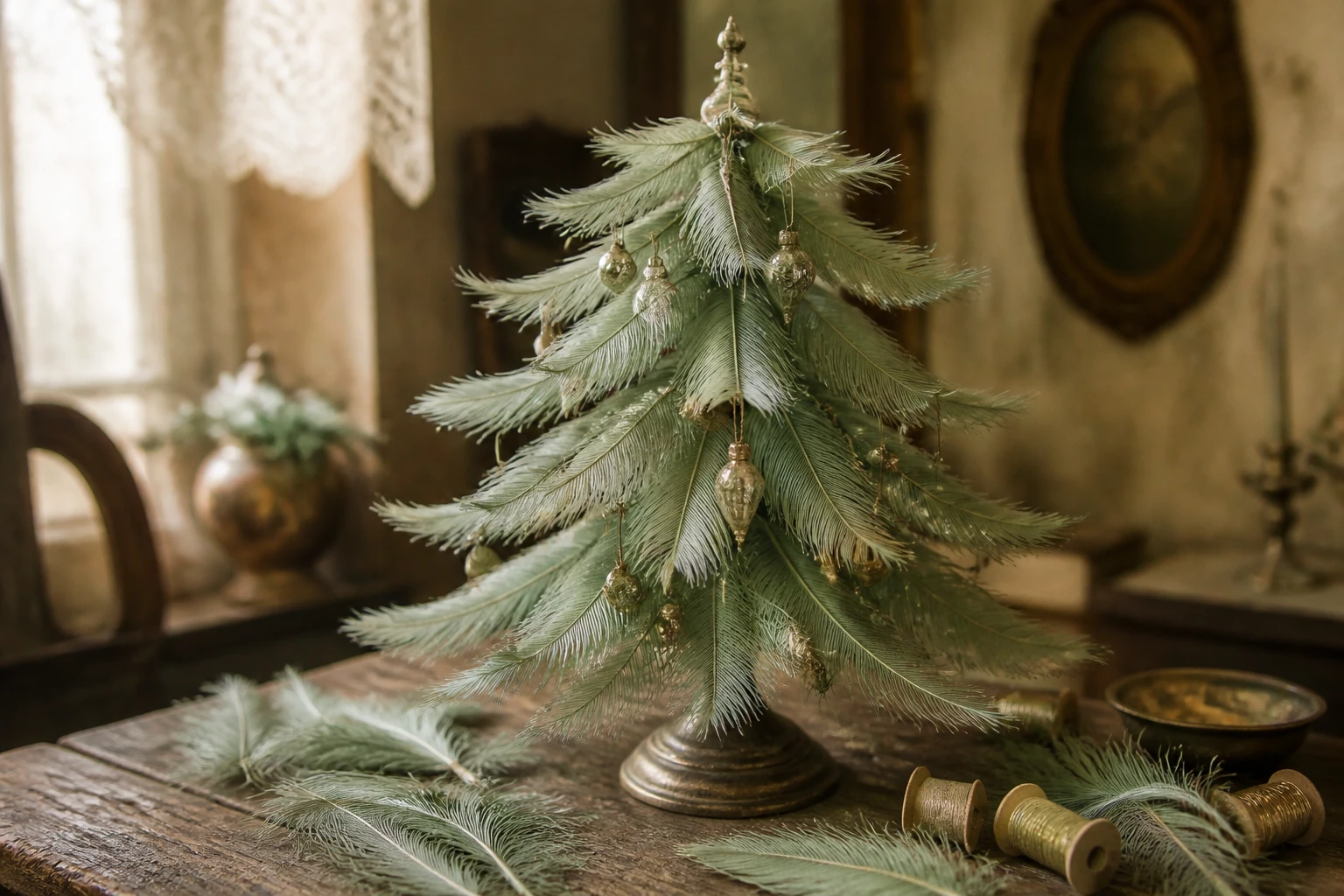
Ever wonder how those gorgeous vintage feather trees are made? You know, the ones that look like they came straight from a Victorian Christmas catalog?
Turns out, you can totally make one yourself with some goose feathers and a little patience.
They’re surprisingly sturdy, delightfully nostalgic, and way easier to create than you’d think.
What the Heck Are Goose Biots Anyway?
Let’s start with the star of the show: goose biots. These aren’t your average craft store feathers.
Goose biots are dyed goose wing feathers that have been split right down the spine, so you’re working with just half a feather.
When you bend them, they naturally splay out in this magical way that creates perfect little pine needle effects.
Here’s the thing about buying these feathers—always order extras. Like, more than you think you need.
There’s always going to be some duds in the batch that are either broken, too stiff, or cut too thick to bend properly around the wire.
Trust me on this one.
For a 16-inch tabletop tree, you’ll need about 55 feathers. That might sound like a lot, but once you get into the rhythm of wrapping, you’ll fly through them (pun absolutely intended).
Gather Your Supplies Before You Start
Nothing kills a crafting vibe faster than realizing you’re missing something halfway through. Here’s what you’ll need for your feather tree adventure:
- 21 wires (18-gauge paper-wrapped, 14 inches long—green or brown, your choice)
- 21 berries (one for each branch—plaster composition ones look the most Victorian)
- Goose biots (remember, buy extras!)
- Clips (clothespins, binder clips, or those cute Dollar Tree clips all work)
- Strong glue (don’t cheap out here)
- Masking tape and floral tape
- Ruler and scissors
- Crepe paper for wrapping the trunk (metallic brown looks amazing, but any color works)
- A base (more on this later)
Quick heads up: the color of your wire will show through a little bit, so choose accordingly. Green gives you a more traditional evergreen vibe, while brown looks more rustic.
The Magic of Wrapping Your First Branch
Okay, this is where things get fun. Each feather has a thick end and a pointy end, and you’ll start your wrapping with the pointed side.
First, attach your berry to the end of the wire with a tiny piece of masking tape. This gives you something sticky (not gummy like floral tape) for the glue to grip later.
Run a line of glue all the way around the wire. Hold the feather with the point toward the wire and the rest extending past the berry. You’re going to hold down that point and wrap over it to secure it.
The Actual Wrapping Technique
As you wrap, the feather naturally splays out—it’s honestly kind of magical to watch. Just keep the spine of the feather against the wire and it’ll spiral perfectly.
Once you get it started, you can actually spin the wire itself while holding the feather taut. Tension is your friend here; it keeps everything from unraveling.
When you get to the end of the feather, you’ll feel it get stiffer. This is when you hold it with your other hand, apply more glue, and finish the wrap.
Don’t worry about crushing the branch with your hand—these feathers are surprisingly springy and bounce right back.
ecure it with one of your clips and let it dry completely. Once dry, snip that little tail short, leaving about a quarter inch that you’ll wrap over with your next feather.
Building Out All Your Branches
Here’s where your measuring skills come in handy. A 16-inch tree needs branches in very specific lengths. Grab your ruler and get ready to make:
Subscribe to DIY Craft Bloom
Get updates on the latest posts and more from DIY Craft Bloom straight to your inbox.
- One 3-inch branch for the treetop (mounted vertically)
- Three 2-inch branches
- Five 2.5-inch branches
- Six 3.5-inch branches
- Seven 4-inch branches
Pro tip: When adding subsequent feathers to a branch, snip off that tapered tip first. This makes your branches look more uniform.
You can also wrap a feather partway to get a specific branch length—no need to use whole feathers every time.
Finishing Your Branch Ends
After you’ve made all your branches, cut off any remaining tails, leaving just that quarter inch. Wrap that last bit against the stem with a small piece of floral tape.
This part gets bent when you attach it to the tree, so the tape acts as a safeguard against unraveling.
Now here’s the important part: bend all your branches (except the 3-inch treetop) at a 90-degree angle using a straight edge. This is what gives your tree that classic tiered look.
Assembly Time: Putting It All Together
Working from top to bottom makes this so much easier. Grab your 3-inch treetop and your three 2-inch branches and gather them together evenly.
Bind them with a small strip of masking tape just to keep things manageable, then start wrapping with floral tape.
FYI, if you’re making a tree over 2 feet tall, you’d want to bind these with fine wire before the floral tape.
You might also need a wooden dowel for support. But for anything under 2 feet? The floral tape is totally sufficient, and the finished tree ends up surprisingly sturdy.
Spacing Your Tiers
For this tree, space your tiers 2.25 inches apart. As you wrap, build up the thickness of the trunk gradually—you want it to taper from top to bottom for that natural tree look.
Keep adding tiers, spacing the branches around evenly. You can adjust them slightly once they’re taped, but try not to overlap the wires too much.
After you attach your last branches, wrap the stems together but leave the ends loose so you can trim them.
Trimming and Finishing the Trunk
How long should your trunk be? That depends on your base, but for a standard wooden base with a 3/8-inch hole, cutting the trunk to 5.5 inches looks pretty proportional.
Once you’ve cut it to length, wrap the rest in floral tape, keeping in mind that hole size—you want it snug but not so tight you have to force it.
Now for the pretty part: wrap your trunk with crepe paper to cover the floral tape. Metallic brown crepe paper looks absolutely gorgeous, but honestly, any color works. Cut about a half-inch strip off the end of the fold to make a long ribbon.
Scootch those branches out of the way and apply two layers of paper for a nice uniform trunk. As you get to the bottom, keep checking that the tree will still fit in your base. You want snug, not stuck.
Creative Base Ideas (Because This Matters More Than You Think)
The base can totally make or break the look of your tree, so let’s talk options. Toy wheels from Hobby Lobby work amazingly well—stack them for a nice heavy base, and they already have holes drilled in the middle. No power tools required!
Other ideas that work great:
- Small wooden plaques (drill your own hole or use clothespin doll stands)
- 2-inch wood cubes (very vintage looking)
- Thrift store finds like terracotta candle holders or small creamers (just chip out any old wax and glue a wheel inside)
Get creative here! Found objects often look the most charming, and they give your tree a unique character.
Attaching the Tree to Your Base
Lay down some wax paper (just in case glue drips), then squeeze glue into your base and spread it around with a toothpick.
Gently twist the tree into place—don’t push it all the way to the bottom, just let it extend through the hole slightly. Easy does it!
Taking Your Feather Tree to the Next Level
Once you’ve mastered the basic tree, the fun really begins. You can electrify your tree, make miniature versions, add tiny ornaments, or create whole village scenes around the base. Spun cotton ornaments look absolutely magical on these trees.
Subscribe to DIY Craft Bloom
Get updates on the latest posts and more from DIY Craft Bloom straight to your inbox.
Try spacing branches closer together or farther apart depending on the look you want. Make tiny sprigs for a vintage Santa scene.
Add a little fence around the bottom for that classic winter village vibe. The possibilities are honestly endless.
IMO, the coolest thing about making your own feather trees is that each one turns out unique.
The feathers vary in thickness, so you’ll have natural variation that makes your tree look authentically vintage rather than mass-produced.
Wrapping This Up (See What I Did There?)
Making a DIY feather tree is one of those projects that looks intimidating but becomes almost meditative once you get into the rhythm.
Yeah, wrapping 21 branches takes some time, but there’s something deeply satisfying about watching that pile of feathers transform into a gorgeous vintage tree.
The best part? These trees last forever. You’re literally creating an heirloom piece that could be pulled out every Christmas for generations.
Plus, you’ll have major bragging rights when people ask where you got that stunning vintage tree and you casually mention you made it yourself.
So grab those goose biots, crank up some good music or a podcast, and get wrapping. Your Victorian-inspired Christmas tree is waiting to happen.
Frequently Asked Questions
Can I make a larger feather tree using the same technique?
Absolutely! For trees over 2 feet tall, you’ll need to upgrade to thicker wire (16-gauge works well) and you’ll probably want to add a wooden dowel to support the trunk.
You should also bind your branches with fine wire before wrapping with floral tape for extra stability. The basic technique stays the same—you’re just scaling everything up.
What if my feathers are too stiff to bend around the wire?
This happens sometimes, and it’s exactly why you should order extras when buying feathers. Some feathers are just cut too thickly or are naturally too stiff to work with.
There’s not really a fix for this—just set those feathers aside and use your more flexible ones. Consider the stiff ones a lesson in why buying extra materials is always smart.
How do I store my feather tree when Christmas is over?
Treat your feather tree gently but don’t baby it too much—those feathers are pretty resilient. Wrap it loosely in tissue paper or a breathable cloth and store it in a box where it won’t get crushed. Avoid plastic bags since they can trap moisture.
The branches might get slightly compressed in storage, but they’ll bounce back when you fluff them out next year.
Can I use different types of feathers instead of goose biots?
You really need goose biots specifically for this project. The way they’re split down the spine and how they naturally splay when bent is what creates that pine needle effect.
Other feathers just won’t give you the same look or work the same way when wrapped around wire. Save your other craft feathers for different projects.
How long does it take to make a complete 16-inch feather tree?
Plan on spending several hours spread across a few days. Wrapping all 21 branches takes the most time—figure on a couple hours for that alone, plus drying time between feathers. Assembly goes pretty quickly once your branches are ready, maybe 30-45 minutes.
The nice thing is you can work on it in stages, doing a few branches at a time whenever you have a free moment.
Where can I find those Victorian-style plaster berries?
Some craft sellers specialize in vintage-style supplies and sell plaster composition berries that look exactly like the ones used in antique feather trees.
You can also use wooden beads painted red, small jingle bells, or even skip the berries entirely for a more minimalist look.
The berries add authenticity, but they’re not absolutely required if you’re going for a different aesthetic.